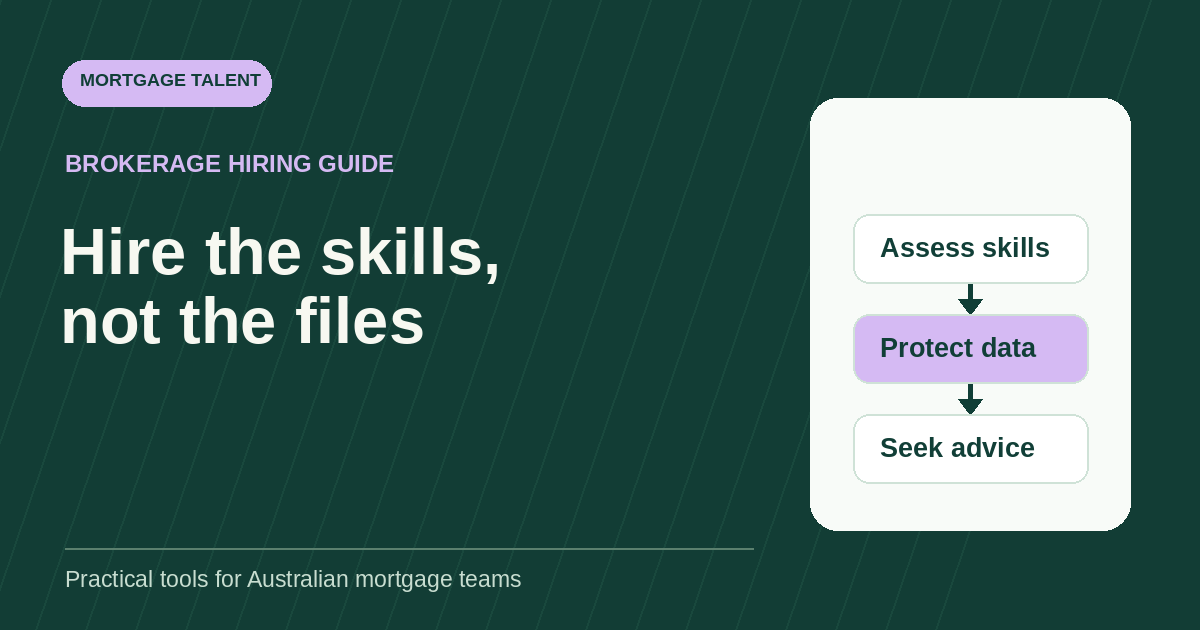
If you want to hire an experienced loan processor, you need evidence of what they can do, not a folder exported from their last brokerage. A candidate can explain their contribution and work through a fictional case without supplying customer records, private procedures or old login details.
Set that expectation before requesting examples. Then keep three questions separate: what capability has been demonstrated, which materials and accounts may enter your business, and which contractual concerns need advice. A successful assessment does not close the other two questions.
Define acceptable examples before the interview
Vague requests such as “bring something from your previous work” leave candidates guessing. Ask for a non-confidential explanation of their responsibilities, the tasks they personally completed and where another person reviewed the result. Supply your own invented documents for any practical exercise.
You can adapt this wording for an assessment invitation:
For the assessment, please use the fictional materials we provide. Describe your responsibilities without identifying customers. Please do not send borrower files, customer lists, login details or non-public procedures from a current or former employer. Raise any question about an example or contractual issue before sending material.
This is suggested wording, not a substitute for your information-handling process. Use the existing loan processor interview and work sample for the assessment itself. The boundary here concerns where evidence comes from and what happens when inappropriate material arrives.
Keep a three-track clean-hire record
Use the following record alongside your hiring brief. It is a proposed operational tool, not legal clearance or a regulator-approved checklist. Give each row a named owner, status, next action and due point tied to the recruitment process.
Scroll sideways to see all columns →
| Track and purpose | Acceptable starting source | Keep outside the ordinary process | Owner and completion evidence |
|---|---|---|---|
| Capability: application-pack preparation | Your invented case and the candidate's non-confidential explanation. | Former-employer applications, borrower documents, lender messages or screenshots. | Assessor records the fictional task and observed contribution. |
| Capability: coordination experience | Explanation of responsibilities, follow-up methods and review boundaries. | Customer lists or a live pipeline offered as a portfolio. | Recruiter records relevant experience; agreed reference checks corroborate it separately. |
| Materials/access: new procedures | Your approved materials, licensed sources or original text reviewed for provenance. | Non-public former-employer templates, including renamed or redacted copies, unless rights and permitted use are independently established. | Operations owner records the source and permission or review reference. |
| Contractual questions: identified concern | Relevant agreement and proposed activities, shared through the appropriate advice route. | A recruiter's verdict that a restraint is enforceable, void or irrelevant. | Hiring owner records advice status and any operational restriction, without circulating sensitive legal material. |
| Materials/access: new accounts | Your brokerage's authorised accounts and approved role permissions. | Former-employer passwords, sessions, shared drives or lender credentials. | System owner records the approved access outcome. |
| Materials/access: unexpected information | Incident reference, sender, channel, receipt time and restricted handling owner. | Confidential content copied into the hiring record or forwarded to the panel. | Privacy/legal owner determines handling, preservation, return or disposal and any further action. |
Useful statuses include “evidence pending”, “permission review needed”, “contract advice pending” and “restricted handling referred”. Set due points such as “before the exercise” or “before this procedure is used”, rather than an arbitrary date. Do not collapse the record into one candidate pass/fail field.
Work through an unsolicited-material scenario
Everything in this example is invented. A processor applying to Fictional Harbour Brokerage describes how they kept document requests moving. They also offer an old checklist and a folder of completed applications to demonstrate accuracy. Separately, they mention a clause in their current employment agreement.
- Continue the capability assessment. The assessor uses the candidate's non-confidential explanation and the brokerage's fictional exercise. Receiving old applications is unnecessary.
- Keep the checklist out of the knowledge base. The operations owner starts from the brokerage's approved procedure and records the provenance question separately. Removing a logo would not establish permission to reuse the content.
- Decline the application folder before transmission where possible. If the attachment has already arrived, stop ordinary circulation and use the restricted handling route. The coordinator records a reference, not borrower details.
- Refer the contract question. Qualified advice considers the actual agreement, proposed duties and timing. The assessor does not decide whether the person may accept or start the role.
The current record can now say: “Assessment continues with fictional material; received-file handling referred; contract advice pending.” This accurately describes three different outcomes. It neither labels the candidate dishonest nor suggests that completing the exercise has cleared the move.
If files arrive, contain circulation and refer the decision
Do not forward an unexpected attachment around the panel to ask whether it is useful. Follow your approved process to restrict access and alert the responsible privacy or legal owner. Record where the material arrived and who is handling it, without reproducing its contents in interview notes.
For entities covered by the Australian Privacy Principles, OAIC's APP 4 guidance requires an assessment of whether unsolicited personal information could have been collected under APP 3. Where it could not, destruction or de-identification is required as soon as practicable if lawful and reasonable, subject to the applicable exceptions. Refer that decision promptly; do not issue a blanket deletion instruction that ignores preservation requirements.
For those entities, APP 6 generally limits use or disclosure to the collection purpose unless an exception applies. Possession of a file is therefore not enough to establish permitted use. APP 11 requires reasonable protection measures, including technical and organisational measures. Have your adviser confirm the obligations applying to your brokerage and circumstances.
Resolve materials and contract questions separately
A checklist with no customer names can still raise confidentiality or permission questions. IP Australia's NDA guidance includes business methods and processes among information that confidentiality agreements can protect. That does not establish that every procedure is a trade secret or determine ownership of a particular document. Start from authorised sources and refer uncertain provenance before reuse.
The Fair Work Ombudsman directs non-compete questions to legal help. Flag an identified concern rather than promising that a clause will or will not apply. Keep the advice status visible to the hiring owner without putting the agreement into a general shortlist pack.
Prepare the new role using your own authorised accounts. This process gives nobody permission to inspect or administer the former employer's systems. Once the relevant boundaries are resolved, use the first-month onboarding plan for ordinary training and supervision.
Put the boundary in your recruitment brief
Before requesting a shortlist, agree who sends the evidence instructions, who receives unexpected material and who tracks unresolved advice. Confirm those responsibilities with any recruiter rather than assuming they are included.
Discuss your loan processor recruitment brief with Mortgage Talent using the duties, experience and assessment arrangements you need. Keep borrower files, former-employer documents and credentials out of the general enquiry. The useful starting point is a clearly scoped role and an agreed way to demonstrate capability.
Take the next step
Explore Mortgage Talent or speak with our team about your hiring needs.