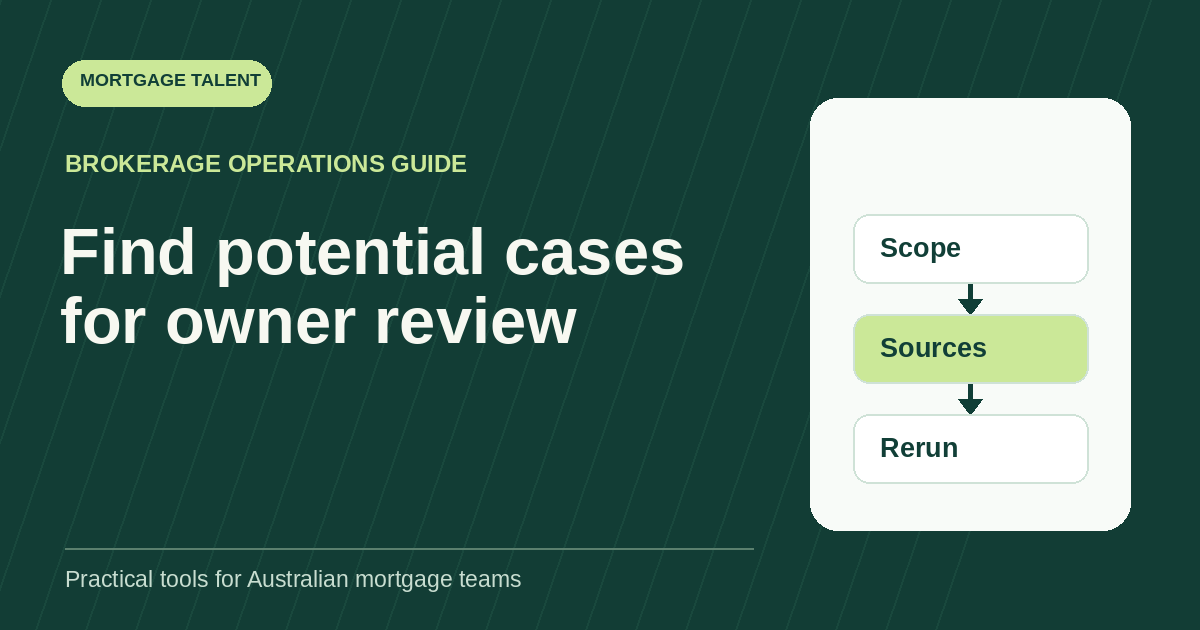
When your licensee starts a retrospective consumer review, give support staff an approved search brief before asking them to find affected files. Specify the suspected failure, review period, record sources and person who decides inclusion. Keep search results labelled as potential cases until the responsible reviewer has made the relevant determination.
This guide helps a mortgage brokerage scope retrieval and case-finding support after that review has been initiated. It does not decide whether remediation is required, assess customer loss, calculate compensation or prescribe notification deadlines. Its practical output is a traceable candidate population with the gaps and changes still visible.
Separate case finding from a substantive file review
ASIC's RG 277 applies to consumer remediation by Australian financial services and credit licensees. Its guidance covers remediations initiated on or after 27 September 2022. Use the responsible licensee's current process and obtain the appropriate specialist advice for the actual matter.
A support worker might retrieve records, preserve source references and run an authorised search. Those tasks are different from deciding whether advice was appropriate, a customer suffered loss or a remedy is sufficient. In RG 277.110, ASIC says file reviewers should meet the training and competence requirements for the relevant services or products. Do not advertise substantive remediation assessment as ordinary document administration.
There are also different populations. Your operational QA sample tests selected work, while the rework log examines recurring correction causes. Here, the question is which historical consumers might fall within an identified problem, including people who have never complained.
Write the search instruction and its limits
Ask the review owner to approve a short search specification. Do not begin with “export all active clients”: a current-status filter could leave out the very historical records the owner wants examined. Record the search logic separately from the owner's ultimate inclusion criteria.
Scroll sideways to see all columns →
| Part | Instruction to record | Question to resolve |
|---|---|---|
| Suspected failure | The event or process being investigated, using the owner's description | What observable record would make a file a candidate? |
| Review period | Approved date range, relevant date field and version of the instruction | Are we searching the service event, transaction date or record-entry date? |
| Source coverage | Current CRM, archived system, finance records and other specifically authorised sources | Which periods and record types can each source actually supply? |
| Population boundaries | Included services, entities and statuses, with unresolved boundaries identified | Could closed or transferred records disappear from this view? |
| Decision ownership | Person who resolves ambiguous matches, missing evidence and scope changes | Who can change the search instruction or determine an exclusion? |
| Delivery | Controlled worklist, source links, search limitations and next review point | What remains unsearched when this list is handed over? |
Access to another system needs its own approved route. The brief does not grant new permissions. Keep full customer records in their controlled locations and use internal references in the worklist. Preserve the source evidence rather than correcting historical records to make the review easier.
Work through a fictional search that grows
All records and events below are invented. A brokerage's licensee has initiated a review after finding that a documented brokerage service-fee waiver was not applied. The review owner issues search version 1: identify potentially relevant service events from 1 July to 30 September across current and archived records, regardless of whether the customer remains active. This is a fictional starting instruction, not a recommended default review period.
The current-system search produces R-01, R-02 and R-03. Archive retrieval is still pending, so the preparer reports three candidates from one completed source, not three affected customers in total. R-02 is closed; it remains visible because the instruction did not limit the search to active customers.
The approved archive retrieval then adds R-04, an August record absent from the current CRM. While inspecting the authorised archive material, the preparer also finds a June record indicating that the same failure may have occurred earlier. They preserve its reference and alert the owner. They do not silently change the period or discard it as irrelevant.
RG 277.49–50 links the remediation review period to investigating when the failure occurred and consumers were potentially affected. The licensee's starting point is when it reasonably suspects the failure first occurred and caused consumer loss.
In this exercise, the owner investigates the earlier evidence and approves version 2, extending the search to 1 April. The preparer reruns every approved source for the revised period. R-05, the June record, and R-06, a May record, are added. The four previous candidates remain. The worklist now contains six potential cases, with each addition linked to its source and instruction version.
Scroll sideways to see all columns →
| Record | How it entered the worklist | Handoff state |
|---|---|---|
| R-01 | Current-system July search, version 1 | Source packet available for reviewer |
| R-02 | Closed August record in current system, version 1 | Retained; closed status is not an exclusion instruction |
| R-03 | September record, version 1 | Referenced waiver document not located; owner decision pending |
| R-04 | August archive record, version 1 | Added after archive retrieval; absent from the first export |
| R-05 | June evidence triggered scope review; added under version 2 | Earlier-period case awaiting substantive review |
| R-06 | May record found by the version 2 rerun | New candidate discovered through the extended search |
The reconciliation is three initial candidates, one archive addition and two earlier-period additions. It is not six confirmed losses or six compensation approvals. R-03 stays unresolved rather than becoming “no issue found” merely because the referenced document is missing.
Keep missing evidence separate from an exclusion
Record what was searched, which source was inaccessible and what was not located. “No matching document in the approved search” is narrower than “the waiver never existed”. Ask the review owner what further retrieval or assessment is required; do not invent a substitute document or make an assumption about the customer's entitlement.
RG 277.127 addresses beneficial assumptions where breached record-keeping obligations leave uncertainty about loss and reasonable grounds to suspect it occurred. That determination belongs with the responsible reviewer, not the person recording a missing attachment.
Before handing over the fictional six-case list, check both directions: every candidate points to its search evidence, and every relevant search result has a recorded disposition. A duplicate source hit can point to the same case; retain both references. If identity is uncertain, raise a match question instead of merging people by a similar name.
Define completion and the support role honestly
The preparer's handoff identifies the current instruction, completed and incomplete sources, candidate list, scope-change history and unanswered questions. The owner can then assess whether further searching is needed. A completed retrieval task does not establish that the whole remediation is complete.
For a temporary support brief, separate retrieval and indexing from specialist assessment and customer communication. Name the person available to answer scope questions, and explain whether the assignment includes later reruns. Do not promise a fixed completion date while an essential archive remains inaccessible.
RG 277.217 permits outsourcing parts of remediation while leaving ultimate responsibility with the licensee. Confirm the actual service, capability and supervision required. Mortgage Talent's staffing discussion is not an offer of independent remediation assurance or a compensation decision.
Discuss your mortgage support brief with the defined retrieval outputs, source systems and review owner. That makes it possible to assess an administrative support requirement without concealing the specialist decisions the business must still resource.
Take the next step
Explore Mortgage Talent or speak with our team about your hiring needs.