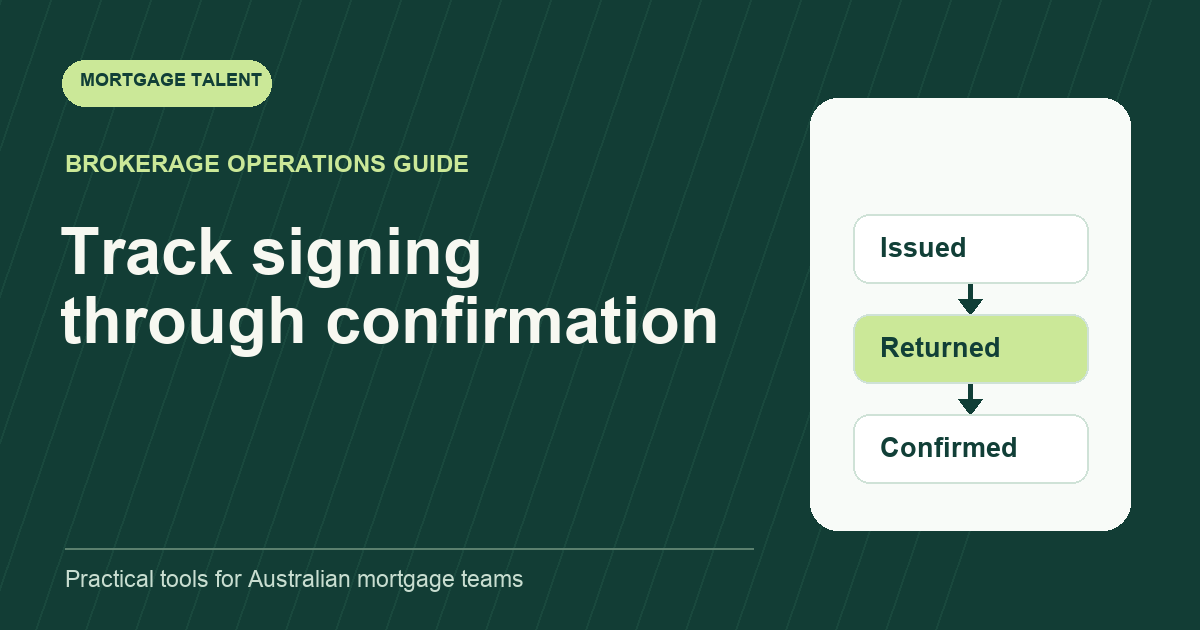
Track loan offer signing by recording each required document, its current issued version, any question blocking action and the evidence that it was returned through the approved route. Keep “signed” separate from “returned” and “confirmation received”. A support worker can coordinate this sequence without explaining contract terms or deciding that the lender has accepted a pack.
ANZ's loan-document signing guidance separates reading, signing and returning documents, and provides guidance for individual documents and states. Use the current instructions supplied for the actual loan; this tracker is an administrative method, not a substitute signing guide.
Identify the issued pack before sending a reminder
Record the document pack reference, issue date, responsible broker and approved source location. Ask the broker which documents and actions the support worker should track. Do not infer that every item visible in a portal requires the same action from the same person.
If a replacement pack arrives, have the responsible owner identify which version applies and what previous steps need checking again. A reminder linked to an old pack can confuse the recipient even if its general wording is accurate.
The document version-control method helps keep current and earlier packs distinguishable. Preserve the approved source references rather than downloading another copy into a personal folder for tracking.
Use one row for each instructed item
Scroll sideways to see all columns →
| Field | Record |
|---|---|
| Document and version | Exact item in the current issued pack |
| Action owner | Person assigned the action under current instructions |
| Current observation | Issued, question raised, signed, returned or confirmation recorded |
| Observation source | Approved system or message and checked time |
| Open question | Specific point routed to the appropriate reviewer |
| Return evidence | Recorded transmission or receipt reference |
| Next check | Named follow-up owner and checkpoint |
These are internal tracking descriptions, not declarations about legal execution or lender acceptance. Where a system displays its own status, record that wording separately and note what the broker has instructed the team to do next.
A person saying they have finished signing is a reported event. Record who said it and when. Check the approved route for the next observation instead of replacing missing return evidence with the customer's statement.
Route questions before encouraging completion
If a customer asks about a term, amount, document difference or signing requirement, preserve their question and send it to the broker or other nominated qualified contact. The assistant should not interpret the contract, select a witness or say a change is harmless.
Use an approved acknowledgement that states who will respond and how the question is being handled. Avoid a generic reminder to “just sign” while the customer is waiting for an answer. Connect the reminder task to the open question so another worker does not continue the sequence blindly.
Once the responsible person provides an instruction, record its source and scope. If the answer applies to one document, do not treat it as permission to give the same explanation about every item in the pack.
Check return evidence without upgrading it into acceptance
Record the return route, date and available reference as directed by the broker. A sent message, uploaded file or system receipt can establish a particular transmission event. It should not be labelled acceptance unless the responsible reviewer has evidence for that conclusion.
If an item appears missing from the returned pack, identify it precisely and ask what clarification or replacement is required. Keep the earlier return visible. Do not describe the entire pack as never received when part of it has an observed receipt.
Use the settlement coordination checklist for the wider file handoff. The signing register supplies its document observations; it does not establish that every settlement dependency is resolved.
Practise with a fictional partial return
Illustrative exercise: a mock pack contains Items A, B and C. The fictional customer reports completing all three. The approved return location contains A and B, while C is not visible and a question about B remains unanswered.
The worker records the customer's report separately from the observed return. A and B have return references; C has an unresolved location question. The question about B is assigned to the nominated reviewer. The summary avoids “all signed and complete”.
Later, the mock reviewer locates C and answers the question about B. The assistant records those events and follows the next instruction. The exercise tests record accuracy and follow-through; it does not demonstrate legal execution or a successful loan settlement.
Use reminders that reflect the actual open action
A useful reminder identifies the outstanding instructed item, current source link, approved next step and contact for questions. Keep timing aligned with the brokerage's chosen communication process and the actual file instructions. Do not invent an external deadline to create urgency.
Before a handover, reconcile unanswered questions, replacement packs, missing return evidence and observations needing reviewer confirmation. Give each item a named next owner. A list of customer names marked “documents pending” leaves too much context for the next person to reconstruct.
Hire for precise coordination
Assess whether a support worker can distinguish reported completion from observed receipt, identify the current pack and write a concise exception note. Use fictional documents and a clear answer guide in training.
Explore assistant support and discuss document follow-through duties. Include your approved signing routes, broker review arrangement and handover expectations in the brief.
Take the next step
Explore Mortgage Talent or speak with our team about your hiring needs.