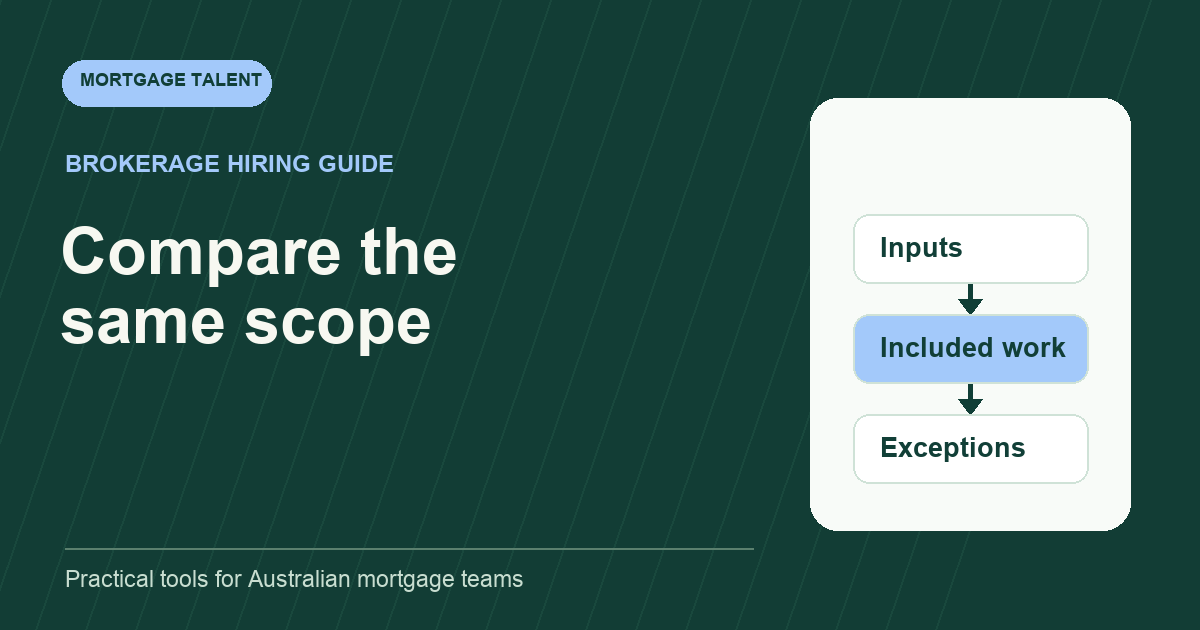
Compare mortgage outsourcing quotes by giving every provider the same file-stage scope, input assumptions, coverage requirements and definition of completed work. Ask each provider to mark what is included, excluded or conditional. Only then compare the proposed fees and the work your brokerage would still need to perform.
A lower headline amount can describe a narrower task. A broader proposal can include work you do not need. This worksheet helps an Australian brokerage make the difference explicit without assuming that one charging model or location is always better. It complements the full support cost worksheet; it does not supply a market price.
Send one scope card to every provider
Write a short scope card before requesting revised proposals. Include the stages you want covered, the systems involved, working-hour overlap, expected contact routes and the broker review points. Describe a ready-to-start file so neither party silently assumes that missing documents or incomplete instructions have already been resolved.
For example, “prepare a broker-approved application pack from indexed documents and return it for review” is more precise than “full loan processing”. Add what happens when the source documents disagree with the broker summary. Name the person who can clarify the instructions and the point at which work pauses.
Use a fictional sample pack if providers need to estimate effort. Give each the same sample and record any additional assumptions in writing. Do not send private borrower information simply to get a preliminary proposal. Your actual information-sharing process should follow the controls already approved by your brokerage.
Copy this inclusion and exception worksheet
Scroll sideways to see all columns →
| Comparison item | Question for each proposal | Record |
|---|---|---|
| Starting input | What must be present before work begins? | Exact input checklist and owner of missing items. |
| Preparation | Which checks and factual entries are included? | Named tasks, systems and returned output. |
| Follow-up | Which customer or lender follow-ups are included? | Contact boundary, frequency assumption and escalation. |
| Review and corrections | Who reviews work and handles corrections? | Responsibility and any excluded rework. |
| Availability | What hours, absence cover and review overlap are proposed? | Local times and named coordination route. |
| Variable work | What triggers a revised scope or additional charge? | Trigger, approval step and basis for the change. |
| Completion | What event makes the task or file complete? | Evidence and acceptance owner. |
Leave an unanswered cell marked “not confirmed”. Do not turn silence into an inclusion. Send the completed comparison back to each provider so they can correct misunderstandings before the brokerage makes a decision.
Normalise two fictional proposals without inventing prices
Suppose Proposal A covers application preparation after all documents have been accepted. Proposal B also includes requesting outstanding documents and coordinating factual lender updates. Both describe “processing support”. Your pipeline contains files with incomplete document responses, so the two proposals do not yet cover the same workload.
Ask A to price the extra coordination separately, or remove those tasks from B and confirm who will perform them internally. Record broker and assistant time that remains with your team. Compare a defined month of the same task mix, using actual revised quotes and your own measured effort.
If one provider charges per file and another offers dedicated capacity, specify the same expected file mix and treatment of withdrawn or paused cases. Avoid assuming every case reaches the same outcome. The per-file versus dedicated comparison explains how to keep workload units consistent.
Test the conditions that could change the comparison
Ask what happens when a file is reopened, a lender requests another document, the broker changes the instructions or a planned settlement moves. These are scope questions rather than predictions about how often each event will occur. Use events your own team has recorded instead of borrowing a provider's average.
For coverage, check how questions are handled when your broker and support person are not online together. Ask whether the proposal includes a coordinator or assumes your manager will allocate and review all tasks. Record the review demand as part of the operating comparison, even if it is not on the provider's invoice.
Write down any volume assumption that makes the quote valid. A forecast is an input, not a commitment you should infer from a marketing page. Ask the provider to explain how changed demand will be discussed and approved under the proposed arrangement.
Separate an attractive scope from verified delivery evidence
The worksheet shows what is proposed; it does not prove delivery quality, worker capability or the effectiveness of controls. After normalising the scope, use the provider due-diligence questions to request evidence for the arrangement you are considering.
Document unresolved questions and who will answer them. If a provider offers a demonstration, test the same fictional scenario used for the scope card. Check whether the returned output matches the stated completion definition. Treat a demonstration as a sample, not a guarantee for your entire pipeline.
Keep commercial terms with the people authorised to review them. This operational comparison should feed their decision, rather than replacing contract, employment, tax or compliance review where required for your arrangement.
What if a provider cannot quote an exception yet?
Keep the uncertain item outside the agreed comparison and ask what information is needed to clarify it. Identify who will retain that work in the meantime. You can still compare the confirmed core scope, but explain the excluded task in the decision record. Do not insert a guessed charge or assume the task will be absorbed later. A useful proposal states the boundary of what has been priced as well as what has been included.
Take a comparable brief into the hiring conversation
Summarise the selected scope in one page: included work, excluded work, start conditions, coverage, review owner and exception process. Preserve the original proposals alongside the clarification record so the reason for your choice remains understandable later.
Use Mortgage Talent's workforce solutions to discuss the role and operating model, and browse the talent marketplace for relevant experience. Share the scope you want compared when requesting support; a precise brief makes the next conversation more useful.
Take the next step
Explore Mortgage Talent or speak with our team about your hiring needs.