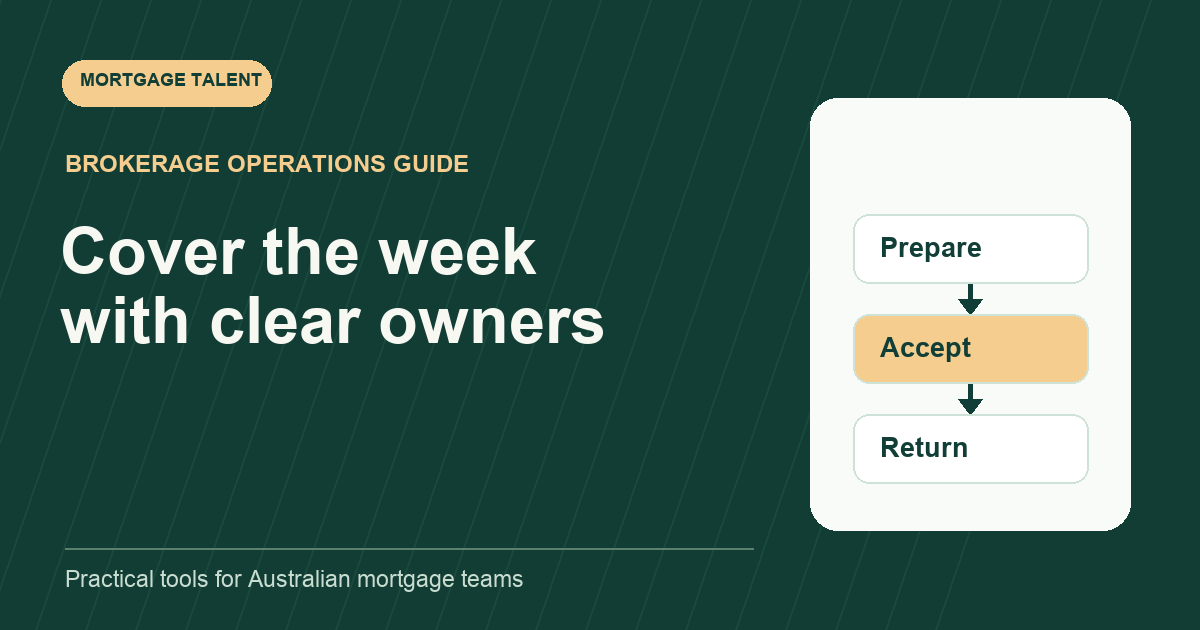
Prepare mortgage support leave cover by listing the work due during the absence, assigning a receiving owner and confirming that the owner has both time and approved access. Include the broker-review queue and a return handover. A forwarded inbox and an out-of-office message do not show that the next actions will be completed.
This is an operational checklist for a planned absence. Agree leave dates and employment arrangements through your usual process, then use this plan for the work. It extends the daily handover template across an entire coverage window.
Define the coverage window and the work that remains active
Record the last working day, first day back and the time zone for each boundary. Include any reduced overlap on the first or final shift. A person returning in the afternoon cannot automatically own a morning customer commitment. Choose the exact point when temporary responsibility starts and ends.
Group tasks into work that must continue, work that can wait with a named decision, and work that needs the broker's direction. Check approaching lender requests, promised customer updates, appointments and preparation due for review. Do not assume every existing task needs the same service during the absence.
Include new work arriving during the window. Name who accepts new files, triages inbox items and routes urgent questions. Covering yesterday's inventory while leaving tomorrow's enquiries unassigned creates an incomplete plan.
Build a temporary ownership record
Scroll sideways to see all columns →
| Field | What to record |
|---|---|
| Task reference | Approved file and work item, without unnecessary customer details |
| Next useful action | The specific step the cover person will perform |
| Due point | Confirmed deadline or promised check, with time zone |
| Receiving owner | The person who accepts temporary responsibility |
| Reviewer | Broker or manager who can resolve the next exception |
| Evidence location | Current instruction and relevant record link |
| Return state | Completed, still covered or accepted back by the usual owner |
Ask the cover person to open the relevant records with their own authorised account and explain the next action. Record acceptance only after that check. A manager naming someone in a spreadsheet does not establish that the person can find the instruction or has accepted the work.
The Australian cyber security system-access guidelines recommend removing or suspending access when there is no longer a legitimate requirement. Use that principle when approving and ending temporary access; the guidelines are a security reference, not a claim that every ISM control is mandatory for your brokerage.
Check capacity by subtracting the cover person's normal work
Do not add a whole person's nominal hours to the coverage plan if most are already committed. Start with their available working time during the window, subtract existing responsibilities and required meetings, then compare the remainder with the proposed cover tasks. Treat that as a planning estimate and review it during the absence.
Illustrative example: a colleague has twelve hours available after their normal duties. The proposed cover work is estimated at eight hours of follow-up, three hours of preparation and three hours of coordination. The fourteen-hour total does not fit. The manager changes scope or assigns a second owner before the absence begins. These numbers describe a fictional planning exercise, not a productivity benchmark.
Check reviewer capacity separately. A cover person can prepare work while the usual broker is also away, leaving outputs waiting without a decision owner. Name an approved reviewer and reserve realistic overlap for the file questions likely to arise.
Rehearse one ordinary task and one exception
Before leave, have the receiving owner complete an agreed task under the normal review arrangement. Then use a fictional exception to test the question route: a missing instruction, changed due date or uncertain portal status. The cover person should know whom to contact and how to keep the item open.
Resolve missing access, broken record links and unclear instructions before the window. If the required cover is not ready, name the manager's fallback decision. The continuity plan can support the escalation, but a planned absence should not depend on contacting the person while they are away.
Keep the handover concise enough to use. Transfer current tasks and their evidence references rather than a long narrative of every historical event. Include history only where it changes the next action or explains an unresolved issue.
Run the absence with a short daily coverage check
- What became due today, and who owns it?
- Which new tasks arrived after the handover?
- Which prepared outputs are waiting for broker review?
- Has a commitment changed or a task moved outside the cover scope?
- Does any temporary owner need a capacity or instruction decision?
Record answers in the existing queue. Avoid creating a separate cover spreadsheet that becomes a competing source of status. If a lightweight temporary list is needed, link it to the authoritative work items and reconcile it each day.
Change ownership explicitly when the plan changes. The original handover should not remain the assumed truth after a manager assigns a different reviewer or the customer changes timing. Keep the current owner and next check visible to everyone responsible for the work.
Accept the work back and close temporary access
On return, review completed actions, new tasks, unresolved questions and commitments made during the absence. The usual owner accepts the next action on each remaining item. Keep work with the temporary owner where that makes more sense until a defined handoff point.
Ask the administrator to close temporary access that is no longer needed and record completion. Capture one improvement for the next absence, such as a missing instruction or an unrealistic review window. If cover repeatedly exceeds available capacity, discuss your team coverage workflow and explore Mortgage Talent's connected people operations. Bring the coverage window and the work that needs an owner.
Take the next step
Explore Mortgage Talent or speak with our team about your hiring needs.