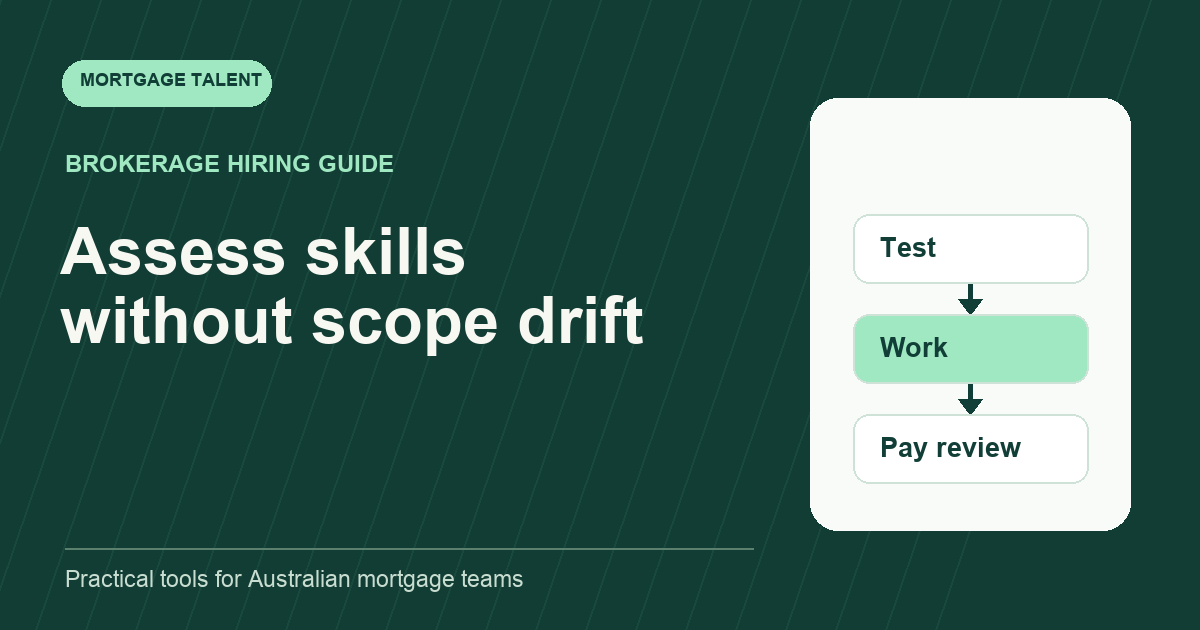
Before inviting a mortgage support candidate to “do a trial”, decide what you need to learn and how the person will be engaged. A fictional interview exercise, a proposed supervised skills demonstration, paid work during further assessment and a supplier's service pilot need different instructions. Calling all four a trial hides the decision that matters.
This guide is for an Australian brokerage assessing an onshore applicant. Use it to prepare the engagement decision with your employment adviser or responsible manager. It does not determine a person's employment status, applicable award or pay entitlement. Keep real borrower files out of recruitment exercises.
Start with the missing evidence, not the backlog
Write one sentence describing what the interview has not established: “We have not seen whether this candidate can notice inconsistent information and hand the uncertainty to the broker.” That is an assessment question. “We need someone to clear twelve files this week” is a capacity problem.
A useful test produces evidence for a hiring decision, such as an annotated fictional file, a draft clarification request and an explanation of the escalation. It should not quietly become your production queue. If you already have enough evidence, make the hiring decision rather than adding another exercise because work is waiting.
Use the existing loan processor interview and work sample for question design and scoring. The decision card below addresses the separate issue of engagement, payment and access. It does not provide a legal exemption for an exercise that uses fictional information.
Check the unpaid-work boundary before offering an exercise
Fair Work Ombudsman's unpaid-trials guidance describes a supervised demonstration of skills relevant to a vacant job. A trial may be unlawful if it is unnecessary, goes beyond what is needed, involves more than demonstrating skills or lacks direct supervision. Time beyond a reasonably required demonstration must be paid at the appropriate minimum. Fair Work identifies paid employment as an option when further assessment is needed.
No fixed number of minutes makes your proposed arrangement lawful. Ask the responsible employment owner to review its actual purpose, activities, supervision and duration. If the answer is unresolved, do not invite the candidate to begin unpaid work while you investigate.
A four-route trial-design card
Complete the relevant column before sending the invitation. These are proposed planning distinctions, not legal classifications or ready-made engagement terms.
Scroll sideways to see all columns →
| Fictional interview work sample | Proposed supervised skills demonstration | Further assessment through paid employment | Supplier-funded service pilot |
|---|---|---|---|
| Purpose: answer a specific selection question using invented material. | Purpose: demonstrate a necessary skill for the vacancy; employment owner reviews the proposed arrangement. | Purpose: assess performance while the person is engaged and paid under a confirmed arrangement. | Purpose: evaluate a supplier's agreed service, rather than directly test an unpaid applicant. |
| Input: fictional pack, instructions, permitted tools and consistent criteria. | Input: tightly bounded demonstration plan, named direct supervisor and stop point. | Input: confirmed duties, engagement terms, pay setup, supervision and approved systems access. | Input: supplier agreement, stated worker/employer responsibilities, service scope and access approval. |
| Output: assessed work sample and evidence-based hiring notes; no customer deliverable. | Output: observed capability evidence; no automatic second shift. | Output: work reviewed by its operational owner and separate performance evidence. | Output: accepted or rejected service results under the pilot's agreed measures. |
| Change trigger: requests for real file work, repeated exercises or a wider task. | Change trigger: longer assessment, reduced supervision or productive backlog work. | Change trigger: new duties, hours or access outside the approved arrangement. | Change trigger: worker, subcontractor, location or scope differs from the agreed service. |
The brokerage hiring manager owns the assessment question. The employment owner resolves how an individual will be engaged and paid. The systems owner approves any later operational access. For a supplier pilot, nominate a contract owner as well as a broker who accepts the work.
When “come back tomorrow” changes the decision
Fictional example: a candidate completes an invented document-checking exercise. The manager likes the result and says, “Come back tomorrow and clear our missing-document backlog so we can see how you go.”
The first exercise does not authorise the second request. Tomorrow introduces productive work, actual customers and a different assessment period. Pause that invitation. Record what is still unknown about the candidate and ask whether another interview question would answer it. If the brokerage wants work performed, send the proposed duties and hours to the employment owner for a paid-engagement decision before arranging the shift.
The manager's revised message could be: “Thank you for completing the sample. We are considering a further stage involving paid work. We will confirm the engagement details, duties, supervision and access before asking you to start.” This is illustrative wording, not an offer or substitute for reviewed terms.
The access decision remains separate. A promising sample does not justify sharing another employee's login or emailing borrower documents to the candidate. A permitted engagement still needs the brokerage's normal onboarding and authorised access process.
What the paid-stage handover should contain
Fair Work's hiring guidance explains that minimum employment terms can come from awards, registered agreements and the National Employment Standards; contracts cannot undercut applicable minimum entitlements. Use the appropriate adviser or employment owner to establish the terms for this person, rather than selecting a rate from a recruitment article.
- Hiring manager: supplies the vacancy, evidence already collected, remaining capability question and proposed work.
- Employment owner: confirms the arrangement and required documentation before the candidate is asked to accept it.
- Operational supervisor: identifies which tasks can be assigned, what must return to the broker and how work will be checked.
- Access owner: records authorised systems and data, the start condition and the removal trigger.
- Decision owner: sets a review point and communicates the next recruitment step without promising an outcome that has not been decided.
A free supplier pilot answers a different question
A supplier may fund a customer-facing pilot or waive its charge. That commercial offer does not tell you whether its workers are paid. Ask who employs and supervises the worker, which entity provides the service, what the brokerage pays, and what happens when the pilot ends. Do not infer unpaid labour from the word “free”. Overseas employment questions need review with the actual employer under the applicable arrangements and law.
For operational acceptance measures, use the mortgage outsourcing pilot plan. Keep the individual recruitment decision separate from whether a supplier workflow meets the brokerage's requirements.
Before inviting anyone, you should be able to name the missing evidence, the chosen route, its approving owner and the event that stops or changes it. If you are ready to recruit, share your mortgage support hiring brief, including the capability you need to assess and the engagement boundaries already confirmed.
Take the next step
Explore Mortgage Talent or speak with our team about your hiring needs.