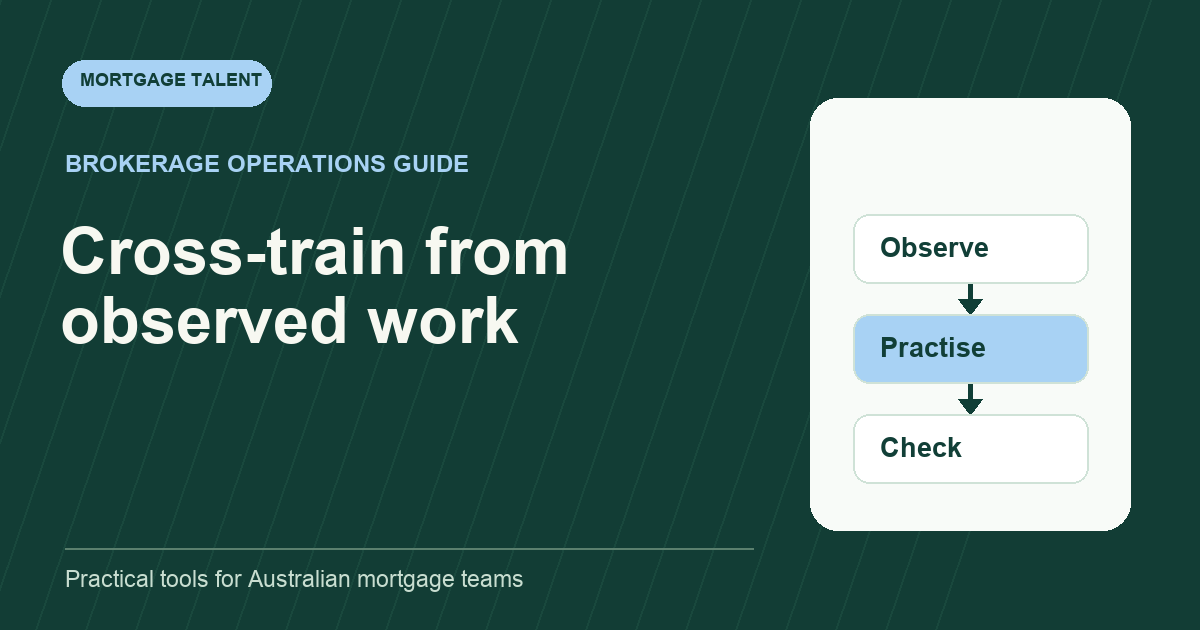
A useful mortgage support skills matrix maps specific tasks to observed evidence, the review each person needs and the next practice step. Keep task readiness separate from system access or authority. Use the matrix to choose cross-training that addresses an actual coverage gap, then test the backup on representative work.
This is an operational planning tool for Australian mortgage teams. It supplements individual onboarding and the business continuity plan. It does not certify professional competence or grant permission to perform a task.
List tasks at a level you can observe
“Loan processing” is too broad for one row. Split it into the tasks your team actually assigns: prepare an agreed pack, record a lender request, draft a factual status update, or maintain an outstanding-action register. Include the inputs and acceptance evidence for each row.
Use the same task definition for everyone. If one person has only practised a simple request and another has handled several exception types, record that difference. A tick beside the task name should not hide the scope of the evidence.
Include coordination tasks that are easy to overlook, such as preparing a daily handover or identifying which item needs a reviewer. Cross-training the visible preparation task while leaving its handoff dependent on one person creates an incomplete backup arrangement.
Use readiness states with evidence
Scroll sideways to see all columns →
| State | What it means in the matrix | Evidence to record |
|---|---|---|
| Not assessed | No current task evidence | The assessment or practice still needed |
| Observed | Has watched a demonstration | Task, date and questions raised |
| Practising | Completes assigned work with close review | Sample reviewed and correction notes |
| Accepted for assigned scope | Meets the local task standard under the defined review process | Reviewer, sample, scope and date |
| Needs refresh | Evidence is outdated or the process changed | Change trigger and next practice |
These labels are a proposed local method. Define them before use and record the actual reviewer. The matrix should link to the relevant instruction and evidence, rather than replace either. “Accepted” applies to the stated task scope, not every possible file situation.
Prioritise the gaps that affect real coverage
For each important task, identify the primary owner and a backup who is available during the needed window. Ask whether the backup has current evidence for that specific task and whether the required reviewer will also be available.
Prioritise a gap where demand is recurring, the primary owner has foreseeable absence and the backup can practise before that absence. A low-frequency task with no current instruction may need a process review before training. The matrix helps expose that sequence.
Do not distribute every task across every person simply to make the table look balanced. Training has a time cost, and unused skills may need refresh. Choose a limited set of coverage improvements that the manager can support and check.
Build practice around demonstration and feedback
The Australian Government's staff development guide describes coaching and job shadowing. Pair those approaches with an explicit practice task: observe the work, explain the steps back, complete an assigned example and review the result.
Start with fictional or otherwise approved training material. The learner should know what counts as complete and where to ask about uncertainty. Record the corrections and update an unclear instruction before asking for another attempt.
Use the support knowledge-base structure to link the current procedure. Training from a demonstration that differs from the written instruction creates two competing methods; resolve the difference before accepting the task evidence.
Work through a fictional backup gap
Imagine a three-person support team where one person maintains the lender-request queue. Two colleagues have seen the register but have not taken over a live working window. The matrix records them as observed, rather than ready backups. All people and circumstances here are fictional.
The manager schedules an approved practice queue with a named reviewer. Each learner must identify the next check, update a returned request and prepare a handover. One person completes the task but omits the next owner. That correction becomes the next practice focus.
The team then tests an actual handover within the approved scope and records acceptance. This does not prove uninterrupted coverage in every future situation. It establishes the evidence for the task and window tested, with remaining exceptions still visible.
Keep the matrix current when work changes
Review evidence after a material process change, a long period without practice or a recurring correction. Use a needs-refresh state where the old evidence no longer fits the current method. Avoid silently preserving a tick because removing it looks like a setback.
Give the matrix an owner and review trigger. Link individual development actions to the onboarding plan where appropriate, but keep team coverage visible across people. A well-supported new starter can still leave the team dependent on one specialist task.
If the matrix reveals a capability the team cannot reasonably develop within its available time, scope a new hire around that task gap. Explore processor hiring and the mortgage talent marketplace, or discuss the skills your support team needs with Mortgage Talent. Share the observed gap and review arrangement rather than an unsupported claim that everyone is fully trained.
Take the next step
Explore Mortgage Talent or speak with our team about your hiring needs.