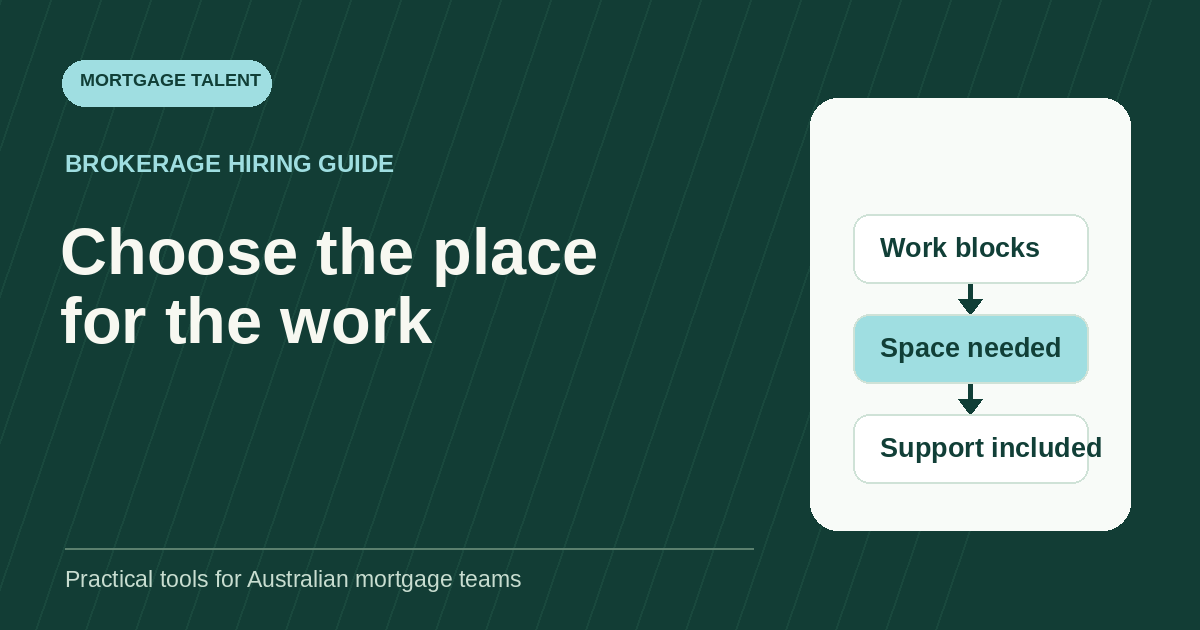
Choose office-based or home-based offshore mortgage support by checking where the proposed working day can actually happen. An office seat may include facilities support without mortgage-workflow coaching. A home-based arrangement may support the preparation queue but leave customer-call space unresolved. Put those differences into the hiring brief before treating either location as the better offer.
This guide is for Australian brokerage owners choosing the ordinary work location of an outsourced processor or assistant. It provides a worksite inclusion card and two fictional proposals to compare. It does not approve a workplace, determine employment obligations or claim that one location produces better staff.
Separate the workplace from the service you are buying
Describe each proposal in three parts: where the person works, who directs the daily queue and what additional help the supplier includes. Keep those answers separate. A person seated beside a provider supervisor might still rely on your broker for every file question.
Ask what “supervised office” means in the particular offer. Does the supervisor handle attendance and facilities, demonstrate the agreed preparation procedure, or check completed work? Name the actual function and its limits. Do not assign a provider employee a broker-review responsibility merely because they are nearby.
If you are still choosing between direct employment and a managed service, use the in-house versus outsourced comparison first. Here, hold the intended duties and management responsibilities constant while comparing the proposed places of work.
Map the work blocks before comparing locations
Write a representative working day using the tasks in your vacancy. Separate quiet factual preparation, approved document-request calls, broker clarification and coached practice. For each block, identify the physical space and people it needs, when they must be available and what evidence would settle an unknown.
business.gov.au's remote-staff guidance recommends clear responsibilities, work hours and availability expectations, alongside regular communication. Apply those management questions to the actual arrangement; have the employer and appropriate advisers resolve the laws and obligations applying to an overseas worker.
A room described as “available on request” needs a booking answer if your assistant makes calls during a fixed contact window. Likewise, a training room says little about who will teach your procedure. Record the resource and the person separately.
Copy the worksite inclusion card
Complete this original card for each proposal. Use the same task blocks across suppliers and distinguish confirmed inclusions from requests that have not been accepted.
Scroll sideways to see all columns →
| Work block | Place requirement | People or service requirement | Evidence to request |
|---|---|---|---|
| Factual application-pack preparation | Agreed workspace suitable for the approved document-handling method. | Worker performs the assigned preparation; named reviewer receives questions. | Proposed site, permitted task scope and a fictional workflow walkthrough. |
| Approved document-request calls | A suitable call area available during the required contact block. | Agreed caller, script boundaries and route for substantive questions. | Actual availability or booking arrangement, not just a room photograph. |
| Coached practice | A place and communication method suitable for the agreed demonstration. | Named person able to teach the brokerage's procedure within the agreed scope. | Coaching inclusion, session arrangement and responsible person. |
| Broker clarification | An approved private communication route from the proposed workspace. | Broker or other designated reviewer available for the relevant questions. | Receiving arrangement and what the worker does while awaiting an answer. |
Add a short footer: confirmed worksite; included facilities; excluded services; unresolved condition; responsible owner; and the decision affected. Keep detailed technical approvals in the device-arrangement record. Repeating its equipment checklist here would obscure the location decision.
Compare two fictional proposals against the same vacancy
Everything in this example is invented. The brokerage wants an experienced processor to prepare factual packs in an early work block and make broker-approved document-request calls later. Its broker has agreed to receive exceptions through the approved channel. For the exercise, assume the separate device and access checks are satisfactory in both proposals; this is not a security assessment.
Proposal Cedar, provider office: a desk is included for the whole shift. The onsite supervisor handles facilities and attendance, not mortgage-workflow coaching. A suitable call room is shared with another team, and its confirmed booking falls outside the brokerage's required call block. No alternative call area has been established.
Proposal Fern, home-based: the supplier's recorded worksite review confirms a suitable preparation and call area for the stated task blocks. The worker has confirmed availability for that arrangement. There is no onsite coach; the brokerage supplies procedure instruction remotely. The same broker-review arrangement applies.
On these supplied facts, Fern meets the example's location requirements for both task blocks. Cedar has a specific unresolved call-space condition. Its desk and onsite supervisor do not resolve that condition. This is a conclusion about the invented proposals, not a finding that home-based staff are generally preferable.
The owner can ask Cedar for a confirmed suitable call area during the required block, change the contact schedule if the business can genuinely support that change, or remove calls from the proposed role and identify who will perform them. Record the revised scope before comparing the offers again. Do not silently transfer the missing work back to the broker while calling the proposals equivalent.
Change the task and check whether the choice still holds
Now change the fictional vacancy: the brokerage needs regular live coaching for a new starter and cannot supply it itself. Fern's earlier fit no longer answers the complete requirement. Cedar's facilities supervisor also does not establish that mortgage coaching is included.
Both proposals need a named coaching arrangement before the owner can compare them for the revised role. If a supplier adds an appropriately scoped coach and usable sessions, record that as a service change. The reason for preferring the revised offer would be the confirmed support, not an assumption about office attendance.
This second pass prevents a location preference from concealing a changed hire. Keep the person's demonstrated capability, available training and worksite fit as separate findings. Use your existing assessment process for capability rather than inventing a performance score from the address.
Check the working environment without collecting a private-life dossier
The OAIC's guidance on changed working environments, published in 2020, discusses privacy risks from overheard conversations and visible records, and whether particular tasks can be performed from a proposed location. It is a useful assessment reference, not certification of a home or supplier office.
Have the responsible privacy and security owners define the evidence needed for your arrangement. Ask task-related questions about the proposed work area and availability through the agreed process. Avoid requesting an unrestricted video tour, household details or continuous camera access as a shortcut. Any proposed staff monitoring needs its own review; the monitoring decision guide covers that separate question.
Carry the conditions into the recruitment brief
Record which location is proposed, which work blocks it supports, the facilities and coaching actually included, and the remaining conditions with their owners. Confirm that the candidate understands the agreed onsite, home-based or hybrid pattern. If a hybrid model is proposed, identify the task allocation for each location rather than treating either arrangement as automatically transferable.
Revisit the card when the worksite, call duties, shared-space availability or coaching arrangement changes. Keep ordinary location fit separate from outage recovery in the business continuity plan.
When discussing a loan processor vacancy or an assistant hire with Mortgage Talent, bring the work blocks and location conditions your brokerage needs. Ask which arrangements the proposed search can support. Do not assume Mortgage Talent supplies an office, home-workspace assessment, equipment or onsite coaching unless those services are expressly confirmed.
Take the next step
Explore Mortgage Talent or speak with our team about your hiring needs.