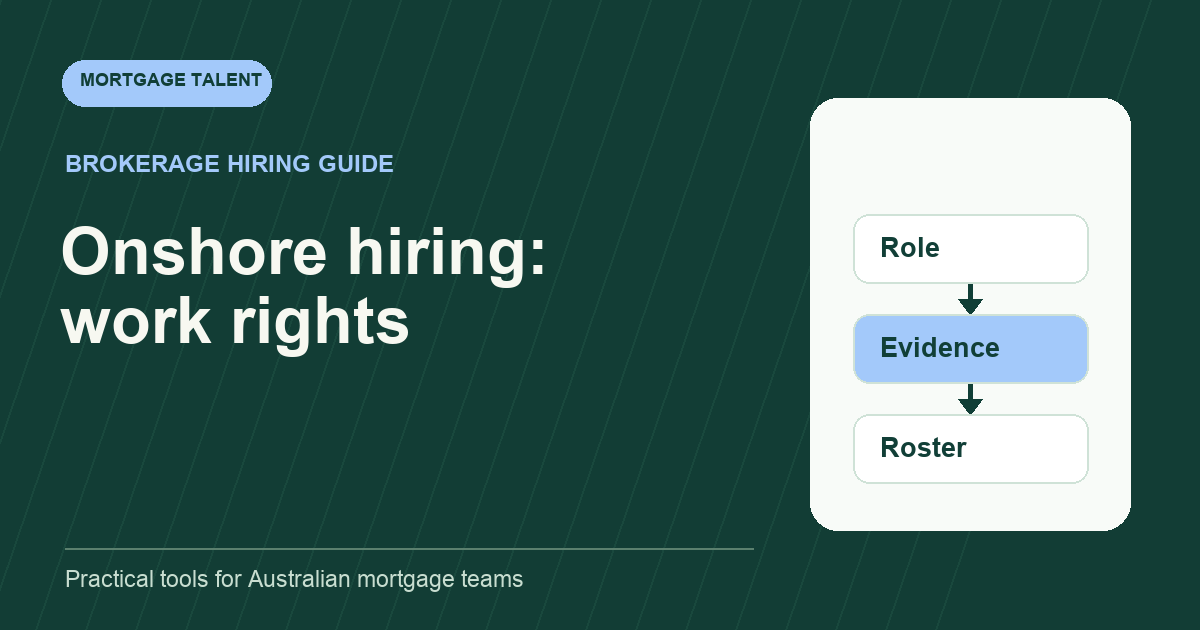
Before an assistant or loan processor starts work physically in Australia, confirm the person's work entitlement against the actual role, then give the roster owner any relevant limits and review dates. A recruitment tick saying “checked” is not enough to tell the manager whether a later change to hours or duties needs another review.
Home Affairs says employers must check that a person can legally work in Australia. This guide offers a hiring handoff for Australian mortgage brokerages. It does not determine anyone's visa eligibility or replace immigration advice.
Start with where the person will actually work
Record the country where the work will be performed, the employing entity, the proposed duties and the working pattern. “Remote loan processor” does not answer the location question: the person could be working from Brisbane, Kathmandu or Manila.
- Working in Australia, directly employed: name the employer's verification owner and the hiring manager who will receive the result.
- Working in Australia through a provider: ask which entity performs the check, who reviews restrictions and what confirmation your manager receives. Have responsibility under the actual arrangement checked; do not assume a supplier's involvement removes your obligations.
- Working wholly overseas: use the relevant local engagement and work-entitlement process with appropriate advice. Do not turn this Australian checklist into a demand for an Australian visa merely because the person supports Australian mortgage files.
A proposed move or visit involving work in Australia is a fresh review point before the arrangement changes. Keep the physical location separate from the customer's location and the brokerage's time zone. The recruitment-versus-outsourcing responsibility map can help identify the parties before you assign the check.
Choose the verification route before requesting documents
Ask applicants the same role-related questions about their ability to work in the stated location and pattern. Do not substitute assumptions based on a name, accent or nationality for verification. Keep the skills assessment separate from the work-entitlement review.
For visa holders, Home Affairs' VEVO guidance describes organisational checks of current work entitlements. Registered organisations need the visa holder's permission. Agree the route and purpose before requesting the travel-document details needed for the check. A visa holder can also send proof of their visa conditions from VEVO.
VEVO cannot confirm Australian citizenship. Home Affairs identifies an Australian passport or citizenship certificate as citizenship evidence in its VEVO overview. Use the appropriate evidence route for the person rather than making every candidate complete a visa check.
A tax file number, Medicare card or driver's licence alone does not establish a non-citizen's right to work in Australia, according to the employer hiring guidance. Payroll setup and work-entitlement verification therefore need separate completion records.
Keep a restricted record and a smaller manager handoff
Home Affairs recommends saving the VEVO result PDF and says you do not need to retain a copy of the visa holder's travel document for that check. See VEVO for organisations, step 7. Do not automatically attach passport scans to a candidate's interview scorecard.
For organisations covered by the Australian Privacy Principles, the OAIC's APP 3 guidance requires collection to be reasonably necessary and explains data minimisation. Agree the necessary evidence, approved storage, access and retention arrangements with your responsible owner. Avoid collecting identity copies “just in case”.
Use the following original worksheet as an operational handoff, not as a government form or a substitute for the underlying evidence. Keep identity documents and detailed visa records in the approved restricted location. Give the roster owner only the information needed to implement the reviewed arrangement.
Scroll sideways to see all columns →
| Field | What to record |
|---|---|
| Role and location | Assistant or processor duties; physical work country; proposed start and working pattern. |
| Responsible parties | Employing entity, verification owner and receiving hiring manager. |
| Check record | Check date, method, permission record where needed and restricted evidence reference. |
| Reviewed fit | Whether the proposed duties and pattern have been checked against the evidence, with reviewer and date. |
| Operational limits | Relevant instructions for scheduling or allocation; unresolved interpretations stay with the reviewer. |
| Next check | Review date or trigger, named owner and backup. |
| Manager acceptance | Confirmation that the roster reflects the reviewed arrangement. |
| Unresolved issue | Question, decision owner, next update and affected start or roster change awaiting resolution. |
Test the handoff against a mortgage workload change
Fictional example: a brokerage is hiring a processor for an agreed part-time preparation queue. Its appointed reviewer has checked the proposed arrangement. Before the start date, a settlement backlog leads a broker to request an extra afternoon each week.
The recruitment record still says “work rights checked”, but that check referred to the earlier pattern. The manager sends the revised schedule to the verification owner before adding the hours. Any question about visa conditions goes to the appropriate adviser; the broker does not decide it from a visa label or an old screenshot.
While the proposed change is unresolved, the manager leaves those extra files with their current owner or arranges other approved capacity. Once the review is complete, the manager records the actual decision and adjusts the roster accordingly. This example illustrates change control; it does not say that any particular visa permits or prohibits those hours.
The same handoff should catch a provider replacing the named processor, a worker proposing to relocate, or a manager changing the role's duties. Carry the relevant condition into the start-date readiness register, so an unresolved check cannot disappear behind completed equipment and training tasks.
Set the next check before closing recruitment
Home Affairs says to maintain valid work permission throughout employment, check within two days of visa expiry or when visa circumstances are known to have changed, and check every three months where a bridging visa has no expiry date shown in VEVO. Follow its current rechecking guidance. Set an earlier internal reminder for preparation; an old check is not permission to work beyond the person's actual entitlement.
If VEVO returns an error, follow the Department's error-resolution instructions. Record the issue and seek clarification rather than treating an unsuccessful search as a final eligibility decision.
For an unclear condition, changed circumstances or a sponsorship question, obtain advice appropriate to the situation. Home Affairs identifies registered migration agents, legal practitioners and exempt persons as people who may provide immigration assistance. Do not ask an assistant or recruiter to invent an interpretation.
Work-entitlement questions also do not remove workplace protections. The Fair Work Ombudsman says migrant workers retain workplace entitlements and protections regardless of migration status. An employment action needs its own properly informed decision.
Put the check into the role brief
Before requesting a shortlist, specify the physical work location, duties, hours, employing arrangement and owner of work-entitlement verification. Ask what the recruitment or staffing provider will deliver and what your manager must complete. Keep migration advice, identity evidence and routine hiring communications on their appropriate paths.
To discuss an assistant or processor role, share your mortgage support hiring requirements with Mortgage Talent. Include the work and location you need covered; do not put passports or visa documents into a general hiring enquiry.
Take the next step
Explore Mortgage Talent or speak with our team about your hiring needs.