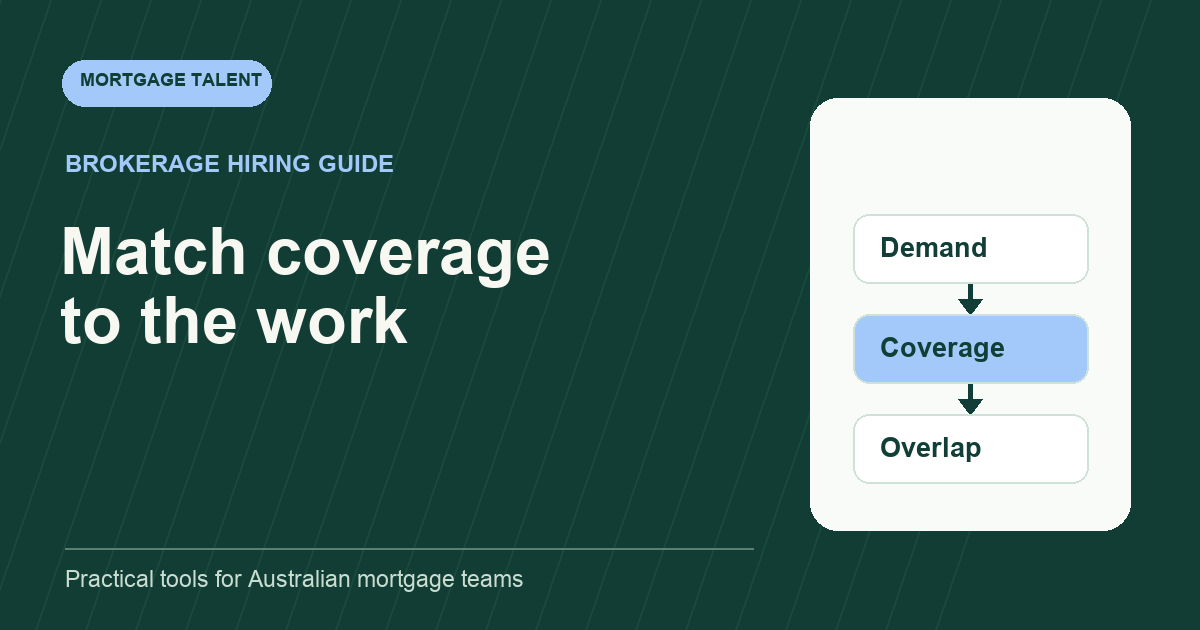
Choose part-time or full-time mortgage support by matching the timing of work as well as its volume. A queue needing attention every business day may fit a shorter daily schedule better than two long shifts. A role with sustained preparation, follow-up and coordination work may need broader coverage even when the raw file count looks modest.
The worksheet below compares coverage patterns using your own workload. “Part-time” and “full-time” describe proposed coverage here; employment classification, hours and terms must be settled separately for the actual arrangement. All numerical examples are illustrative, not staffing benchmarks.
Measure tasks instead of dividing files by people
List the work expected from the support role over a normal week. Separate preparation, follow-up, record updates, meetings and clarification. Count the minutes spent working on each activity rather than the days a file remains open. A file waiting for a response is not consuming continuous processing time, although it may still need a scheduled check.
Record a quieter week and a busier week as well. If your sample contains only a recent surge, you may overstate the recurring requirement. If it contains a holiday week, you may understate demand. Keep uncertainty visible and use the workload worksheet for hiring decisions when the underlying need is still unclear.
Build a coverage map across the week
Create a column for each day and mark when new work arrives, when brokers can review it, and when outbound follow-up is useful. Give each activity one of three labels: can wait for the next planned session, needs a same-day owner, or needs a pre-arranged response window. Define those labels from your service commitments rather than assuming every message is urgent.
Scroll sideways to see all columns →
| Activity | Illustrative weekly effort | Coverage need | Scheduling implication |
|---|---|---|---|
| File preparation | 9 hours | Planned focus blocks | Protect uninterrupted sessions |
| Document follow-up | 5 hours | Short daily checks | Avoid long uncovered gaps |
| CRM updates | 2 hours | After agreed milestones | Batch where practical |
| Questions and handover | 2 hours | Overlap with a reviewer | Book actual broker availability |
This fictional queue totals eighteen hours. It does not automatically require an eighteen-hour engagement: availability, breaks, training, variation and the agreed scope still need consideration. Conversely, booking more hours does not solve the problem if the reviewer is never available during them.
Compare three schedules against the same queue
Test a shorter daily arrangement, a smaller number of longer days, and a broader weekly arrangement. Use the same work sample for each. Mark which items would wait overnight or over an uncovered day. Ask who owns messages that arrive after the scheduled finish, and whether that person has enough context to act.
A shorter daily schedule may suit frequent follow-ups and a predictable handover. Longer blocks may suit concentrated preparation work when another team member already owns incoming enquiries. Broader coverage may suit mixed duties and repeated interaction with several brokers. These are design possibilities, not universal rules.
Also check the cost of fragmentation. Splitting a complex task across several short sessions can create repeated catch-up work. A compact schedule may work well if the scope is deliberately narrow; the same schedule can struggle when it is stretched across reception, processing, reporting and ad hoc administration.
Calculate useful capacity with explicit assumptions
Start with scheduled hours, subtract known meetings and training, and then reserve an explicit allowance for normal interruptions. Show each deduction. Do not apply an unexplained “productivity percentage” and treat it as an industry fact. The purpose is to expose assumptions you can later replace with observed data.
For example, suppose a proposed twenty-hour week includes one hour of training, one hour of coordination and two hours reserved for variable work. That leaves sixteen planned task hours. Against the eighteen-hour example queue, the plan has a two-hour gap before any unusual event. You could narrow the scope, rearrange existing cover, or discuss more scheduled capacity.
Now stress the example with four extra preparation hours. The gap becomes six hours. Decide in advance which work moves, who approves extra capacity and who updates expectations. A small buffer is useful only when the team knows how to respond once it is exhausted.
Keep supervision and cover out of the blind spot
A support schedule should have a matching reviewer schedule. Name a primary reviewer and a backup, with a defined way to raise questions. Do not assume a full-time person needs no supervision or that a part-time person can absorb all questions at the end of a shift.
Document absence cover separately from the regular roster. Two part-time people may provide complementary coverage, but that arrangement also creates handovers and shared instructions to maintain. One full-time person may offer continuity, but the brokerage still needs a plan for absences. The continuity planning guide helps test that separate question.
Use a four-week review to change the schedule deliberately
Agree a review date before the arrangement starts. Track incoming work by day, useful task hours, carry-over, rework and waiting for broker decisions. Record why an item carried over. “No capacity” and “awaiting broker clarification” call for different changes.
- Compare planned hours with actual task demand across each weekday.
- Identify recurring uncovered windows rather than one exceptional day.
- Check whether the role has expanded beyond the original brief.
- Test one schedule or scope adjustment at a time.
- Confirm the revised arrangement with the people responsible for delivery and supervision.
If the queue fits but deadlines are missed at the same time each day, adjust overlap first. If the queue exceeds useful capacity throughout the week, assess additional coverage. If rework dominates, correct the process before assuming that more hours are the only answer.
Turn the result into a clear hiring brief
State the proposed days, working windows, recurring task volume, reviewer overlap and backup arrangements. Include your normal-week and busy-week assumptions. Avoid “flexible hours” as a substitute for an actual coverage plan; explain what flexibility the workflow needs and discuss what the candidate or provider can offer.
Explore mortgage talent once that brief is ready, or discuss a support role with Mortgage Talent. A specific schedule and task boundary make it easier to assess fit without turning a coverage discussion into an unsupported promise about output.
Take the next step
Explore Mortgage Talent or speak with our team about your hiring needs.