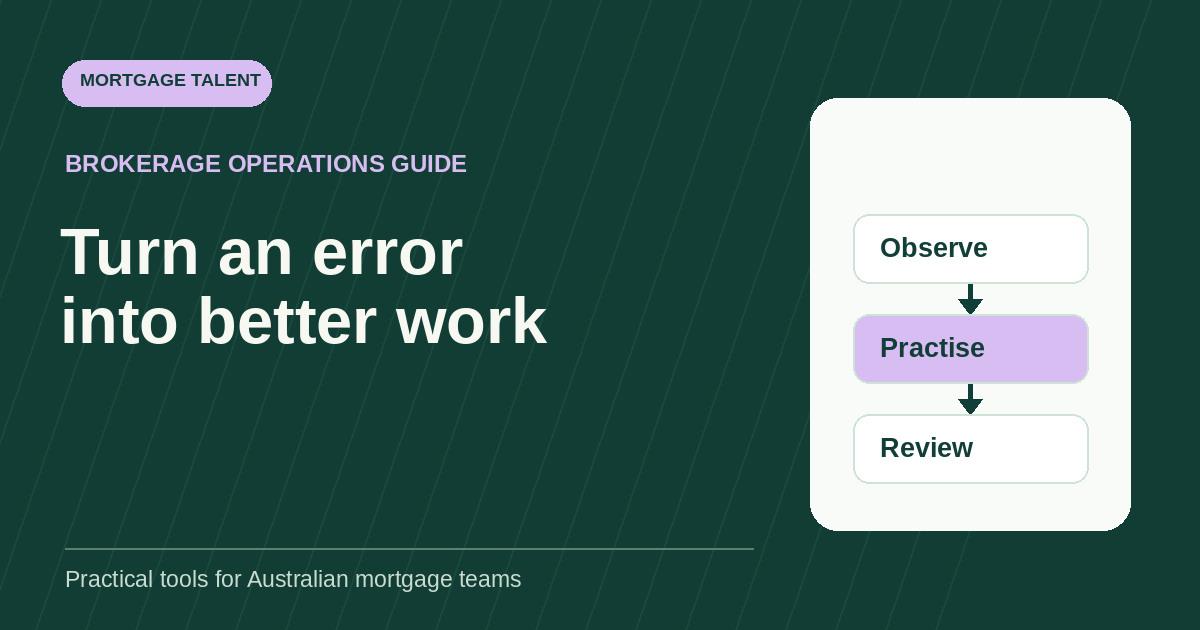
To coach a remote loan processor after an avoidable error, first contain the file issue, then discuss one observable missed step, hear the processor's explanation and agree what they will do differently on the next comparable task. Finish with a practice check and a dated follow-up. “Please be more careful” leaves the person to invent the improvement.
This guide is for Australian broker owners and operations leads managing outsourced support. It covers everyday task coaching. Use your provider's agreed management arrangements and obtain appropriate advice for formal employment matters.
Check the facts before calling it avoidable
Arrange the immediate correction through the approved file workflow. If a customer deadline or an incorrect external message needs attention, give that work a named owner first. The coaching discussion can then focus on learning without delaying the correction.
Bring the instruction that applied when the task was done, the expected output and the specific difference. Check whether the processor could access the source and whether someone changed the requirement later. An available checklist step that was skipped needs a different conversation from an instruction nobody had supplied.
If the cause remains uncertain, investigate it with the processor. The loan-processing rework log and root-cause guide helps distinguish execution mistakes from changed requests and process gaps. This article picks up once you have a concrete task to discuss.
Arrange a focused private conversation
Send a clear invitation: “Can we review yesterday's document-pack check and practise the step that was missed?” Include the task reference and current instruction so the person can prepare. Choose a time inside both people's working windows and specify the time zone.
Use a private call when the issue needs explanation or a shared walkthrough. A small, unambiguous correction may only need a clear written exchange. If a provider team leader manages coaching, agree who will lead and who will answer workflow questions. Avoid separate brokers issuing competing directions.
Discuss one behaviour at a time. Keep the existing review and approval arrangements in place while the person practises.
Use four prompts to keep feedback specific
The Center for Creative Leadership's Situation-Behavior-Impact guidance recommends describing the situation, observable behaviour and impact, then asking about intent. Use that sequence to open the discussion:
- Locate the task: Which handoff, file stage and instruction are we discussing?
- Describe the difference: What did the submitted output show, and what did the agreed step require?
- Explain the effect: What actually happened because of the mismatch?
- Invite the explanation: What did the processor understand, notice or decide at that point?
Keep the impact factual. If the broker had to reopen a pack, say that. Do not claim the error caused a lost approval or settlement delay unless you have evidence. Avoid labels such as careless, disengaged or poor at communication.
Work through an illustrative coaching conversation
The following example is fictional. A brokerage's written process requires a processor to compare a document pack with its approved inventory before marking it ready for broker review. One listed document was absent, but the pack was marked ready.
Broker: “On yesterday's practice handoff, the inventory listed four documents. The pack contained three, but you marked the inventory check complete. I reopened the task to locate the missing item. Can you walk me through the check you made?”
Processor: “I checked the new uploads, then used the previous status note to confirm the remaining document. I didn't reopen it.”
Broker: “Thanks. The current instruction asks us to confirm each listed item in the pack. Was there anything preventing you from opening it?”
Processor: “No. I assumed the earlier note was enough. Next time I'll open each listed item before completing that check.”
Broker: “Let's try that on a fresh fictional pack. If an item is missing, what will you record?”
Processor: “The missing item and the task reference. I'll leave the pack awaiting clarification and send the question to the named reviewer.”
Broker: “Agreed. I'll provide the practice pack today. For the next two comparable handoffs, show the completed inventory check to your usual reviewer. We'll discuss the evidence at our agreed follow-up.”
The two handoffs are an illustrative practice choice, not an industry standard or proof of overall competence. Agree a suitable amount of practice for the task and keep any existing file checks.
Copy this coaching worksheet
Complete one worksheet together. Use approved task references and links; leave customer names, documents and financial details in the authorised file system.
Scroll sideways to see all columns →
| Prompt | Record together |
|---|---|
| Expected step | Instruction link and version; what a complete output looks like |
| Observed difference | Specific output or missed step; evidence reference |
| Processor's explanation | Their account; any facts still to check |
| Next-task action | One observable action and the point where it happens |
| Manager's support | Example, clarification or practice material; owner and due time |
| Practice and review | Task type, reviewer, evidence to inspect and existing approval gate |
| Follow-up | Date, time zone and outcome: demonstrated, more support needed or awaiting evidence |
For the example above, write “Open every listed item before completing the inventory check.” That is inspectable. “Improve accuracy” is too broad to tell either person what the next task should look like.
Practise the changed step before relying on a promise
Ask the processor to explain the next-task action in their own words, then demonstrate it on a fresh fictional example. Include the normal route and one relevant exception. For an inventory check, the exception could be an inaccessible document rather than another missing document.
Watch where the person looks, what they record and when they ask for help. If you have to prompt the critical step, record that it still needs support and try again after clarifying the instruction. Do not mistake a fluent explanation for a completed check.
The manager also owns an action. Supply the promised example, answer the unresolved question or correct the confusing instruction before judging whether the processor used it. Keep the practice narrow enough to observe without turning one coaching conversation into a full role assessment.
Send the recap and check the next work
Fair Work Ombudsman's guidance on discussing performance issues recommends confirming expectations and agreed next steps in writing, allowing a response if something was misunderstood, and arranging follow-up. Those communication practices are useful here; the guidance does not establish the employment arrangements for an offshore provider's staff.
Send a short recap containing the agreed action, manager support, evidence to be reviewed and follow-up time. Invite corrections. A reply acknowledging the message confirms receipt; use the next work to establish whether the step was applied.
At follow-up, name what you observed: “You checked each inventory entry and raised the inaccessible item before marking the pack ready.” If the evidence is incomplete, record what remains unknown and agree the next opportunity to observe it. If the same miss recurs, review the explanation and support before simply repeating the original instruction.
Close this coaching action when the agreed evidence supports it. Keep wider performance trends in the outsourced loan processor KPI scorecard; a successful practice item does not establish a brokerage-wide quality rate.
Handle disagreement without losing the useful question
- “The instruction changed.” Check the version and timing together. Correct the feedback if the evidence supports that explanation.
- “I was rushing to meet the deadline.” Examine the actual priority conflict and agree who resolves it before the next affected task.
- “I understand.” Ask for a demonstration of the changed step and the exception route, rather than asking for another assurance.
A useful conversation ends with both people knowing what happens on the next file and how they will check it. If the discussion exposes unclear role ownership or supervision capacity, discuss your mortgage support requirements with Mortgage Talent using those specific gaps as the starting point.
Take the next step
Explore Mortgage Talent or speak with our team about your hiring needs.