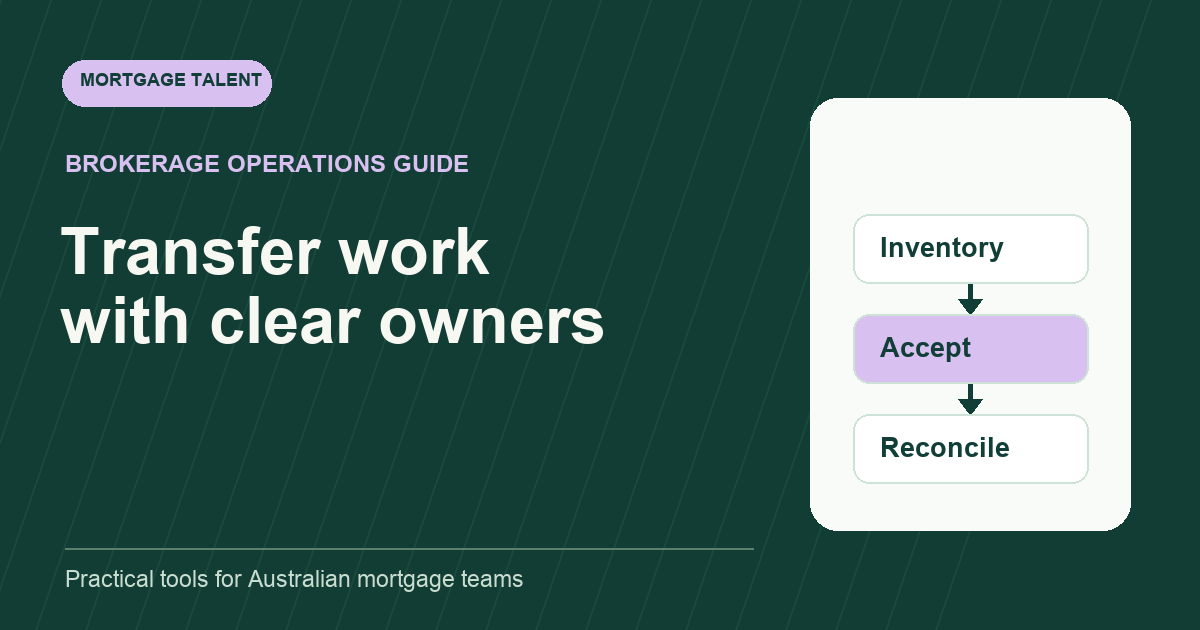
Change a loan processing support arrangement by inventorying the open work, assigning a receiving owner to every task and checking that the new team can find the current instructions and evidence. Move work in controlled batches where practical. Close the transition only after reconciling the queue and resolving missing or duplicated ownership.
This guide covers an operational provider or team transition for Australian mortgage brokerages. Your brokerage should separately settle the agreement, access and other requirements that apply. Use the provider due diligence checklist when assessing the new arrangement.
Define what is changing and what must be transferred
Name the affected workflows: preparation, lender follow-up, customer update drafting, settlement coordination or all of these. Decide whether open work transfers to the new team or remains with the existing owner until a defined stage. An unclear split can leave both teams assuming the other is acting.
Record the manager responsible for the transition and who can decide when a batch is ready to move. Distinguish the operational plan from the agreement process. A target start date alone does not show that the receiving team has the instructions, capacity or reviewer availability required.
Identify the approved systems of record and where current task evidence lives. A spreadsheet export may list files without their outstanding questions. The transition inventory needs the work still to be done, not merely a list of customers.
Copy the transfer inventory
Scroll sideways to see all columns →
| Field | Why it matters |
|---|---|
| File and task references | Reconcile specific work between teams |
| Current stage and checked time | Show how recent the status is |
| Next action | Describe the work being transferred |
| Deadline and dependency | Identify work that needs a careful handoff |
| Current and receiving owners | Make the responsibility change explicit |
| Instruction and evidence references | Let the receiving owner find the current basis |
| Broker or reviewer | Route questions after transfer |
| Acceptance and reconciliation state | Show what has actually moved |
Give each transferred task one active owner. A shared transition meeting does not by itself establish acceptance. Ask the receiving owner to identify the next action and confirm that the referenced evidence is available through the approved arrangement.
Test a small batch before a larger cutover
Select representative tasks that the manager can supervise. Include an ordinary ready task and an open exception where practical; testing only the easiest work leaves the exception path unexamined. Keep approaching deadlines visible when deciding what should transfer.
Use the controlled pilot method to define the acceptance checks. The receiving team should demonstrate that it can locate the current instruction, record the task outcome and route a question to the right reviewer. This is an operational rehearsal, not a promise about future turnaround.
The Australian Government's digital strategy guide recommends an action plan with priorities, due dates and owners. Apply that structure to the transition tasks and make the unresolved items visible before expanding the batch.
Work through a fictional reconciliation
A brokerage has 18 open tasks in its approved queue. It assigns six to a trial batch, and the receiving team confirms acceptance of five. The sixth lacks a current instruction. The manager keeps that task with the existing owner until the instruction is resolved. These are fictional counts, not customer results or a transition benchmark.
The reconciliation is explicit: 12 tasks remain outside the batch, five have accepted receiving owners and one remains with its current owner pending clarification. All 18 still have a visible owner. Counting six as transferred simply because they were listed in an email would hide the incomplete handoff.
After the clarification, record the sixth acceptance and repeat the check. If new tasks arrived during the trial, include them in the inventory or retain them in a clearly defined new-work queue. Reconciliation needs a stated cut-off time so changing counts can be explained.
Plan the change window and stop condition
Agree who assigns new work during the change window, who monitors urgent questions and what triggers a pause. A missing evidence location, an unavailable reviewer or unreconciled ownership should lead to a named decision about the next batch.
Keep a recovery arrangement in the continuity plan. Recovery should identify how work remains owned if the transfer cannot proceed; it should not depend on assumed availability from a departing team.
Ask the people responsible for agreements and system administration to handle their own transition requirements. The coordinator can track that those decisions are complete without inventing a universal access-removal sequence or interpreting contractual obligations.
Close the transition with evidence and follow-up
Reconcile the final inventory at the agreed time. Check for tasks with no owner, duplicate active ownership, stale status or a broken evidence reference. Record any work retained by the original team and the exact condition for its later transfer.
Schedule a short follow-up review of the new arrangement. Look at the first accepted work and the questions that arose after cutover. Update the instruction or handoff that caused each material issue rather than treating the transition date as proof of success.
If you are designing a new support arrangement, review the Mortgage Talent hiring journey, explore the mortgage talent marketplace and discuss your processing support needs. Bring the work inventory, receiving scope and reviewer arrangement so the next team starts with a concrete operating brief.
Take the next step
Explore Mortgage Talent or speak with our team about your hiring needs.