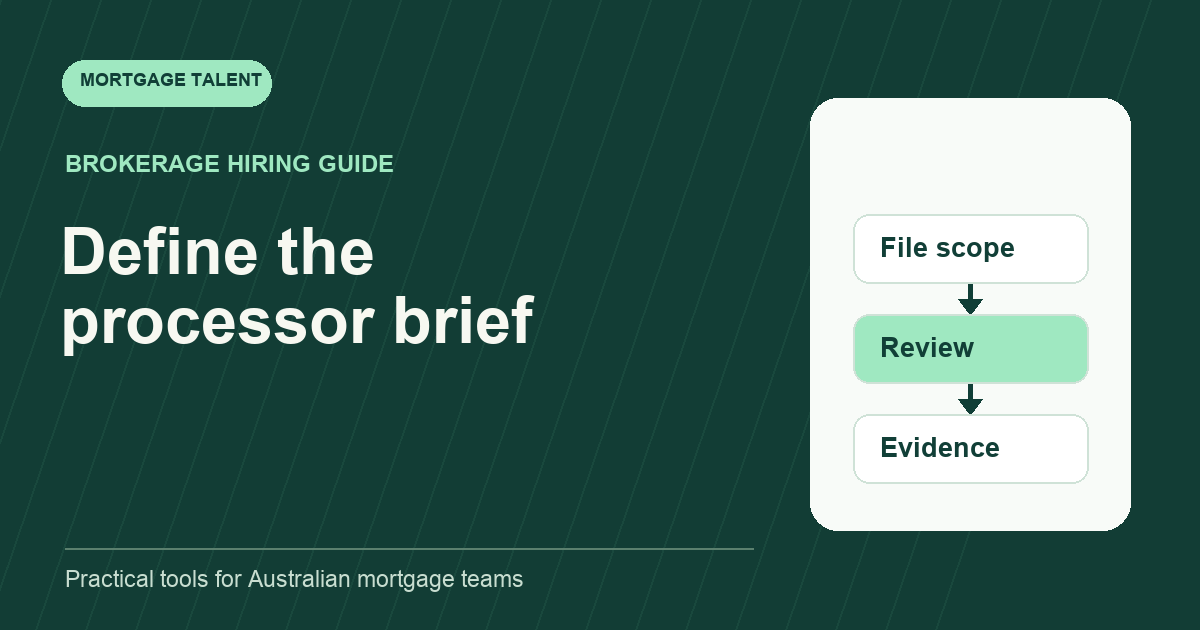
A useful loan processor hiring brief names the file stages the person will handle, the inputs they receive, the work they return and the reviewer who accepts it. Start with those details before listing software or asking for years of experience. The result should let a candidate explain how their experience fits your actual Australian mortgage workflow.
This guide provides an operational brief, a scope table and a fictional example. It builds on the loan processor hiring service page; the final duties and authority need to be set for your brokerage.
Choose the processing problem the role will solve
Describe a recurring problem in one sentence: complete packs wait for preparation, lender requests lack an owner, or the broker repeatedly reconstructs file status. Each problem suggests different work. A preparation-heavy role needs evidence accuracy; a follow-up-heavy role needs organised tracking and clear communication. Combining every problem into one vacancy makes the selection criteria harder to use.
Review several recent files and write down where work stopped, what was available at that point and who could have moved it forward. Use task observations rather than a hoped-for settlement target. If most delays arise before a complete file exists, revisit the assistant and processor role comparison before recruiting for processing capacity.
Copy this file-stage scope table
Scroll sideways to see all columns →
| Field | What to write | Example evidence |
|---|---|---|
| Starting stage | The point at which work is assigned | Broker-approved summary and document checklist received |
| Inputs | Required records and instructions | Current summary, source documents and named reviewer |
| Outputs | The preparation or tracking artifact | Checked pack, exception list and status note |
| Review point | Who accepts the prepared work | Broker records a decision before the next assigned step |
| Systems | The tasks performed in each tool | Update approved factual fields in the brokerage CRM |
| Coverage | Working windows and reviewer overlap | Agreed daily overlap with the file reviewer |
| Exceptions | What needs another person's decision | Conflicting source facts returned with references |
Keep each row observable. “Own the end-to-end process” leaves questions about the start, finish and decisions. “Prepare the assigned pack, identify missing inputs and return it for broker review” is a clearer starting scope. Add further stages only when their inputs and acceptance points are defined.
Separate essential evidence from trainable familiarity
Use a short essential list. For example, the candidate can reconcile a fictional summary with source facts, write a usable exception note and explain how they track an unanswered request. Name the evidence you will request for each criterion. A system name on a CV does not establish which tasks the person performed in it.
The Australian Government's recruitment guide describes position descriptions and selection criteria. Apply that structure to your own workflow. This template does not determine employment terms, classifications or qualifications.
List desirable experience separately: a particular CRM, a familiar lender portal or exposure to the loan types common in your brokerage. Ask which parts need training. A candidate who describes a sensible verification process may be easier to assess than one who claims familiarity with every platform without an example.
Use a fictional brief to expose unclear expectations
Imagine a two-broker team that prepares standard application packs but loses track of lender follow-up after submission. Its new role is intended to maintain the request register and prepare factual updates. The brief therefore prioritises request ownership, dated evidence and concise escalation notes. Application preparation is a secondary duty during quieter periods, with a separate reviewer gate.
The manager originally writes “manage 25 files”. On review, that is unhelpful: some files have no open request, others have several. The revised brief says “maintain the current action, owner and next review date for each assigned open request”. File counts remain context; they are not a promised output. All figures and circumstances in this example are illustrative.
Give a colleague the brief and ask them to describe a normal working day. If they imagine different duties, revise the table before sending it to candidates. The exercise is also useful when deciding whether to split one broad role into two narrower roles.
Define the first month through accepted work
Choose first-month outcomes that depend on the assigned person and available inputs. Examples include a complete request register for the selected queue, clear exception notes and evidence that reviewed instructions were followed. Avoid holding the person to an approval outcome controlled by another party.
Record the training time, reviewer availability and initial sample of work. Use the 30-day onboarding plan to translate the brief into supported practice. A first-month outcome should tell the manager what to inspect, not merely say the candidate is expected to be productive.
Connect the brief to the interview and hiring journey
Keep one version of the brief for candidates, interviewers and the eventual manager. Use the processor interview and fictional work sample to test the essential evidence. Record any agreed change to the scope before progressing the hire.
When the brief is ready, compare relevant experience in the mortgage talent marketplace and discuss the processing role with Mortgage Talent. Share the starting stage, outputs, working windows and reviewer arrangement. Those details give the search a useful operating context.
Take the next step
Explore Mortgage Talent or speak with our team about your hiring needs.