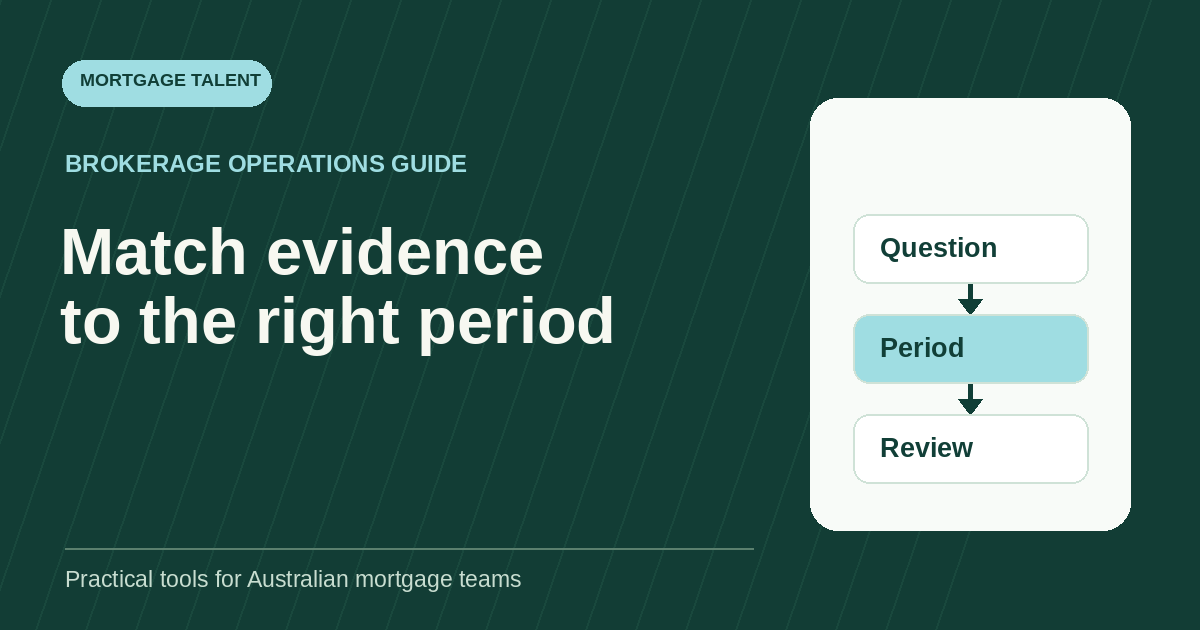
Prepare an Australian credit licence annual compliance certificate by matching each question to its own date or reporting period before collecting evidence. A current document, last quarter's report and a financial-year ledger can all be accurate while answering the wrong question. Give support staff the question, time basis and evidence task; keep the certification decision with the responsible licensee.
This guide is for mortgage brokerages holding their own Australian credit licence and delegating administrative preparation for CL50. Its completed fictional exercise tests whether evidence fits four selected questions. It is not a complete certificate checklist, legal assessment or instruction to lodge.
Fix the question map before requesting documents
ASIC's annual-certificate guidance distinguishes the annual compliance date from the lodgement deadline, which is no later than 45 days afterwards. The annual date is the licence anniversary or another date ASIC has approved. Record the actual dates with the owner rather than borrowing another brokerage's calendar.
Ask the owner to confirm which questions apply, the current form version and the exact period boundaries. Keep the requested item beside its source reference. “Annual compliance evidence” is not a sufficiently precise instruction for someone choosing between several exports.
The ASIC question guide uses different time bases: the written compliance plan is assessed at the annual date; professional indemnity and received disputes refer to the preceding year; applicable trust-money questions distinguish the last and current financial years. Its ongoing-compliance certification requires appropriate inquiries about arrangements, systems and their operation in the stated period.
Use that map to request evidence. Do not replace the actual form with the four selected areas below or assume every question uses one annual window. The licence owner and relevant advisers resolve applicability and interpretation before support prepares an answer.
Test four apparently useful source items
Everything in this exercise is invented. The brokerage's annual compliance date is 30 September 2026 and its financial year ends on 30 June. The owner confirms the relevant periods; the support worker reviews the supplied records afterwards. The table records preparation findings, not Yes or No certification answers.
Scroll sideways to see all columns →
| Selected question area | Evidence supplied | Preparation finding and next action |
|---|---|---|
| Written compliance plan at the annual date | Plan first approved and effective on 6 October 2026. | Later than the relevant snapshot. Ask the compliance owner for the earlier plan and relevant records, or an explanation of what existed then. Keep the October improvement separately dated. |
| Professional indemnity during the preceding year | Current policy schedule starts on 1 July 2026. | It leaves the earlier part of the review period unevidenced. Request preceding documents and the responsible insurance/licence review. Missing documents do not prove there was no insurance. |
| Disputes received during the preceding year | Row count from a January–June 2026 IDR data file. | Different period and population. Reconcile the annual receipt population rather than copy the count. The next exercise shows the difference. |
| Applicable last-financial-year trust-money question | Ledger extracted using the certificate's annual window. | Request the accountant's correct financial-year evidence. Keep the separate current-year question open. The worker does not decide whether particular receipts are trust money. |
For the first row, relabelling the October plan as the “annual plan” changes nothing about its effective date. For the second, finding an older schedule may improve the evidence coverage, but the adviser still assesses the actual arrangements. A preparation worker should not convert either finding into a compliance conclusion.
For the ledger, write the actual requested start and end dates into the accountant's question. Do not change the business's year end to align with CL50. Where the owner has not settled the applicable period or treatment, record precisely what needs their answer before generating another extract.
Compare the two complaint populations
The current IDR reporting handbook includes complaints made in the reporting half-year and certain earlier complaints that were not closed throughout it. Consequently, a valid half-year file need not contain the same records as an annual count of disputes received.
In this bounded fictional example, the owner has confirmed that these are the complete relevant records. Dates deliberately sit well inside or outside the relevant periods. For real work, the owner must settle exact boundaries and source coverage, including complaints first received by credit representatives and forwarded to the licensee.
Scroll sideways to see all columns →
| Mock record and history | January–June 2026 data file | Annual received population for this certificate |
|---|---|---|
| A: received August 2025; still open into January 2026. | Included: carried open. | Excluded: received before the annual window. |
| B: received November 2025; closed December 2025. | Excluded: closed throughout the half-year. | Included: received within the annual window. |
| C: received March 2026; closed April 2026. | Included. | Included. |
| D: received August 2026; still open in September. | Excluded: after the half-year. | Included. |
The half-year file has two rows, A and C. The annual receipt population has three records, B, C and D. Copying two into the certificate would answer a different question. Adding every historical export would also be unreliable: it could count the same carried-open complaint repeatedly.
Return the record-level comparison and its source references to the complaints owner. They check completeness and the proposed answer. Keep this comparison separate from the technical task of formatting or validating an IDR submission; a file passing validation does not establish that its row count answers CL50.
Give the reviewer an answerable exception list
Hand over the question reference, required period, evidence location, observed mismatch and named decision owner. Distinguish “not retrieved”, “retrieved but wrong period” and “period matched, assessment pending”. These describe different next actions, so a single green “document received” tick is unhelpful.
For this exercise, the handback identifies a historical-plan question, missing earlier insurance evidence, a reconciled three-record receipt population awaiting owner acceptance, and an accountant's financial-year query. None becomes complete merely because the assistant has sent a request.
If an owner supplies an explanation, date it as an explanation and retain the underlying references. Use the support file-note method to separate the source, the preparation finding and the owner's decision. Do not backdate new documents or silently rewrite the evidence gap.
Agree the next check and an internal escalation date early enough for the responsible person to address unresolved matters. An approaching deadline is a reason to escalate, not to select a reassuring answer. Any further action about the certificate stays with the authorised owner.
Define preparation separately from certification
ASIC specifies who can sign according to the legal entity holding the licence. Assigning document preparation does not itself authorise signing or lodgement. Have the licensee confirm the appropriate signatory and any separate agent or portal-access arrangements.
In the brokerage responsibility matrix, give support the retrieval, period comparison and follow-up tasks. Name the compliance, insurance, complaints and accounting owners who answer the substantive questions. Keep final certification and submission ownership explicit.
For a hiring exercise, give a candidate the fictional source list and ask which items need a different period, what should be requested next and which decisions they would leave with the owner. A useful response explains the two-versus-three count and preserves uncertainty without inventing compliance advice.
Discuss your compliance-administration support brief with Mortgage Talent. Describe the preparation work, approved systems and available reviewers. Confirm any specialist compliance advice or lodgement service separately rather than assuming it is included in recruitment or processing support.
Take the next step
Explore Mortgage Talent or speak with our team about your hiring needs.