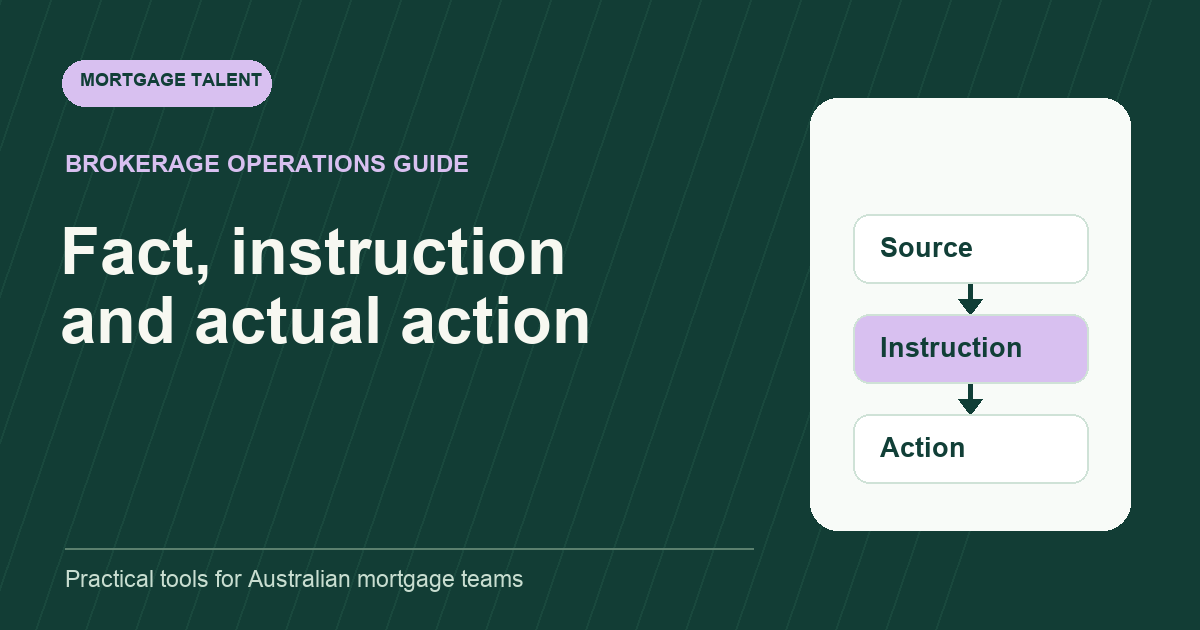
A useful mortgage support file note records the source of information, the instruction received, the action actually performed and the next owner. Distinguish a customer's report from an observed document and a broker's decision. Someone reading the note should be able to continue the task without guessing who said or did what.
This is a proposed administrative note method for assistants and processors. The responsible broker's assessment and advice record needs its own approved process. A support note should describe the work performed without inventing the broker's reasoning or claiming that a template establishes compliance.
Start with the event and its source
Name the event, the relevant date and the controlled source reference. If a customer provided information by phone, attribute the statement to that contact. If the worker observed a document or system status, identify where they looked and when.
Keep the event time distinct from the time the note was entered. A message received yesterday and recorded today should not appear to be a new customer report. Where a time is unknown, say so rather than supplying a plausible value.
Use the permitted internal file reference and approved record location. Avoid copying full customer documents or unnecessary personal details into a note merely to make it self-contained. The reader needs a reliable route to the source, not another uncontrolled copy.
Use a four-part note structure
Scroll sideways to see all columns →
| Part | Prompt | Illustrative wording |
|---|---|---|
| Source and fact | What was reported or observed, and where? | Customer message M-4 reports a revised start date |
| Instruction | Who directed the next action? | Broker instruction B-2 requests a clarification before updating |
| Performed action | What did the worker actually do? | Approved clarification sent through the recorded contact route |
| Next ownership | What remains, who acts and when? | Reply pending; assistant checks the approved inbox at the agreed point |
The labels are proposed prompts, not mandatory system fields. Adapt them to your existing CRM so the note remains easy to write and find. A good structure should make missing context noticeable without encouraging people to fill it with assumptions.
If there was no broker instruction because the task followed an approved routine procedure, identify that current procedure instead. Keep a procedure reference separate from a claim that the broker personally reviewed this specific event.
Replace broad completion language with an observed action
“Documents done” is difficult to interpret. The worker may mean they received an upload, renamed a file, prepared a pack or recorded reviewer acceptance. Write the actual event and the unresolved next step.
For example, “Items D-1 and D-2 received in the approved location; reviewer acceptance not recorded; returned to reviewer R for the next check” is a clearer fictional note. It does not upgrade arrival into approval or conceal the internal review queue.
Similarly, “lender contacted” leaves out the reference, question and response. Record whether contact was attempted, a message was sent or a reply was received. Add what the reply changes under the responsible person's instruction instead of closing the task from the contact alone.
Practise with a before-and-after exercise
Illustrative first note: “Spoke to customer. Everything sorted. Broker happy.” The mock exercise provides a customer message, a missing-page observation and a broker instruction to request the page. There is no evidence that the broker accepted a complete pack.
An improved note records: “Customer message M-7 says the pack was sent. Page 3 is not visible in document D-8. Broker instruction B-5 requests that page through the approved channel. Request R-2 sent; reply pending with assistant owner A.” All identifiers are fictional.
The better note lets the reviewer find the evidence and the next action. It does not judge the customer's account, claim authenticity or imply that the broker approved something absent from the supplied exercise.
Keep decisions attributed to their actual owner
When the broker decides a question, record the source of that instruction and the specific action it authorises. Do not write “we approved” when the worker only prepared material for review. A team phrase can blur which person made the decision.
If an instruction is ambiguous, record the clarification question and owner. Do not expand a direction about one document into an assumed rule for the whole application. The broker-to-processor handoff gives the wider task context; the individual note records what happened within it.
Keep a customer's explanation attributed even after it is passed to the broker. A later reviewer decision can be recorded beside it without rewriting the original statement as independently established fact.
Correct a note without hiding the earlier event
Use your system's approved correction or amendment process. Identify the note being corrected, what was inaccurate, the source supporting the correction and who recorded it. Avoid silently changing the earlier note so the task history appears different.
In a fictional example, an assistant wrote that a request was sent when it had only been prepared. The correction should distinguish preparation from the later actual transmission and retain their separate times. That history helps explain why a follow-up should start from the real send event.
If an inaccurate note influenced another task, identify that dependency and ask the responsible owner what needs reconciliation. Correcting the text alone may leave a queue, reminder or customer message based on the earlier error.
Review whether another person can continue the work
- Can the source be located?
- Are reported information and observations distinguishable?
- Is the instruction attributed accurately?
- Does the action describe what actually occurred?
- Is the unresolved next step owned?
Use the quality sampling method to examine notes alongside their controlled source records. Coach the worker on the missing distinction rather than requiring longer notes for every task.
Explore processor support or discuss traceable support work. Include your note conventions and reviewer arrangement in the role brief and fictional training sample.
Take the next step
Explore Mortgage Talent or speak with our team about your hiring needs.