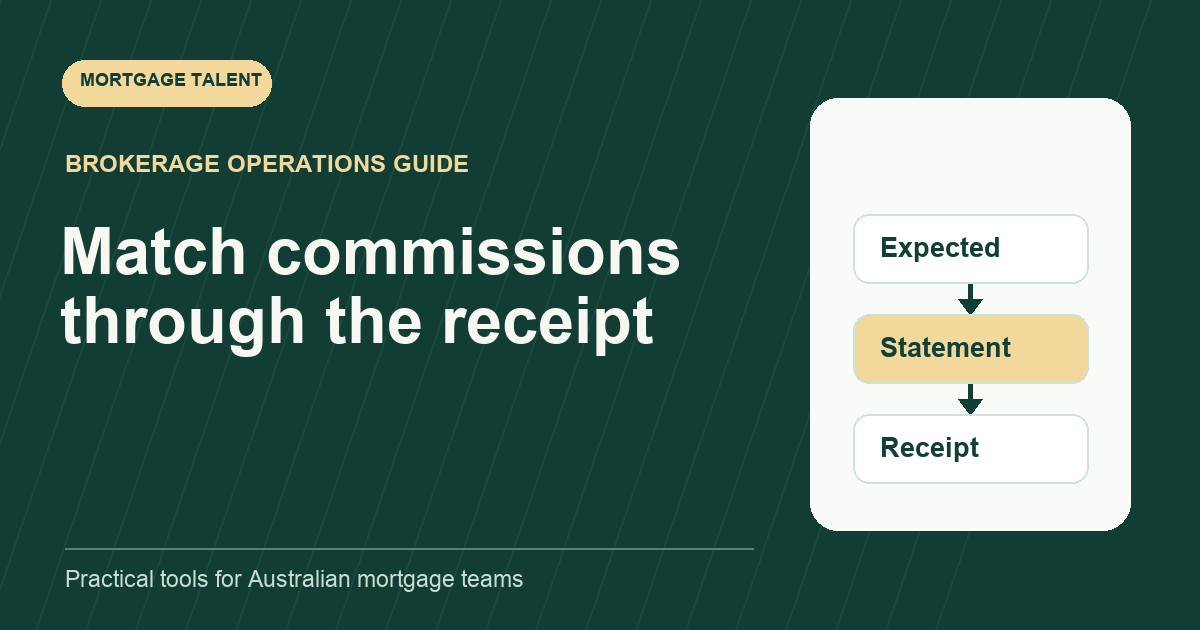
Prepare a mortgage broker commission reconciliation in three stages: match the finance-approved expectation to the statement line, allocate the statement to its payment batch and compare the batch with the recorded receipt. Keep unexplained differences open for the finance owner. A payment that balances at batch level can still contain a wrongly matched line.
This proposed worksheet concerns factual reconciliation support. It does not establish commission entitlement, interpret an aggregator agreement or decide tax and accounting treatment. The finance owner supplies the expected amounts, source agreements and treatment of adjustments.
Define the period and expected source
Record the reconciliation period, statement version, payment-batch references and the finance-approved expectation source. Confirm the cut-off the owner wants used. Do not combine different periods because their receipts appear close together in the bank record.
ASIC's Moneysmart explains that lender-paid mortgage broker commissions typically include an upfront and an ongoing payment. Keep the actual statement's line types visible rather than grouping every payment into one generic commission total.
Use controlled internal loan or deal references. The reconciliation task does not need a broad spreadsheet containing borrower document packs. Where a statement includes more personal information than the working view needs, follow the approved finance handling process.
Copy the expectation-to-receipt worksheet
Scroll sideways to see all columns →
| Stage | Record | Question for the owner |
|---|---|---|
| Expected line | Approved amount, period and basis reference | Is this the authorised expectation? |
| Statement line | Deal reference, type and stated amount | Does the line match the expected item? |
| Difference | Stated less expected on the same basis | Explanation supplied or still unresolved? |
| Batch allocation | Statement line and payment reference | Which receipt should contain it? |
| Recorded receipt | Approved bank or ledger source | Received, pending or unmatched? |
| Review outcome | Finance instruction and subsequent check | What action closes the exception? |
Define the sign convention and amount basis before calculating differences. Use the same finance-approved treatment of deductions and adjustments on both sides. If those bases are unclear, leave a question instead of adjusting a number until the total agrees.
Preserve the original statement values in the controlled source. Proposed classifications and reviewer answers belong in separate fields. A worker should be able to explain the reconciliation without rewriting the statement itself.
Match individual references before relying on totals
Check each line against the assigned reference, period and type. Flag an unknown deal reference, duplicate line or missing expected item. Similar amounts are not enough to establish a match. A neat total can conceal an omitted line offset by an unrelated addition.
Keep the approved expected amount separate from a support-calculated illustration. The finance owner may direct a calculation from an agreement, but the worker should record its inputs and return any uncertain interpretation. Do not invent standard commission rates or automatic adjustment rules.
The provider invoice check is useful for the separate expense side of finance administration. Keep its service records and payment approvals distinct from this incoming-commission reconciliation.
Work through a fictional split-batch example
Illustrative arithmetic uses invented accounting units, not actual commission rates or client amounts. A mock approved expectation has two lines: 600 units for item A and 400 units for item B. The statement shows A at 600 and B at 380, plus an unexplained 20-unit adjustment.
The statement total is 1,000 units, matching the expected total. Yet B differs by 20 and the adjustment has no approved explanation. The trainee leaves both exceptions visible. They do not allocate the adjustment to B merely to make the line-level record balance.
The mock statement is paid in two batches of 700 and 300 units. Only the first receipt is currently visible. The trainee records 700 received and 300 pending under the supplied mock batch references, rather than describing the whole statement as paid. Finance decides the line treatment and any follow-up.
Return questions with a precise evidence trail
Give the finance owner a short exception list ordered by the agreed review process. Each question should identify the expected source, statement line, batch and reason it cannot be resolved administratively. Distinguish missing information from a confirmed arithmetic difference.
Use the support file-note method to separate source facts, reported explanations and the owner's instruction. A payer's explanation is attributed evidence; it does not automatically authorise the brokerage's accounting classification.
After an answer arrives, record the authorised adjustment or follow-up separately. If a revised statement is issued, reconcile its changed lines and total against the earlier version. Do not silently discard the exception history or apply the same answer to a different period.
Keep a separate unresolved-receipt list for batches that have a statement reference but no confirmed receipt in the assigned source. A later receipt should close that specific timing exception after rechecking the batch. It should not automatically close an unrelated line difference that was waiting for a finance decision.
Close preparation without creating a financial action
- Every expected item has a matched line or visible exception.
- Statement totals and individual matches were both checked.
- Receipt status follows the actual assigned batch source.
- Finance decisions are recorded separately from support observations.
- Unmatched items have an owner and next check.
The support task can prepare this evidence for review without initiating a transfer, recovery request or ledger change. Those actions follow the finance owner's authority and process. Assess the worker with fictional split batches and offsetting differences before assigning real reconciliation work.
Explore administration support or describe your commission reconciliation queue. Include the source statements, expected-amount owner and finance approval boundary in the brief.
Take the next step
Explore Mortgage Talent or speak with our team about your hiring needs.