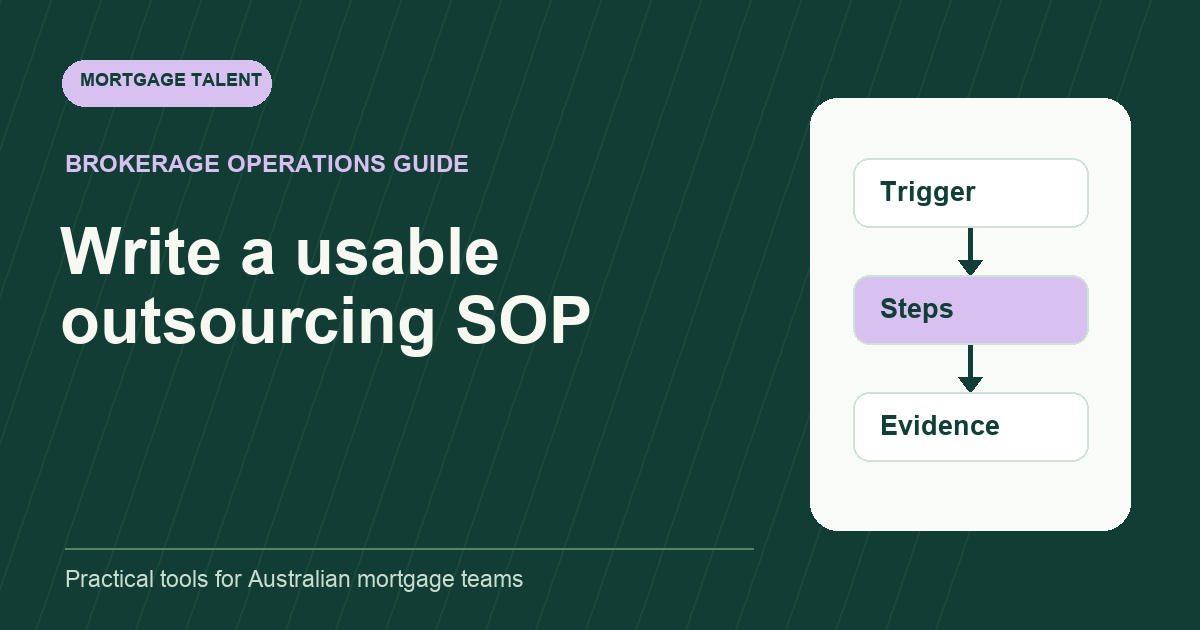
A mortgage broker outsourcing SOP should let an approved team member complete one defined outcome consistently without guessing what they may decide. The minimum useful SOP records the trigger, accepted inputs, owner, authority boundary, observable steps, decision points, acceptance evidence, exception route, system of record, version and review owner.
Write one SOP per outcome, not one enormous manual called “loan processing”. A narrower procedure is easier to test, train, update and withdraw when a system or requirement changes.
Choose one observable outcome
Start the title with the result, such as “Prepare a file for broker review”, “Record a client document request” or “Complete the post-settlement closure check”. Avoid titles such as “Help with applications” because nobody can tell where the procedure begins or ends.
Write the completion statement before the steps: “This SOP is complete when the required fields and evidence are recorded, all validation checks pass, exceptions have an owner, and the item is placed in prepared-for-review status.” This prevents “done” from meaning something different to each person.
Use this SOP anatomy
Scroll sideways to see all columns →
| Section | Question to answer | Good evidence |
|---|---|---|
| Purpose | What outcome does this procedure protect? | One concise result statement. |
| Trigger | What verified event starts the work? | Approved status or assigned task. |
| Inputs | What must be present and current? | Named fields, documents and instructions. |
| Owner | Who prepares, reviews and accepts? | Roles mapped to the workflow. |
| Authority | What may the support role do or not do? | Explicit decisions and escalation points. |
| Steps | What observable actions occur in order? | System action plus expected result. |
| Acceptance | How does the reviewer know it is ready? | Checks, evidence and approved status. |
| Exception | What stops the normal path? | Reason, owner and response point. |
| Record | Where is work and approval stored? | Authoritative system and linked evidence. |
| Control | Which version applies and who reviews it? | Owner, version, date and change note. |
Define the authority boundary first
Before describing clicks, state what the outsourced role can prepare, enter, request, communicate or escalate, and what remains with an authorised person. Do not rely on “use common sense”. New staff and backup staff need the same explicit boundary.
- List the decisions the support role must never make independently.
- Name the role that approves or accepts prepared work.
- Define what the support role may communicate from an approved template.
- State what happens when instructions conflict or evidence is incomplete.
- Link to the current permissions and access matrix rather than copying credentials.
Map those roles in the mortgage broker workflow RACI matrix. The SOP explains how one task runs; the RACI shows who owns decisions across the workflow.
Specify inputs and acceptance separately
Inputs are what must exist before work begins. Acceptance is what must be true before work leaves the support role. Mixing them allows an incomplete item to enter the queue and makes the processor responsible for discovering missing context after the service clock has started.
For each input, state the field or evidence, acceptable condition and action when it is missing. For each acceptance check, state who reviews it and where the result is recorded. The broker-to-processor handoff template can carry file-specific intent while the SOP holds the repeatable rules.
Write observable steps, not intentions
Each step should start with an action, name the system or record, and end with a visible result. “Check documents” is weak. “Compare the received items with the approved request list; mark each item present, missing or unclear; record the result in the task; route unclear items to the named reviewer” is testable.
- Open the assigned record from the approved queue.
- Confirm the trigger and required inputs are present.
- Perform the named actions in sequence.
- Record evidence and decisions in the authoritative system.
- Stop and route any defined exception.
- Run the acceptance checklist.
- Move the item to the approved next status and assign the next owner.
Use screenshots only where the visual location is genuinely hard to find. Interface images age quickly; pair each image with a text description of the intended result.
Build decision points as branches
A useful SOP does not pretend every item follows the happy path. Write branches in a consistent format: condition, permitted action, required evidence, owner and latest response point.
Scroll sideways to see all columns →
| Condition | Support action | Owner / evidence |
|---|---|---|
| Required input missing | Pause normal work and send the approved request. | Intake owner; missing-input reason recorded. |
| Information conflicts | Record the mismatch without choosing a preferred value. | Authorised reviewer; linked source evidence. |
| System unavailable | Use the approved outage path; do not create an uncontrolled duplicate. | Operations owner; outage and recovery log. |
| Instruction exceeds authority | Stop and request a decision. | Authorised role; decision returned to the record. |
| Acceptance check fails | Keep the item out of ready-for-review status. | Task owner; failed check and corrective action. |
Keep evidence in the source of truth
The SOP should name the authoritative record for task status, evidence, instructions and approval. Chat may alert a person, but a decision that changes the work must be returned to that record. Do not ask staff to maintain a separate shadow spreadsheet unless it is deliberately the approved operating system.
For cross-shift work, summarise the current state through the remote mortgage team daily handover and link back to the source record. The handover says what changed and what is next; the SOP says how the standard task is performed.
Test the SOP before live use
Run at least three fictional scenarios: a normal item, an incomplete item and a conflicting-input item. Ask a trained person who did not write the SOP to follow it without verbal help. Observe where they pause, infer or search elsewhere.
- Can they identify the correct trigger and version?
- Can they tell whether every required input is accepted?
- Do they stop at the correct authority boundary?
- Can they find the reviewer and expected response point?
- Does the source record show what happened and why?
- Can the next owner verify acceptance without reconstructing the work?
Fix the instruction when multiple people make the same mistake. Training is important, but repeated ambiguity is a process defect.
Train for judgement at the boundary
Do not train only the happy path. Give the team fictional examples of missing evidence, conflicting instructions, urgent requests, unusual customer questions and unavailable systems. Ask what they would do, what they would not do and where they would record the escalation.
During the first 30 days of loan processor onboarding, require observed practice and accepted evidence before independent work. Completion of a reading task alone does not demonstrate that the person can apply the procedure.
Control versions and changes
Give each SOP an owner, version, effective date, review point and short change log. Archive superseded copies so the active version is obvious. Trigger an earlier review when the system, workflow, role boundary, lender process or material input changes.
A change request should name the problem, affected step, proposed change, reviewer, test evidence and effective date. Tell the team what changed; do not silently replace a procedure while work is in progress.
Read a filled fictional SOP
This fictional procedure prepares a missing-input list for broker review. It illustrates the level of detail to record; the brokerage must choose its actual input list, permitted actions and reviewer.
Scroll sideways to see all columns →
| SOP field | Filled example |
|---|---|
| Outcome / trigger | Missing-input list prepared when DEMO-031 enters the assigned preparation queue. |
| Inputs | Approved expected-item list, controlled record link and current reviewer instruction. |
| Owner / boundary | Processor compares presence and clarity; named reviewer decides ambiguous or conflicting items. |
| Steps | Open the assigned record; compare each expected item; mark present, missing or unclear; record the source link; create the review request. |
| Exception | If the expected-item list is absent, stop comparison and ask the process owner for the approved version. |
| Acceptance | Every expected item has a status; unclear items have a question and reviewer; the source task shows the next action. |
| Control | Process owner maintains version, effective date, fictional test record and next review point. |
A test reader should be able to produce the list without guessing which source to trust or what “checked” means. If the expected-item list changes midway through preparation, preserve the version used and obtain the owner's instruction before continuing. Test that branch as well as the normal path. A filled example makes the intended evidence visible; it does not establish that the procedure has been accepted or used on live files.
Copy this mortgage outsourcing SOP template
- Title and purpose: one observable outcome and why it matters.
- Scope: workflows, systems and items included or excluded.
- Trigger: verified event that starts the procedure.
- Required inputs: item, accepted condition and missing-input action.
- Roles: preparer, reviewer, approver, backup and escalation owner.
- Authority boundary: permitted actions, prohibited decisions and required approvals.
- Steps: numbered actions with system, result and evidence.
- Decision branches: condition, safe action, owner and response point.
- Acceptance checklist: observable checks before the next status.
- System of record: where status, evidence, instructions and approval live.
- Handover: what must be visible when work crosses a person or shift.
- Controls: owner, version, effective date, test record and next review.
Publish the SOP only after the authority owner and operational reviewer accept the fictional tests. Then sample real use, remove stale instructions and feed recurring exceptions into the weekly improvement meeting. A good SOP reduces guessing while preserving the point at which human judgement and authorised review are required.
Take the next step
Explore Mortgage Talent or speak with our team about your hiring needs.