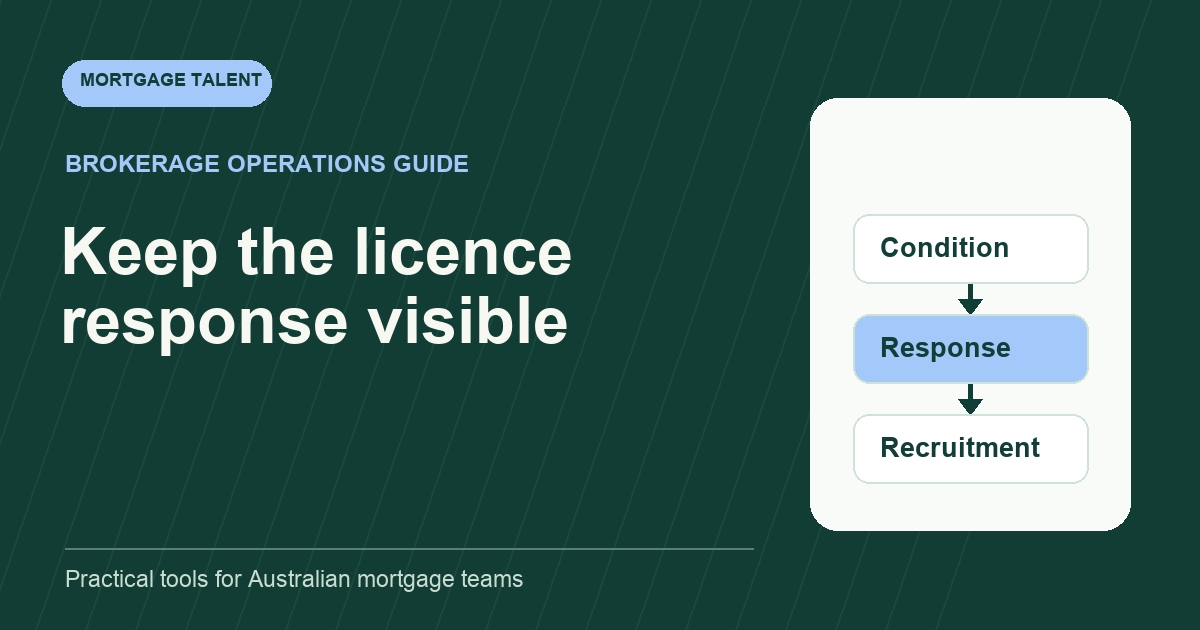
When a responsible manager is leaving an Australian credit licensee, check the actual licence conditions before treating the departure as an ordinary replacement hire. A named key-person condition creates a separate regulatory task. Give an administrative coordinator the evidence-preparation work, while the licensee and its advisers decide the response, replacement suitability and any effect on ongoing activities.
This guide is for a mortgage brokerage holding its own Australian credit licence. It does not determine your obligations or whether your business may continue particular activities. The completed exercise below helps prevent a recruitment update from being mistaken for completion of the licence response.
Check whether the person is named in a licence condition
Start with the current licence certificate and conditions, the person's actual responsibilities and the confirmed departure information. Do not infer key-person status from a senior job title. Equally, do not assume that appointing another manager automatically resolves a condition naming someone else.
ASIC's credit competence guidance, RG 206.48–49, distinguishes licensees with a key-person condition from those whose responsible-manager responsibilities are more widely distributed. Have the licensee's compliance or legal adviser assess the actual position. This distinction is why a generic staff-exit checklist cannot determine the response.
For a responsible manager named as a key person who has left, ASIC's credit-licence variation guidance describes two separate steps: an initial notification within five business days when the named key person has left, explaining the planned replacement actions; and a CL03 application to change or remove the condition. It also says the variation application should not be submitted until its required supporting documents are available. Ask the responsible owner to confirm the applicable requirements and dates promptly; do not wait for recruitment to finish.
Keep Australian credit licence guidance separate from Australian financial services licence guidance. The same role label can appear in both, but a search result about one is not the instruction for the other.
Give support a three-part preparation brief
The coordinator needs three clearly labelled work areas. First, the departure and actual licence-condition record. Second, the licensee's response and supporting evidence. Third, the recruitment or internal-succession process. Connect related items, but keep their completion states separate.
For each requested item, specify the owner, approved source, intended use and access location. The coordinator can retrieve an authorised document, identify a missing version and record receipt. They should not decide whether a candidate satisfies competence requirements, whether a condition applies, or what the licensee should certify or submit.
Use the responsibility-mapping guide to make those decisions explicit. Identify the person authorised to communicate with the adviser and any person authorised to lodge a response. A task to assemble papers does not itself supply either permission.
Test a fictional departure record
Illustrative exercise: A brokerage's supplied licence condition names Morgan as a key person. Morgan's departure has been confirmed. The licensee has appointed a compliance owner to assess and manage the response. An internal candidate, Riley, is interested in taking on the responsibilities, but their evidence has not been assessed. The coordinator receives the following updates. All people, records and outcomes are invented.
Scroll sideways to see all columns →
| Update received | What the coordinator can record | What remains with the responsible owner |
|---|---|---|
| Riley has agreed to an interview next week. | A recruitment event is booked. Retain the actual date. | The initial regulatory-response task remains independently owned and timed; an interview booking does not close it. |
| A current CV and qualification copies have arrived. | The requested documents were received, with their source and date. | The licensee/adviser assesses relevance and sufficiency. Receipt is not a suitability decision. |
| The compliance owner confirms that the initial notification was sent and supplies its record. | Record that specific action and its evidence under the owner's instruction. | The separate variation preparation and any outstanding evidence remain open. |
| A draft CL03 pack is assembled but one requested supporting item is missing. | Return a specific missing-item note to its owner. | The authorised owner determines readiness and submission. The coordinator does not mark the pack lodged. |
| Riley accepts an employment offer. | Record the accepted offer in the hiring workstream. | The licence-condition and ongoing-activity questions still require their own documented decisions. |
Completed handback: Recruitment has progressed and the initial notification has a supplied action record. The variation pack has an identified missing item. The coordinator has no basis to report that the named licence condition has changed or that every activity can continue unchanged. Those questions stay with the licensee's authorised owner.
The important correction is to the status report: “replacement secured” would hide two different kinds of unfinished work. A more useful update names what happened, what remains unresolved and who decides it. It does not reach a legal conclusion from an accepted offer.
Keep operational cover inside the owner's decision
Once the responsible owner has assessed the interim position, translate their actual instructions into the team plan. Record which tasks continue, which need a different reviewer and which await a decision. Do not substitute a senior processor or operations team leader simply because that person is available.
The existing support team-leader guide covers allocation and coordination responsibilities. Those duties are useful, but do not by themselves establish that someone can discharge a responsible-manager role. Keep the candidate's proposed appointment separate from their ordinary support duties.
For administrative assistance, define the retrieval, scheduling, document tracking and adviser-follow-up work you need. Discuss that support brief with Mortgage Talent, with a named licensee reviewer and approved access. Confirm responsible-manager recruitment, specialist advice and regulatory lodgement services separately rather than assuming they are included in support recruitment.
Take the next step
Explore Mortgage Talent or speak with our team about your hiring needs.