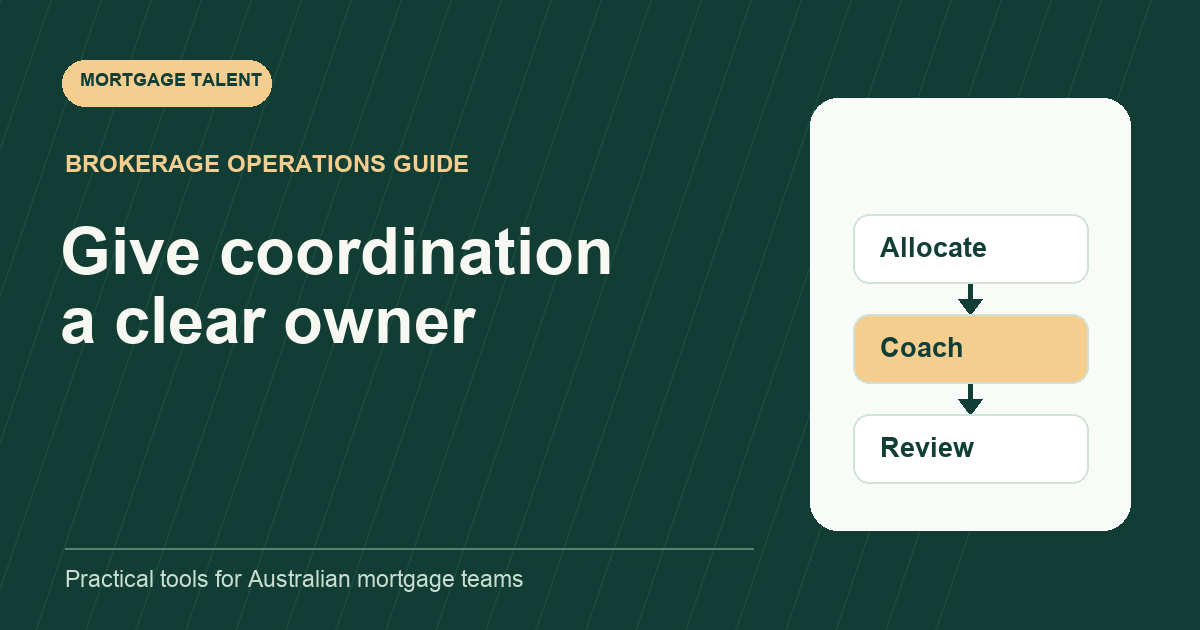
A mortgage support team needs a dedicated coordination role when recurring allocation, handover, coaching and exception work is consuming time that no one has explicitly been assigned to provide. Another processor adds preparation capacity; a team leader organises how that capacity is used. Decide from the coordination workload, not the number of people alone.
This guide sets out an operational role charter for Australian brokerages. It does not assume a title grants additional authority. Start with the workforce model your brokerage needs and define the leader's decisions, review boundaries and protected time.
Measure the work between tasks
For a short observation period, record who allocates incoming work, resolves competing priorities, checks handovers, answers routine process questions and arranges cover. Capture the time and interruption pattern. Also record unresolved coordination issues; work that nobody does will not appear in a timesheet.
Separate these observations from the actual preparation of application packs. A senior processor may already perform both, but their processing capacity should reflect that. If the team plans all their hours as file work and then expects them to coordinate everyone else, the plan contains more work than the available time.
Review whether clearer instructions or a named daily owner could solve the problem without a new role. A team leader is useful when there is an ongoing coordination job to own. It is less useful when the real constraint is an absent broker decision or an undefined process that the leader cannot change.
Write a role charter with clear decisions
Scroll sideways to see all columns →
| Area | Leader coordinates | Boundary to record |
|---|---|---|
| Daily allocation | Assign ready tasks within agreed priorities | Who changes priority when deadlines conflict? |
| Queue visibility | Maintain owners, blockers and next actions | Who decides substantive file exceptions? |
| Quality feedback | Gather correction patterns and arrange coaching | Who accepts work and changes the standard? |
| Coverage | Confirm backup and handover readiness | Who approves schedule or staffing changes? |
| Process improvement | Propose a change and track its trial | Who approves changes before use? |
| People support | Hold practical coaching conversations | Who owns formal employment decisions? |
Replace each boundary question with an actual role or person before using the charter. The workflow responsibility matrix helps connect the leader's coordination work to broker and manager review points. Avoid creating an extra approval layer for every routine task merely because the title is senior.
Protect coordination time in the workload plan
Give the leader a visible allocation for queue review, coaching and handover. If they also process files, plan that remaining capacity explicitly. An informal expectation to help whenever needed is difficult to measure and easy to overfill.
In a fictional team, a senior processor works a 30-hour week. The manager reserves six hours for coordination and two for coaching, leaving 22 for assigned file tasks before other allowances. These are constructed inputs, not staffing benchmarks. The important step is to make every commitment visible in the same plan.
Check the arrangement against the actual timing of incoming work and broker reviews. Six hours spread across the week can behave differently from one long meeting block. The allocation needs to support the queue, rather than become a calendar convention that leaves daily decisions unattended.
Assess leadership with a coordination exercise
Give a candidate a fictional queue with two competing deadlines, an absent team member, one unclear instruction and a reviewer who is available for a limited window. Ask for an allocation plan and a short explanation. Look for a named owner, an acknowledged constraint and a decision request where the candidate lacks authority.
Ask how they would coach a recurring correction without taking over all the work themselves. A strong explanation distinguishes unclear instructions, missing practice and genuine task difficulty. It should identify an observable improvement and a follow-up check.
The Australian Government's staff development guide describes coaching and job shadowing. These are useful options for a leader's development plan; they do not establish that a person is qualified for every task in a mortgage workflow.
Use a first-month review that matches the role
Review whether ready work has a named owner, whether blockers reach the right reviewer and whether repeated process questions become clearer instructions. Also ask team members whether they understand the leader's role. These observations are closer to coordination outcomes than a raw count of files processed.
Use the weekly mortgage operations agenda to review a small set of decisions. Record which problems the leader could resolve and which remained outside their authority. If the leader repeatedly waits on the same unavailable reviewer, adding more supervision time will not remove that dependency.
Choose the next hire from the remaining constraint
After the charter and allocation are tested, reassess the queue. If coordination is clearer but ready preparation work still exceeds available hours, additional processor capacity may be the next step. If preparation is adequate and unresolved management work remains, strengthen the leader's scope or manager support.
Use the support role comparison for the remaining task mix. Explore relevant experience in the mortgage talent marketplace and discuss a coordination or support role with Mortgage Talent. Share the charter and time allocation so the search reflects the job you need.
Take the next step
Explore Mortgage Talent or speak with our team about your hiring needs.