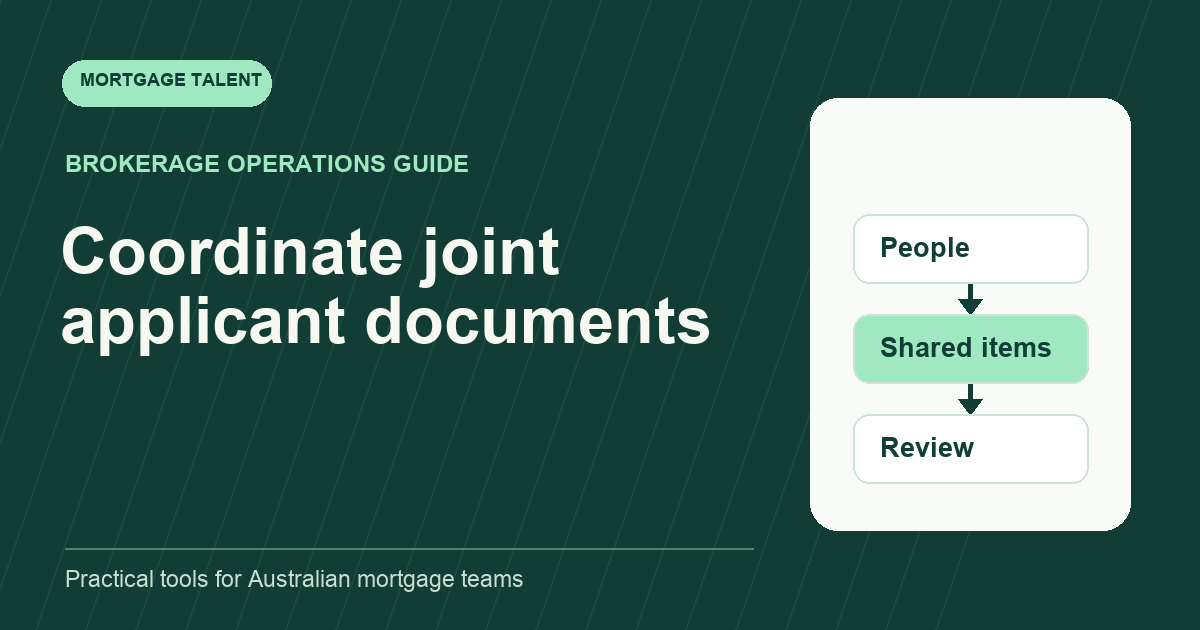
Coordinate a joint mortgage application with one document row for each required item and a clear link to the person or shared record it belongs to. Review coverage applicant by applicant before calling the pack complete. One person's finished checklist should never hide another person's outstanding request.
This proposed worksheet helps a brokerage assistant organise a broker-approved request list. It does not choose applicants, decide whose income can be used or establish lender acceptance. The broker sets the actual requirements and resolves questions about the application.
Map people before allocating documents
Start with the applicant list in the approved instruction. Give each person a stable internal label and link to their controlled record. Keep legal names and contact details in the approved system rather than copying them into every coordination view. Confirm which contact route the team may use for each request.
ANZ's document guidance says a partner who does not already bank with ANZ may still need to supply identity information; the page excludes ANZ Plus products. Treat this as a lender-specific example of why coverage can differ between people, rather than a checklist for every joint application.
Ask the reviewer to mark each requested item as individual, shared or unresolved. A shared statement may relate to both people, while an employment document belongs to one. If the source does not clearly identify the relevant person, flag attribution instead of placing it under the most convenient name.
Copy the applicant-by-item matrix
Scroll sideways to see all columns →
| Coordination field | Record | Check |
|---|---|---|
| Applicant or shared label | Person A, Person B or shared record | Matches the approved instruction |
| Requested item | Exact item and requested period | Requirement was assigned, not assumed |
| Source link | Controlled document and version | Relevant person can be identified |
| Coverage | Received, missing or query | Separate from reviewer acceptance |
| Next contact | Permitted recipient and owner | No duplicate request already open |
| Review result | Decision reference and next action | Applies to this specific row |
Use the existing document request tracker for request states and due points. The matrix is a view of those records, not a second competing chasing list. Link a shared document to both relevant rows without sending two replacement requests for the same item.
Leave an explicit not-requested state where the approved list has no item for one person. A blank cell can otherwise look like overlooked work. Do not copy Person A's requirements onto Person B simply to make the table symmetrical.
Send requests with a clear individual purpose
Draft a short request that identifies the item, the period where specified, the approved submission route and the next contact. Check the recipient against the task instruction. Avoid attaching one person's document while explaining what another person needs to supply.
If a single nominated contact coordinates the household's documents, confirm the approved communication arrangement before using that route. Record who supplied each reply. A message from one person about the other person's work does not become verified evidence merely because it arrives in the same conversation.
When two replies arrive together, allocate each item once and preserve its source. Keep the shared message reference so a reviewer can see the original context. Route disagreements or an unclear communication arrangement to the named owner before preparing another broad request.
Practise with a fictional two-person pack
Illustrative exercise: Person A has supplied the two items on their mock checklist. Person B has supplied one of two requested items. A fictional joint statement has also arrived, but the file name identifies only Person A. The instruction lists that statement as shared evidence.
The assistant links the shared source to both appropriate rows, records Person B's remaining request and avoids chasing Person A again. The file is described as partially covered, with a precise outstanding item, rather than complete because most uploaded documents relate to Person A.
A replacement joint statement then arrives with a clearer label. The trainee uses document version control to identify the current item and preserves the earlier review context. This tests attribution, coverage and coordination; it does not test a lending decision.
Return a pack the broker can review by person
Provide a concise summary with individual coverage, shared items and unresolved questions. Make it possible to open either person's sources without searching through an undifferentiated upload folder. Put the approved request list beside the matrix so the reviewer can judge coverage against the actual instruction.
If one person's missing item blocks the next preparation step, identify that dependency and the task owner. Do not close another person's completed row merely to make the entire file look unfinished. Preserve the distinction between an individual item's state and overall pack readiness.
After review, record decisions against the relevant rows. If the reviewer changes the requested scope, update the affected person and shared dependencies together. A covering colleague should be able to see what changed and which contact is now due.
Define completion and assess the support role
- Every requested item has an individual or shared owner label.
- Each received item points to an identifiable current source.
- Shared evidence has one coordinated request, with the right links.
- Missing coverage has an accepted task owner.
- Reviewer decisions are attached to the items they address.
Use a fictional pack to assess these behaviours during hiring and onboarding. Ask the person to explain an unresolved attribution question and show the next request they would prepare. Accuracy includes leaving a genuine uncertainty visible.
Explore loan processor support or share your joint-application document workflow. Include the applicant mix, approved system and review arrangement in the role brief.
Take the next step
Explore Mortgage Talent or speak with our team about your hiring needs.