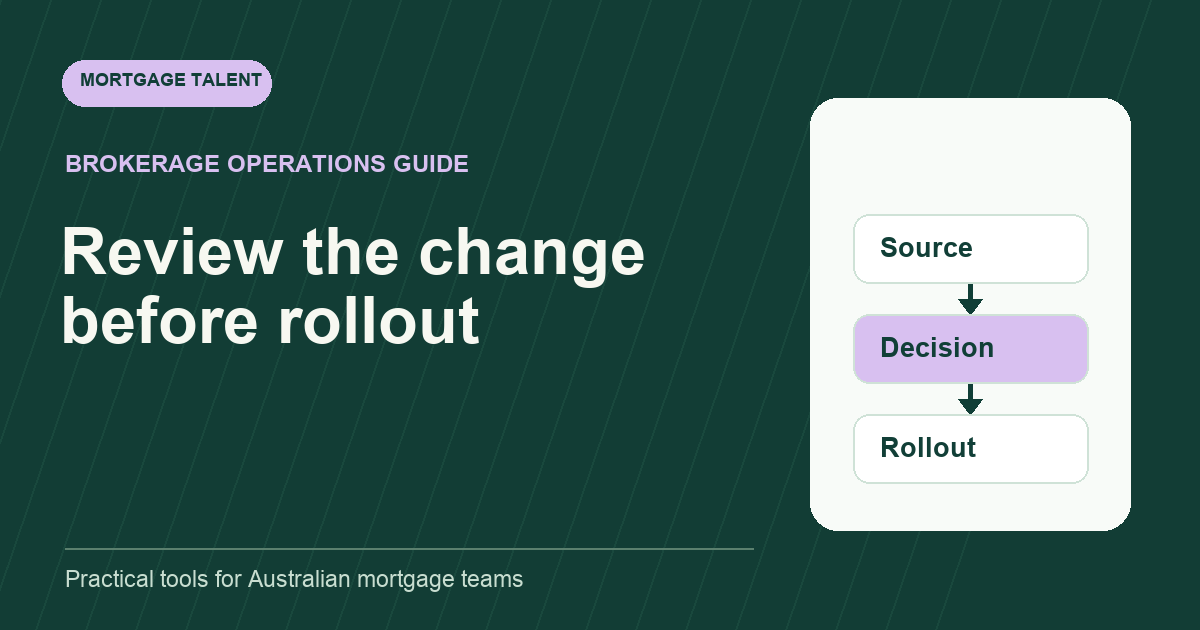
Organise lender policy updates by capturing the current source, recording the stated effective date and asking the responsible broker to decide what changes in the workflow. Only then update task instructions and notify affected staff. A forwarded announcement is an input to review, not an approved operating procedure.
This guide covers monitoring and coordination by a mortgage support team. It does not authorise a support worker to interpret credit policy, choose a lender or decide whether a customer qualifies. Keep those decisions with the brokerage's responsible reviewer.
Create one intake point for policy announcements
Choose an approved location for announcements from lenders and your aggregator. Record the sender, source link, received date, policy topic and the wording of any effective-date instruction. Preserve the original communication reference so the reviewer can check context rather than relying on a summary.
Qudos Bank's broker toolkit links credit policy and other lender resources. It is one example of an originating source location. Use the relevant lender's current materials for each update rather than assuming another lender's document or a third-party summary applies.
Distinguish a policy change from a product announcement, a software-screen update or a general reminder. The intake owner can categorise the message for review without deciding its application to a live borrower. An uncertain category should remain an open question, not disappear into an archive.
Record the questions a reviewer must answer
Scroll sideways to see all columns →
| Field | Reviewer question |
|---|---|
| Current source | Which originating communication or policy supports this? |
| Effective wording | What date or application event determines use? |
| Affected task types | Which preparation or review steps might change? |
| Open-file inventory | Which assigned work needs a broker decision? |
| Instruction dependencies | Which checklist, template or training example is affected? |
| Decision and approver | What change is approved, for which scope? |
| Rollout and check | Who updates the instruction and verifies its use? |
The support worker prepares the card and identifies potentially affected work under the agreed process. The broker confirms applicability. Avoid writing a definitive interpretation into the card when the source is unclear.
Keep the old instruction active or pause the affected task according to the responsible person's direction while the question is unresolved. Do not quietly apply a guessed rule because the announcement appears urgent.
Identify work that needs review without making the decision
List relevant task references, their stage and upcoming action. For example, identify preparation not yet reviewed, reviewed work awaiting action and submitted work with a new question. These stages help the reviewer assess the change; they do not establish which policy applies.
Record the inventory cut-off time. New work arriving after that point needs its own route through the updated process. If the policy announcement is clarified later, identify which tasks were reviewed under the earlier understanding and return them for the appropriate decision.
Use minimal task references in the coordination record and keep borrower details in the approved file system. The change log should help owners find affected work, rather than becoming an unnecessary copy of the loan pipeline.
Test effective-date ambiguity with a fictional scenario
Illustrative example: a mock lender announcement says a document requirement changes on Monday, but it does not explain whether the change applies to applications prepared, submitted or assessed after that date. Three fictional tasks sit at those different stages.
The support worker records the ambiguous wording, lists the three tasks and asks the broker for a decision based on the lender's current guidance. The worker does not infer that all Monday actions follow the new rule or that every existing file is exempt. Once clarification is obtained, the reviewer records the scope of the instruction.
The example is invented and intentionally contains no real policy requirement. Its purpose is to test whether the team can preserve uncertainty and obtain a responsible decision before changing work.
Update the current procedure and its dependencies
Use the knowledge-base structure to identify the current instruction owner. Record what changed, who approved it, the applicable scope and when it takes effect. Link the source and decision instead of duplicating the entire lender policy inside a local manual.
Check dependent templates and training examples. A changed document step may affect the request wording, preparation checklist, fictional training pack and reviewer handoff. Use the support SOP template to keep the entry condition, output and stop point clear.
Mark superseded instructions so old bookmarks do not silently suggest an earlier process. Preserve history under the chosen system's approved method. A new edit date does not prove the team understands or is following the change.
Verify rollout through an observed task
- Can the worker find the current instruction?
- Can they explain its scope and effective point?
- Does a fictional task reach the newly approved output?
- Are uncertain live files routed to the reviewer?
- Have the affected templates and examples been checked?
Ask a trained worker to demonstrate the changed step and explain its exception route. Record the observation, correction and reviewer rather than counting acknowledgements as proof of readiness. If an instruction still causes confusion, revise it and repeat the affected exercise.
Review outstanding announcements in your normal operations rhythm. Separate items awaiting a decision, approved updates awaiting rollout and completed changes awaiting an effectiveness check. This turns monitoring into owned work instead of a crowded email folder.
If your brokerage needs someone to maintain this coordination queue, review processor responsibilities and share the support workflow you need owned. Specify source monitoring, instruction maintenance and broker-review boundaries so the role supports your decisions with clear records.
Take the next step
Explore Mortgage Talent or speak with our team about your hiring needs.