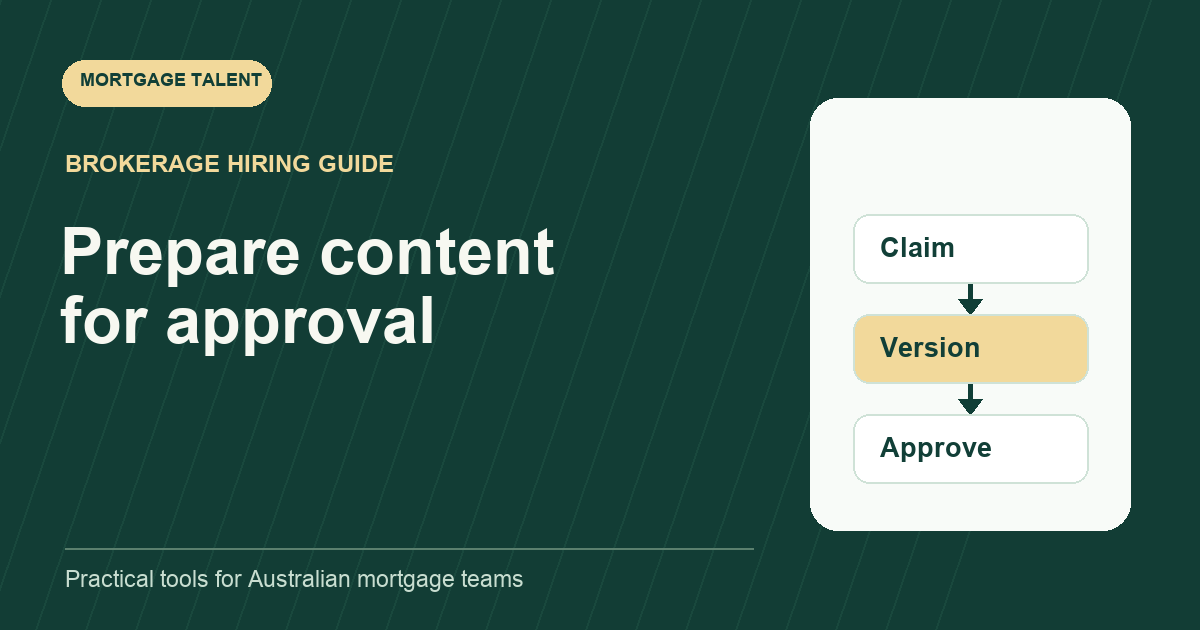
Give a mortgage marketing assistant a release brief that identifies the exact asset, its supporting evidence, the person approving it and the permitted publication destinations. “The broker liked the draft” is too vague when the email subject, social image and landing-page headline say different things.
The useful output is a review-ready pack: copy and artwork, a claim-source schedule, audience information, unresolved questions and a clear version history. The responsible approver decides whether that particular version can be released. This workflow helps a brokerage organise that decision; it does not certify advertising compliance or replace the relevant legal, compliance or marketing advice.
Choose the work you are delegating
Start with one campaign asset, not a job description that adds “all marketing” to a processor's workload. Preparing a newsletter from a reviewed brief is different from devising its proposition, choosing a paid-media strategy or deciding whether a product claim is appropriate.
Scroll sideways to see all columns →
| Role | Useful responsibility | Decision to send elsewhere |
|---|---|---|
| Production assistant | Draft and adapt approved material, maintain evidence and versions, prepare publication checks. | Unsupported product claims, uncertain audience permissions, strategic changes or unapproved release. |
| Campaign adviser or agency | Develop strategy and creative direction within the agreed engagement; explain campaign assumptions. | The brokerage's final product, compliance and publication authority unless explicitly assigned appropriately. |
| Brokerage approver | Review the actual claims and scope through the brokerage's authorised process; accept or return the identified version. | Questions outside their expertise or authority, referred to the appropriate specialist. |
| Publisher | Load only the approved asset and destination; inspect the real output and preserve publication evidence. | Any substantive edit or unresolved mismatch between master and channel. |
One person may hold more than one role. Keep the decisions separate anyway: who drafted, who approved the message and audience, and who checked the published result? The mortgage marketing manager role guide can help scope broader campaign ownership. The release record below is for a specific piece of work.
Keep the regulatory source beside the claim
ASIC's RG 234, issued in June 2026, addresses advertising of financial and credit products and services. Its scope includes promotional communications across media, including advertising generated using artificial intelligence. A different channel or drafting tool does not remove the need to consider the applicable advertising requirements.
Have the responsible approver examine the impression created by the full asset, including headline, image, qualifications and destination. Do not ask an assistant to solve a doubtful claim by adding small print and marking the file complete. The proposed record here is an operational method, not an ASIC-prescribed form.
The annotated publication brief
Fictional campaign: a brokerage wants to invite eligible contacts to book a conversation about preparing for a home-loan application. The following entries are invented to illustrate the workflow; they are not a live offer or evidence of campaign results.
Scroll sideways to see all columns →
| Brief field | Illustrative entry | Why the approver needs it |
|---|---|---|
| Objective and reader | Help prospective applicants prepare questions for a broker conversation; no approval promise. | Shows whether the content serves the stated audience and avoids drifting into a different offer. |
| Deliverables | One email, one social card and a linked booking-page introduction. | Prevents approval of one asset being treated as permission for every adaptation. |
| Claim schedule | C1: preparation topic; C2: rate statement awaiting verification; C3: booking availability awaiting owner confirmation. | Exposes missing support before the copy reaches the publisher. |
| Audience and send authority | Email audience specification and permission evidence held by the audience owner; exclusions unresolved. | Separates a good creative draft from permission to send it. |
| Image rights and specification | Social-card image origin unclear; replacement or documented permission required. | Stops “found in the shared folder” being treated as an adequate asset decision. |
| Version and destinations | Master M1; email E1; social S1; booking-page B1. All marked draft. | Makes the items under review identifiable. |
| Recheck and expiry | Recheck if claims, availability, audience, destination or presentation changes; owner sets a publication review date. | Gives the publisher a stop condition rather than indefinite permission. |
Store source material with an access-controlled working pack. The record needs enough context for the approver to reproduce the check, without copying borrower documents or private client histories into a marketing folder.
Use a per-claim schedule, not a pile of links
For every material statement, record its exact wording, where it appears, source owner, source version or date, date checked, relevant limits and the approving decision. A link to a lender homepage is not a clear explanation of which statement it supports.
In this fictional pack, C2 is copied from an older rate sheet. The assistant cannot confirm that it remains current or that the accompanying eligibility wording applies. The correct output is a flagged claim, its old source and a question for the approver. Do not substitute a remembered rate or borrow a competitor's wording.
C3 concerns appointment availability. Its source is the brokerage's actual booking arrangement, not a public lending guide. Ask the service owner to confirm what can be promised. If the booking page offers different times or a different service, return the mismatch before release.
A source can support a factual statement while the overall presentation still needs review. Capture unresolved limitations as questions. Avoid turning “source found” into a green tick for every use of the claim.
Work the pack from correction to published check
- Draft M1 is returned. The approver requests removal of the unverified rate statement and a clear source for the image. The assistant logs both requests against C2 and the artwork item.
- Correction M2 is prepared. The assistant removes the stale claim from the email, social copy and booking-page text, not just the master. They replace the image with an asset whose permitted use has been documented for review.
- Master M2 receives a recorded decision. The authorised approver identifies the exact copy, artwork and destinations accepted, with any conditions and recheck date. Silence or a reaction to an earlier draft does not count as this workflow's release record.
- Channel versions are reconciled. Email E2, social S2 and booking-page B2 are compared with M2. The assistant lists every adaptation, including subject line, crop, shortened text and button wording.
- A crop causes another review. In this fictional case, the social layout hides a qualification. The publisher holds S2 and returns it for correction rather than relying on the master approval.
- The released result is inspected. After authorised publication, the publisher records destination, time and final version, then checks the visible content, working link and mobile presentation. A saved screenshot establishes what was visible, not legal compliance or campaign performance.
If the live item differs materially from the approved asset, follow the brokerage's correction process and notify the decision owner. Preserve the relevant versions rather than silently overwriting the record. Agree who can pause or remove an asset before the first release, including when the usual approver is unavailable.
Approve the audience separately from the creative
ACMA's marketing-message guidance says recipient consent is still needed when someone else sends the messages for the business. Messages must identify the sender, include contact details and provide an easy way to unsubscribe. For express consent, ACMA says to keep who gave it, when and how.
Ask the audience owner to identify the permission basis and exclusions for this particular send. A CRM label alone should not be your evidence of approval. Where the basis is uncertain, hold the affected audience for review; do not ask the production assistant to infer consent from a customer relationship.
Ordinary service communications and promotional campaigns need their purpose understood rather than being treated interchangeably. For work after an event, use the separate event follow-up workflow to organise promised actions. It does not replace the release decision for new marketing content.
Assess the skill with a review-ready pack
Use fictional material for a hiring exercise. Give the candidate the stale claim, unclear image origin and three destinations. Assess whether they identify the problems, preserve source/version information and return questions to the right owner. Do not reward confident publication of an unresolved draft.
Use the assistant role-brief template to record the production queue and the approvals the brokerage retains. Once the responsibilities are clear, discuss your marketing-support role brief with Mortgage Talent. Describe the production skills, approved tools, supervision and release boundaries required; candidate availability and the suitable scope need to be confirmed.
Take the next step
Explore Mortgage Talent or speak with our team about your hiring needs.