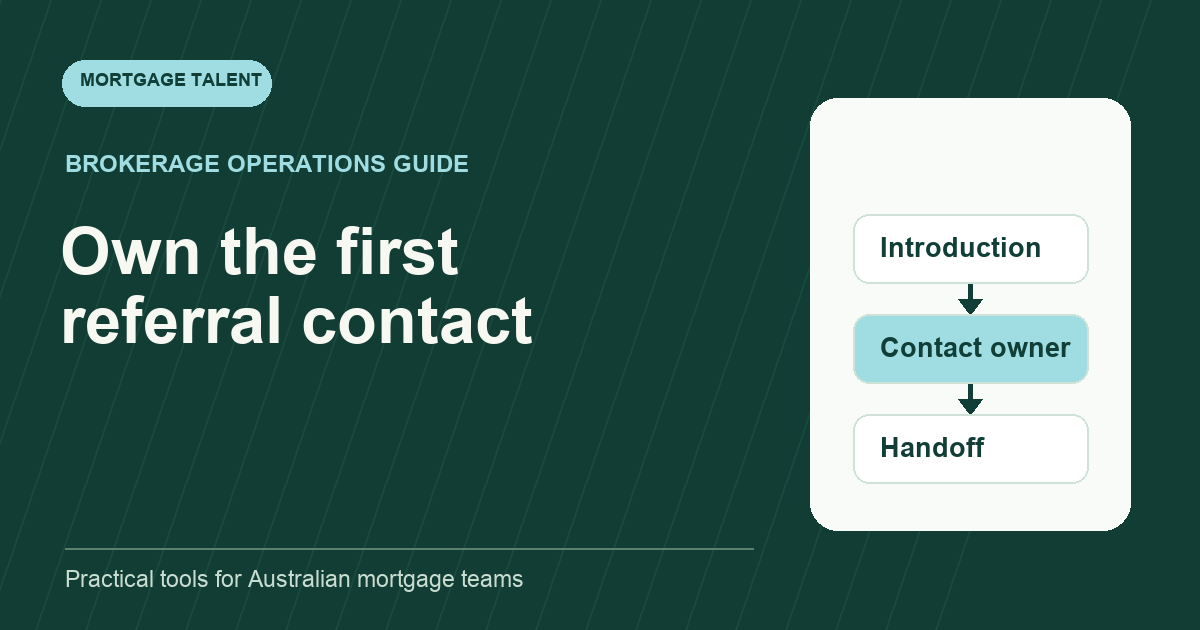
Handle an incoming mortgage referral as an introduction that needs an approved contact task, rather than as a complete borrower file. Record who introduced whom, the stated purpose, the permitted contact route and the broker who owns the next step. Check for an existing enquiry before creating another opportunity.
This is a proposed intake method for a brokerage assistant. The brokerage's responsible owner defines what may be collected, how prospective customers may be contacted and what may be shared with the partner. The worksheet does not decide those permissions or authorise a financial discussion.
Capture the introduction without expanding it
Save the original introduction in the approved system and create a concise reference. Record the partner, the prospect's supplied contact route, the stated reason for the introduction and any requested next action. Keep the original wording separate from the assistant's interpretation.
An introduction saying that someone would like an appointment is different from one saying that the partner thinks they may be interested. Ask the broker or designated owner to resolve an unclear contact instruction. Do not invent the prospect's objective or mark an appointment as requested when the introduction does not say so.
Avoid requesting financial documents as part of a routine acknowledgement unless the broker has directed that step. The initial handoff can identify the question the broker needs to answer without collecting an entire application pack.
Copy the first-contact handoff record
Scroll sideways to see all columns →
| Field | Record | Next check |
|---|---|---|
| Introduction source | Original message and time received | Can the owner read the actual request? |
| Partner reference | Known relationship and verified route | Who owns partner acknowledgement? |
| Prospect reference | Controlled record and supplied route | Is there already an enquiry? |
| Stated purpose | Attributed words from the introduction | What remains unclear? |
| Contact instruction | Approved person, channel and scope | Who may make the first contact? |
| Outcome | Attempt, response, booking or pause | Who owns the resulting task? |
Keep prospect contact and partner acknowledgement as separate tasks. A polite thank-you to the partner does not establish that the prospect has been contacted. Likewise, a booked appointment does not authorise detailed file updates to the referrer.
Use the referral-partner update workflow if an outgoing progress message is later requested. Its sharing check belongs to that later task. Do not attach a borrower document to a first-contact acknowledgement merely because the partner made the introduction.
Check for a duplicate before assigning ownership
Search within the approved CRM process using the supplied reference and permitted identifiers. Treat a similar name as a review flag, rather than proof that two records belong together. Ask the record owner about uncertain matches and preserve the introduction source.
If the prospect already has an open enquiry with a broker, link the introduction to that context and ask who should contact them next. Avoid creating a second independent follow-up sequence that may run alongside the first. Do not delete or merge records without the assigned authority and process.
When two partners introduce the same prospect, keep both sources visible and route attribution questions to the responsible owner. The assistant can identify the overlap without deciding commercial credit, referral arrangements or payment entitlement.
Prepare two short messages with different purposes
Partner acknowledgement: Thank you for the introduction. [Assigned owner] is reviewing the next contact step. We will use the agreed communication arrangement for any further updates.
Prospect contact draft: [Brokerage/owner] received an introduction from [approved reference] about [confirmed purpose]. If you would like to arrange the next conversation, [approved booking or reply route].
These are illustrative drafts for the owner to adapt and approve. Use only the context permitted by the brokerage's process. If the introduction itself is unclear, prepare an internal question before sending a prospect message.
Record what was actually sent and through which route. An undelivered message should return to an owned exception task. Avoid using a different channel automatically when the permitted route fails.
Practise with a fictional duplicate introduction
Illustrative exercise: a fictional accountant introduces a prospect using a name and email already attached to a mock open enquiry. A second fictional agent then sends an introduction for the same prospect, requesting a quick appointment. No real customer information is used.
The trainee identifies the possible match, links both introduction messages and asks the current broker owner to confirm the contact task. They do not launch two appointment requests or send either partner details from the existing mock file.
After the owner confirms one contact path, the assistant prepares the approved booking step. The appointment-intake workflow then receives the confirmed purpose, open questions and relevant source context.
Define an acceptance check for the intake handoff: the receiving broker can identify the introduction, the approved next contact and any unresolved duplicate. If that broker declines ownership, return the task to the assignment owner rather than leaving the prospect in a queue with no accountable person.
Close the intake with a visible next owner
Record whether the prospect replied, booked, asked for later contact, declined or remains awaiting an authorised attempt. Use the actual outcome rather than a general converted label. Each open branch should identify who will act next.
Review samples for duplicated outreach, missing original context and unclear partner acknowledgements. These observations can improve intake instructions without claiming a conversion result. Review assistant responsibilities or share your incoming-referral coordination work when scoping the role.
Take the next step
Explore Mortgage Talent or speak with our team about your hiring needs.