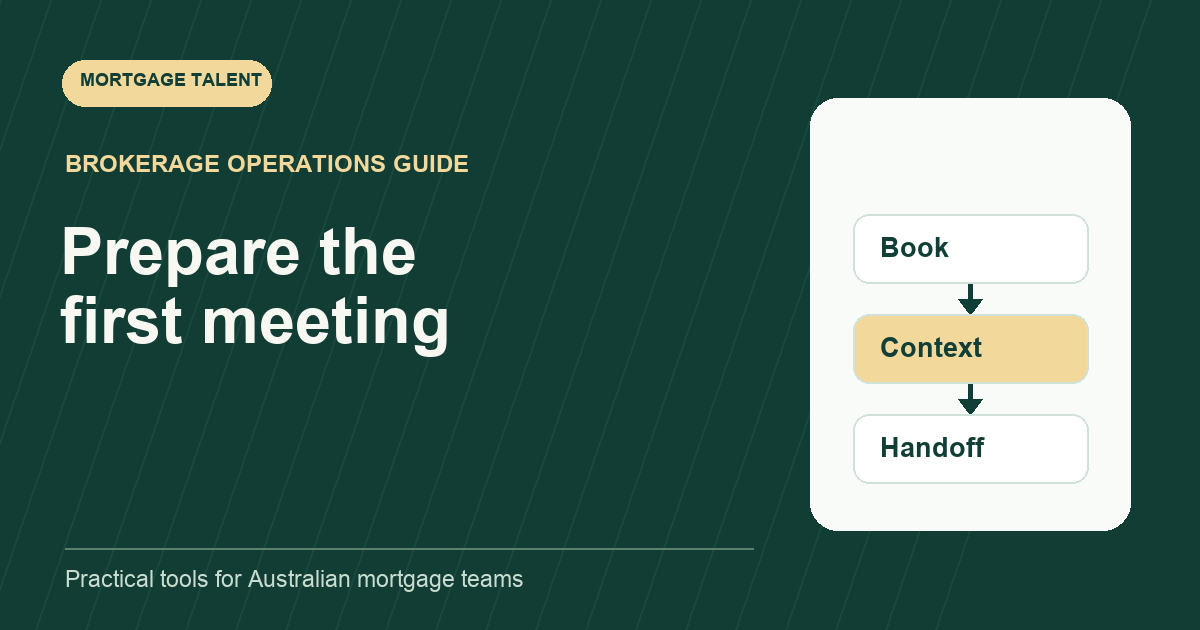
A mortgage appointment intake workflow should give the broker a confirmed meeting, the customer's stated reason for it, the available factual context and a list of questions still unanswered. An appointment in a calendar is only one part of the handoff. The assistant's task is to organise the meeting and context within the brokerage's approved process.
This guide covers appointment coordination for Australian mortgage teams. It does not assess borrowing capacity or recommend a loan. Use it to define a practical part of the mortgage broker assistant role.
Separate scheduling from the broker's conversation
Give the assistant a short set of approved scheduling prompts: the person's stated reason for contacting the brokerage, preferred contact method, availability and any timing they want the broker to know. Record the customer's words accurately rather than turning them into a financial conclusion.
If a person asks what they can borrow or which product they should choose, preserve the question for the broker. A scheduling exchange can acknowledge the topic without attempting to answer it. Record who will respond and how the question reaches them.
Agree what context the broker needs before a first meeting. Avoid requesting a broad collection of documents merely to make the handoff look complete. Use the brokerage's approved intake process and let the relevant reviewer determine the next information request.
Copy the appointment handoff fields
Scroll sideways to see all columns →
| Field | What the assistant records |
|---|---|
| Enquiry reference | The existing approved customer or enquiry record |
| Stated purpose | A factual summary of the customer's request |
| Meeting details | Date, time zone, format and location or meeting link |
| Broker and booking owner | Who attends and who coordinates changes |
| Contact preference | The customer's recorded preference in the approved system |
| Context available | References to information already provided |
| Open questions | What the customer wants the broker to address |
| Confirmation state | Proposed, confirmed, rescheduling or cancelled |
| Handoff acceptance | The broker's acknowledgement or next requested action |
Use consistent state labels. If drafting a simple workbook, Microsoft's Data Validation guidance shows how to provide allowed choices. The list supports consistent entry; it does not verify a booking or decide whether the context is sufficient.
Confirm the meeting details in one clear message
State the date, time zone, meeting format, broker and the way to request a change. Include the current approved preparation instructions, if any. Avoid a message that combines a confirmed booking with an unanswered request for the same time slot.
An illustrative confirmation reads: “Your appointment with [broker] is booked for [date] at [time and time zone] by [format]. The broker will discuss [your stated purpose]. Please let [booking contact] know if you need to change the time. Your question about [topic] is included in the meeting notes.” Replace each placeholder with checked details before use.
Check the booking in the actual calendar after any change. If a team member reschedules the customer but leaves the earlier event or meeting link active, the confirmation process is incomplete. The appointment record should make the current event clear.
Work through a fictional incomplete handoff
A new enquiry says the customer wants to discuss buying a property and can only speak during a lunch break. The assistant books a call but records “new loan lead” and no timing context. The broker opens the meeting without knowing the customer's question or time constraint.
The improved handoff records the stated purpose, the available meeting window and the unanswered questions. It references information already in the approved record. The broker can decide how to use the conversation and what further information to request. This is a fictional scenario, not an observed customer result.
The assistant does not need to make the notes sound more qualified than the customer described. Useful intake is accurate and organised. Invented certainty creates a poorer handoff than an explicit unknown.
Manage rescheduling and unanswered bookings
Give every proposed appointment a booking owner and next check. If the customer has not confirmed, retain the proposed state. Define the brokerage's own reminder and close-out process rather than treating silence as acceptance.
When a meeting is cancelled or moved, update the relevant record and tell the broker what changed. Preserve any customer question that still needs a response. A cancelled calendar event should not automatically close every open enquiry action.
Use the inbox triage guide for incoming replies and the assistant job description to name who owns this coordination work.
When several assistants share the queue, identify who can change the booking and who communicates the change. Check that the customer and broker receive the same current details.
Review handoff quality before adding more bookings
Inspect a small sample: could the broker find the meeting, understand the stated purpose and see the unanswered questions? Record missing context separately from the outcome of the broker's conversation. A large booking count does not show whether the meetings were usable.
Once the broker has provided file instructions, move into the file handoff workflow. Keep the stages connected without treating appointment intake as application preparation.
If appointment coordination is drawing time away from broker conversations, explore the mortgage talent marketplace and discuss an assistant role with Mortgage Talent. Bring the appointment volume, working windows, approved prompts and handoff standard so the role can be scoped around the real work.
Take the next step
Explore Mortgage Talent or speak with our team about your hiring needs.