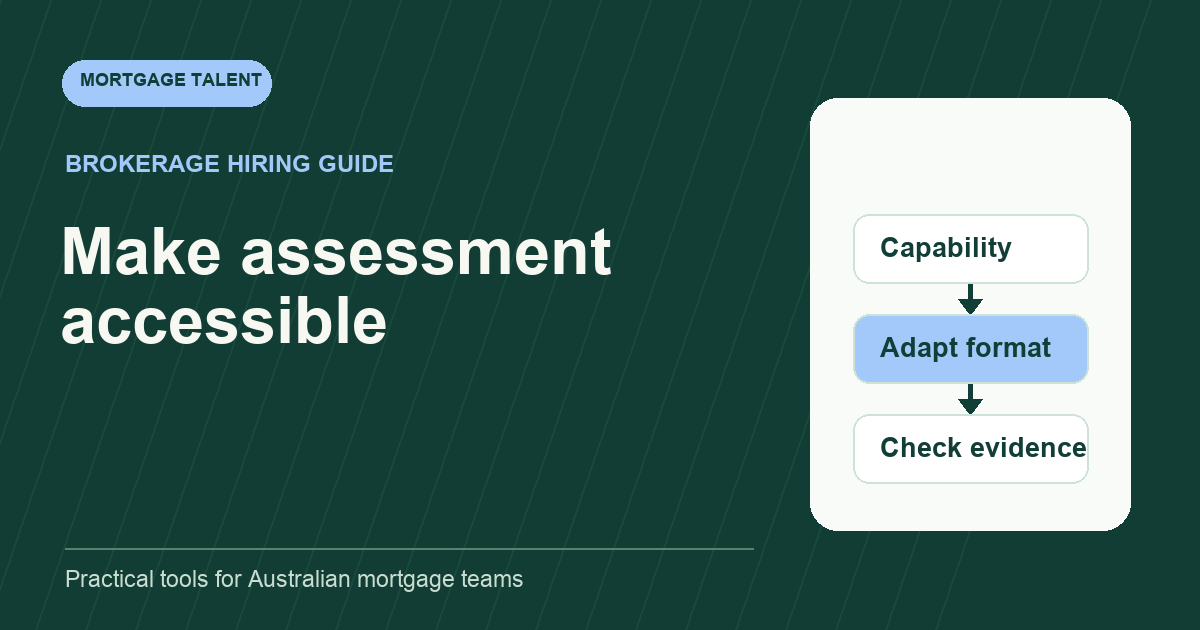
Make a mortgage support recruitment assessment accessible by deciding which job evidence you need, asking candidates about practical adjustments, and changing the assessment method where appropriate. Record the agreed format and how the assessor will judge the output. A familiar interview format is not itself evidence that someone can coordinate a mortgage file.
For a brokerage hiring an assistant or processor, the useful distinction is between the capability being assessed and the way the candidate must demonstrate it. This guide offers an assessment adaptation record and a fictional file-checking example. It does not decide an individual's legal entitlements or prescribe an adjustment for every person.
Define the capability before choosing the test format
Start with the first duties in the loan processor hiring brief. If the person must compare an application summary with supporting information, the assessment needs evidence of factual checking. If they will coordinate appointments, it needs evidence of handling a changed time and leaving a clear next action.
List what would demonstrate each capability. For factual checking, this might be identifying a conflicting figure, locating its source and explaining the unresolved question. Reading a low-quality scanned image under a short timer is a separate demand. Decide whether that demand belongs to the actual job, rather than inheriting it from an old test.
Keep genuine job requirements visible. If some work has a particular response window, describe the real task and why that window matters. Do not assume that every exercise must be timed, or that removing a timer automatically resolves every accessibility question. Have the responsible hiring owner consider the proposed method and any advice needed for the situation.
Ask about adjustments before the assessment
The Australian Human Rights Commission's recruitment guidance recommends asking all candidates whether they need reasonable adjustments at interview or assessment, providing accessible digital options and focusing assessments on essential job requirements. Its examples include extra time and alternatives where an online assessment is inaccessible.
Translate that guidance into an invitation your team can fulfil: explain the planned conversation, fictional exercise, software and output, then give a named contact for adjustment requests. Allow a candidate to raise a practical barrier privately. The coordinator should pass the request to the person who can agree the arrangement, rather than promise a change they cannot deliver.
A useful question is, “Is there an adjustment to the assessment arrangement that would help you demonstrate the work described?” Keep the discussion connected to the assessment. Avoid collecting a broad medical history to resolve a document-format or meeting-access problem.
Use an assessment adaptation record
Scroll sideways to see all columns →
| Field | Record before the interview | Assessor check |
|---|---|---|
| Job evidence | The capability and observable output | What would show it was demonstrated? |
| Planned method | Materials, platform, duration and response format | Which features are necessary for this evidence? |
| Barrier raised | The practical difficulty described by the candidate | Have we understood the request without assuming a diagnosis? |
| Agreed adaptation | The approved change, owner and confirmation | Does it give a workable route to demonstrate the capability? |
| Assessment instruction | The evidence criteria and any revised conditions | Does the panel know what it is judging? |
| Completion check | Whether the agreed arrangement was actually available | Did a delivery problem affect the evidence collected? |
This is a planning record, not a medical file or a legal determination. Store it through the approved recruitment process with access appropriate to its purpose. Keep practical arrangements distinguishable from the panel's capability observations. A candidate's request for a different format is not a score for or against their mortgage knowledge.
Work through a fictional document-checking example
Everything in this example is invented. A brokerage wants a processor to identify mismatches in a broker-approved preparation pack. Its old exercise consists of screenshots embedded in a presentation. A candidate explains that this format does not work with the tools they use to read documents.
The hiring owner reviews the intended evidence: compare two supplied figures, identify a missing page and prepare a short factual handoff. They arrange an accessible text version of the same fictional information. Before the assessment, another team member checks that the new version contains the same figures and omissions and does not accidentally label the discrepancies.
The assessor receives the revised material and the original evidence criteria. They judge whether the candidate spots the conflict and records it accurately. They do not reduce the score because the candidate used an agreed reading tool. Nor do they assume a correct response proves competence in every production system; the exercise tests only the work supplied.
Now change the scenario: the accessible file fails to open at the interview. Record that delivery failure before interpreting the candidate's incomplete response. The hiring owner should resolve the arrangement and decide how to obtain usable evidence. An assessment report that simply says “did not complete” conceals the information needed for a fair decision.
Brief the panel on evidence and arrangements
For each candidate, keep the same job-related capability question clear while recording the actual agreed assessment conditions. Consistency of criteria can coexist with different accessible methods. Avoid treating an unchanged interface or identical stopwatch setting as the only way to compare evidence.
The processor interview and fictional work sample supplies examples of factual checking and escalation criteria. Adapt its delivery deliberately rather than removing useful accuracy checks. For assistant roles, use the assistant interview exercise to assess appointment coordination and follow-through.
Ask assessors to write what they observed and what remains untested. If different conditions change what an exercise can establish, explain that limitation and choose a relevant follow-up. Do not resolve missing evidence with assumptions about confidence, health or someone else's preferred way of working.
Carry confirmed arrangements into recruitment coordination
Before confirming an interview, check that the meeting route, materials and named contact can support the agreed arrangement. Afterward, ask whether it was delivered as planned. Change the reusable recruitment instructions when the process itself created a barrier, while keeping individual candidate details within the appropriate record.
Share your mortgage support hiring brief with Mortgage Talent. Include the duties and evidence you need to assess, the interview owner and the arrangements your brokerage can provide. Confirm any specialist assessment or accessibility assistance directly rather than assuming it is included in a recruitment service.
Take the next step
Explore Mortgage Talent or speak with our team about your hiring needs.