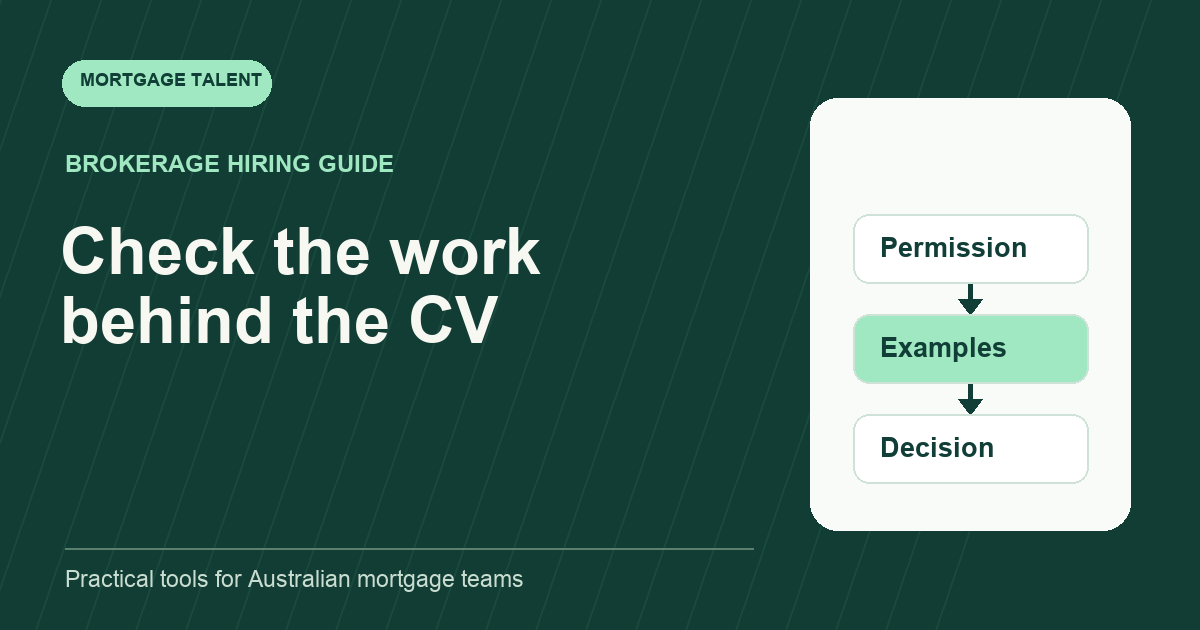
Check a mortgage support candidate's references by asking what work the referee directly observed, how much review the person needed and what happened when a file became unclear. Compare the answers with your role brief and work sample. A positive reference is useful evidence, but it does not establish competence in a different lender workflow or system.
This guide is for Australian brokerage owners hiring an assistant or loan processor. It provides an ordinary recruitment conversation and evidence record. Where the proposed role involves authorisation or mortgage broking activity, have the responsible licensee determine the applicable reference process before using a general form.
Start with the claims that affect your hiring decision
Take three material claims from the candidate's application: the queue they owned, the systems they used and the level of supervision under which they worked. Turn each into a question that a former manager can answer from observation. “Experienced in Australian mortgages” is too broad to verify without this breakdown.
Use the shortlist comparison scorecard to identify the evidence still missing after interview. If the candidate prepared application data but never handled lender requests, record those as separate capabilities. Do not let a strong reference for administration stand in for unobserved processing work.
Fair Work's reference-checking form includes the referee's relationship to the applicant and job-specific questions. The mortgage examples below are an original extension of that structure, rather than an official mortgage qualification test.
Arrange a reference conversation the candidate understands
Agree with the candidate whom you intend to contact, when and about which role. Ask whether contacting a current employer would create a problem before arranging the call. Record the agreed contact and purpose in your recruitment process. Verify the referee's identity and working relationship through a suitable business contact route.
Explain your proposed duties briefly so the referee can distinguish relevant experience from a different job. Request examples without borrower names, documents or financial details. Keep the conversation focused on work accuracy, follow-through, communication and supervision; unrelated personal information is not useful evidence for the brief.
ASIC's reference-checking protocol guidance sets out a separate process for specified prospective representatives and relevant mortgage brokers, including written consent and prescribed requests. Do not assume a general support-role reference call satisfies that process. Ask the licensee to decide its application to the actual role.
Ask questions that reveal the work and review arrangement
- What tasks did you directly supervise, and during which period?
- Which mortgage systems did the person use, and what did they do in each?
- What did a completed task look like before you accepted it?
- Describe a factual mismatch they identified and how they raised it, without customer details.
- How did they keep an unanswered document or lender request visible?
- Which outputs still needed your review before sending or submission?
- What coaching or process support helped them perform reliably?
- Which duties in our proposed brief would require additional training?
Follow broad praise with a neutral request for an example. “Reliable” might mean regular attendance, accurate entries or clear handovers; these are different observations. If the referee did not observe a duty, mark it unverified. Avoid leading questions that invite a simple endorsement of your preferred candidate.
Ask about the operating environment as well as the person. Someone may have performed well with a dedicated reviewer and a small queue. That matters when your proposed role involves several brokers and limited overlap. The purpose is to understand the conditions under which the evidence was observed.
Record observations separately from conclusions
Scroll sideways to see all columns →
| Candidate claim | Referee observation | Hiring implication |
|---|---|---|
| Owned document follow-up | Maintained requests and escalated missing responses | Compare with your follow-up queue and exercise |
| Used a named CRM | Entered notes; manager handled workflow configuration | Configuration experience remains unverified |
| Worked independently | Routine entries reviewed each afternoon | Plan reviewer availability rather than assuming no review |
| Handled lender requests | Referee did not observe this duty | Seek another relevant observation or training plan |
Add the date, referee relationship and interviewer to your private record. Summarise what was actually said without upgrading an inference into a fact. Keep candidate information within the authorised recruitment process and record access according to your organisation's policy.
Resolve a contradiction before deciding
Illustrative example: a candidate says they owned application submissions. Their referee explains that the candidate assembled packs and a broker performed the final portal action. This does not automatically mean the candidate was dishonest; the phrase may have described the whole team process. Ask the candidate to explain the steps they personally performed.
Then compare the explanation with the assistant interview exercise or your processor sample. If final submission experience is essential, treat the gap explicitly. If preparation experience is sufficient, write the review boundary into onboarding. Do not manufacture certainty by averaging conflicting accounts into a score.
A referee may decline to answer or give only dates and a position title. Record that limitation. Decide whether another relevant referee, an additional fictional task or a narrower starting scope can resolve the question. A missing answer is not itself evidence of poor performance.
Turn the result into a practical hiring brief
Conclude with supported capabilities, unresolved questions and the supervision needed for your initial duties. Decide who owns each follow-up and what must be resolved before a hiring decision. Avoid promising that a reference check eliminates future performance risk.
For an outsourced arrangement, agree who conducts the checks and what evidence the brokerage can review. Keep provider screening, your own reference observations and your hiring decision distinguishable. If you need a shortlist, share your mortgage support role brief and explore the Mortgage Talent marketplace. Bring the actual duties, systems and reviewer arrangement so relevant experience can be assessed against the work.
Take the next step
Explore Mortgage Talent or speak with our team about your hiring needs.