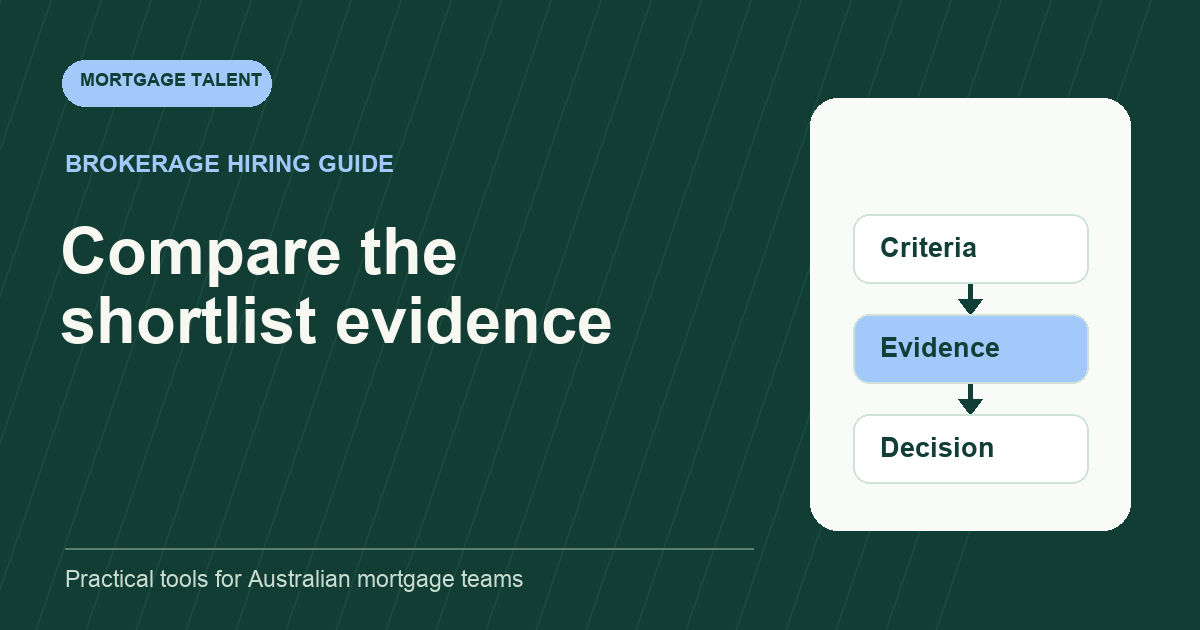
Compare a loan processor shortlist against the same role criteria, then separate the strength of each answer from the confidence you have in its evidence. Record unknowns explicitly. A high total with an unresolved essential requirement should trigger a follow-up, rather than an automatic hiring decision.
This scorecard helps an Australian brokerage bring interview notes, fictional work samples and systems discussions into one decision record. It is a constructed management tool, not a validated predictor of job performance. Start with the scope on your loan processor hiring brief.
Agree on criteria before comparing names
Choose criteria tied to the assigned work: preparation accuracy, exception handling, written updates, task tracking and relevant systems use. Set their importance before discussing candidates. Otherwise a memorable interview can change the yardstick after the fact.
The Australian Government's recruitment guide describes essential and desirable selection criteria. Use your role's requirements to make that distinction. This scorecard does not set employment terms or replace your recruitment checks.
For each essential criterion, define the evidence that would satisfy it. “Accurate” could mean that the candidate identifies the mismatches in a fictional pack and references the conflicting items. “Organised” could mean that an open-request list shows owners and next actions. If the criterion cannot be observed, rewrite it.
Copy the comparison record
Scroll sideways to see all columns →
| Criterion | Importance | Evidence to compare | Unanswered question |
|---|---|---|---|
| Factual accuracy | Essential | Same fictional pack exercise | Which discrepancy was missed? |
| Exception handling | Essential | Written note and explanation | Did they flag uncertainty or guess? |
| Request tracking | Role dependent | Prioritised fictional task list | What happens after no reply? |
| Customer update writing | Role dependent | Same factual update task | Is status distinguished from a promise? |
| Systems tasks | Essential or trainable | Explanation of actual tasks performed | What needs local training? |
| Working overlap | Practical requirement | Confirmed schedule discussion | Is reviewer overlap available? |
Add a candidate column for each person, with a short evidence note in every cell. Keep “not tested” separate from “did not meet the requirement”. An unasked question tells you about the assessment process, not the candidate's ability.
Match loan processor experience to your file mix
A claim such as “five years in Australian mortgages” leaves an important question unanswered: which parts of which files did the candidate personally prepare? Add a file-mix check to the shortlist record when your role includes different document or coordination tasks. Record the work, when it was last performed and the review it received. Years of experience provide context; they do not establish each capability.
The matrix below applies the role-specific selection criteria already defined in your brief. Assess the evidence for the actual job tasks rather than treating broad industry exposure as proof of readiness.
Scroll sideways to see all columns →
| Work in your role | Task evidence to request | What remains unverified |
|---|---|---|
| PAYG application preparation | Compare a fictional summary with supplied source documents and the mock checklist; identify a conflicting date or figure. | Finding a mismatch does not establish experience preparing a different document mix. |
| Self-employed document organisation | Index fictional documents by entity and reporting period; flag an item supplied for the wrong entity or period. | Orderly indexing does not establish income-assessment or lender-policy expertise. |
| Construction progress-request coordination | Keep two fictional stage requests distinct; connect each response to the correct request and document version. | Preparing the initial application does not establish later progress-request experience. |
These rows are assessment examples, not lender document requirements. Choose only tasks in the proposed role. PAYG and self-employed describe income contexts, while construction describes a lending purpose and workflow; they are not mutually exclusive file categories. One file can involve both self-employed document preparation and construction-stage coordination.
Record personal contribution and recency
Beside each relevant row, ask: “What did you personally produce, when did you last do it, and who checked it?” Record the answer separately from the observed exercise. Someone who collected documents, someone who indexed them and someone who reviewed the pack contributed different work. Do not collapse those contributions into a single “handled self-employed files” tick.
Use the self-employed pack workflow and construction progress-request guide to define the preparation tasks. Give every candidate assessed for the same requirement the same fictional materials, instructions and acceptance criteria. Request descriptions of previous work without borrower details or former employers’ documents.
Resolve a file-mix gap before choosing
Illustrative example: a brokerage needs routine application preparation plus recurring construction-stage coordination. Candidate A describes several years preparing applications but has not coordinated progress requests. Candidate B describes that coordination work, but the claim has not been tested. Neither account resolves the requirement yet.
The manager gives both candidates the same fictional two-request exercise. One identifies that a lender response belongs to the earlier request; the other marks both requests complete. Record that specific difference. Then decide whether the role requires this task at commencement or whether a named reviewer can support training. Keep any unresolved essential requirement visible instead of allowing a strong general score to conceal it.
Use scores as a conversation aid
A simple scale can make differences discussable: 1 means the observed work needs substantial correction, 2 means it meets parts of the task, 3 means it meets the stated standard, and 4 means it meets the standard with a clear explanation of exceptions. These labels are illustrative. Adapt them to the exercise and describe what each means before use.
Alongside every score, mark evidence confidence as direct observation, described experience or untested. A confident interview statement is not the same as an observed work sample. Do not turn an untested criterion into a zero just to complete a spreadsheet.
If you use weights, show the arithmetic and keep the underlying notes. A weighted total can help order a discussion, but it should not hide an essential gap. Record the person responsible for the final decision and the evidence they still need.
Work through a fictional two-candidate comparison
Candidate A has used the brokerage's CRM and speaks fluently about the process. Their fictional exception note omits a conflicting date. Candidate B needs CRM training but spots the conflict, references both source items and leaves a clear question for the reviewer. Neither candidate is a real person; the example demonstrates how to reason about different evidence.
If the role mostly prepares factual packs, Candidate B's observed accuracy may deserve more attention than software familiarity. If the role requires immediate ownership of a particular workflow, Candidate A's system knowledge may matter more. The brief determines the trade-off. The scorecard itself cannot decide which operating need is more important.
The team can give both candidates a short follow-up on the same untested criterion. It can also estimate the actual manager time available for training. That produces a decision with stated conditions instead of a vague judgement about overall fit.
Resolve disagreements with evidence
Have interviewers complete their notes before a group discussion. Compare the work that led to each score. When two reviewers disagree, identify whether they saw different evidence, interpreted the standard differently or weighted the role differently. Each issue calls for a different correction.
Use the existing processor interview exercise when assessment evidence is missing. Avoid inventing a second test that measures a different task for only one candidate. Record new evidence separately so the decision history stays understandable.
Keep the original task instructions beside the results. If the brief changed during interviews, mark which requirements changed and ask whether earlier candidates need the same opportunity to address them. A neat final table is less useful if its rows silently combine different versions of the role. Preserve enough context for another hiring manager to understand the comparison later.
Carry the decision into onboarding
Write a short decision note: the chosen candidate's relevant strengths, confirmed gaps, training arrangement and the manager who will check the first work. An accurate shortlist record is useful when setting the first-month onboarding plan.
If both candidates fit a different role from the vacancy, revisit the assistant and processor comparison. A hiring decision should solve the defined problem. Explore the mortgage talent marketplace or discuss the evidence your shortlist needs with Mortgage Talent when preparing the search.
Take the next step
Explore Mortgage Talent or speak with our team about your hiring needs.