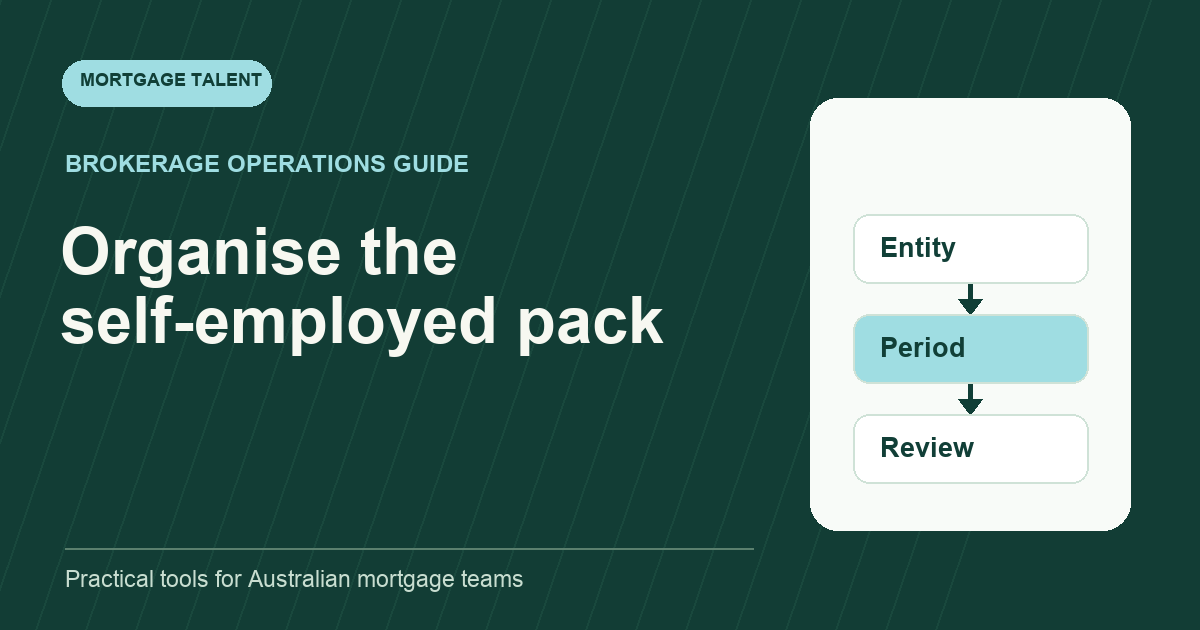
Support staff can organise a self-employed mortgage document pack by recording the broker-approved requirements, indexing each item by entity and period, and returning factual gaps for review. Keep document receipt, completeness checking and the broker's assessment as separate steps. A tidy pack does not establish an income figure, lender acceptance or loan approval.
This workflow helps Australian brokerages scope administrative and processing support for document-heavy files. It starts after the broker has identified the requirements for the case. Use the document request tracker to manage collection; use the pack index below to organise what has arrived.
Start from the case-specific document list
Ask the broker to identify the entities, periods and document types the pack should contain. Record the source and date of those instructions. If a request only says “financials”, clarify which documents and period are intended before sending a broad request to the customer.
NAB's self-employed home loan page gives examples including personal and business tax returns, financial statements and bank statements. Those examples illustrate document types; use the broker's current case-specific list rather than assuming that every lender or borrower needs the same pack.
Keep the worker's task explicit: collect against an approved list, organise factual labels and raise differences. Income interpretation, adjustments, loan structure and suitability decisions belong with the responsible broker or reviewer. The document index should make their review easier without silently making those decisions.
Build an entity-and-period index
Scroll sideways to see all columns →
| Field | What to record | Example entry |
|---|---|---|
| Entity label | The name shown on the source document. | Fictional Example Trading Pty Ltd. |
| Document type | The received item's actual type. | Financial statement pack. |
| Period | The start and end dates stated on the item. | Year ended 30 June, as labelled. |
| Version and location | Received date and the approved document location. | Version 2, received Tuesday. |
| Completeness observation | Missing pages or unclear labels. | Contents lists a page not supplied. |
| Reviewer question | The factual point needing clarification. | Confirm whether this replaces version 1. |
| Review status | The reviewer decision and date when provided. | Awaiting broker review. |
The entries are illustrative. Do not use them as a list of lending requirements. Link each row to the approved file location instead of reproducing financial information across multiple working documents. Keep the original source available for the reviewer.
Check labels and completeness before interpretation
Compare the stated entity and period with the approved request. Identify missing pages, unreadable sections or duplicate versions. Record the observation precisely: “page 4 is absent from a five-page sequence” is more useful than “financials incomplete”. If the document itself is ambiguous, ask the reviewer rather than changing its label to make it fit.
Use distinct states for received, organised, queried and reviewed. A file attachment can be received while still leaving the requested item unresolved. Avoid marking the whole pack complete just because a folder contains enough files to look substantial.
If the broker changes the requested period or entity scope, update the request record and index together. Keep a note of what changed and which previous rows remain relevant. This prevents the assistant and processor from following different lists.
Walk through a fictional version conflict
Imagine a fictional company pack contains two files with similar names. One says “draft” and one says “final”, but the received dates are reversed. The customer's message does not explain which should be used. A personal return covers a different period from the request. These are made-up administrative observations, not an example of a lending decision.
The support worker keeps both versions identifiable, records the labels and received dates, and asks the broker which item should be treated as current. The period mismatch becomes a separate question. The worker does not choose an income figure from whichever version appears more favourable.
The handoff can say: “Two versions indexed; current version not confirmed. Personal return period differs from request. No pack-complete status recorded. Broker clarification requested for the next review session.” That gives the reviewer a concise route to the evidence.
Return a review-ready pack with open questions
Provide the index, the original approved request, unresolved questions and a short change summary. Group questions by entity or period so the reviewer can answer them without reconstructing the whole folder. State what has been checked and what remains outside the support task.
Use the broker-to-processor handoff to carry instructions into the preparation stage. If the reviewer asks for additional items, return them to the document tracker with an owner and next check date. Keep the index current as new versions arrive.
For repeat pack problems, the file quality sampling guide can help your manager examine comparable completed work. Sample administrative accuracy separately from the broker's credit assessment, and keep the sample limits clear.
Should the index repeat every financial figure?
Keep the index focused on finding and reviewing the documents unless the broker has assigned a specific factual extraction task. Repeating figures without context can create another version to reconcile. When extraction is assigned, record the source document, page, period and reviewer question with each observation. Never turn a copied figure into an assessed income value by changing its label. The broker should be able to trace the observation to the original item before using it.
Hire for the preparation work you need
Describe the role through observable tasks: entity-period indexing, version tracking, factual discrepancy notes and concise review handoffs. Test those tasks with fictional documents and an answer guide. Ask candidates to explain where they would stop and seek direction.
Explore loan processor support and the mortgage talent marketplace for relevant file-preparation experience. Discuss your self-employed pack workflow with the document mix and reviewer needs, so the proposed role matches the work rather than implying independent credit decisions.
Take the next step
Explore Mortgage Talent or speak with our team about your hiring needs.