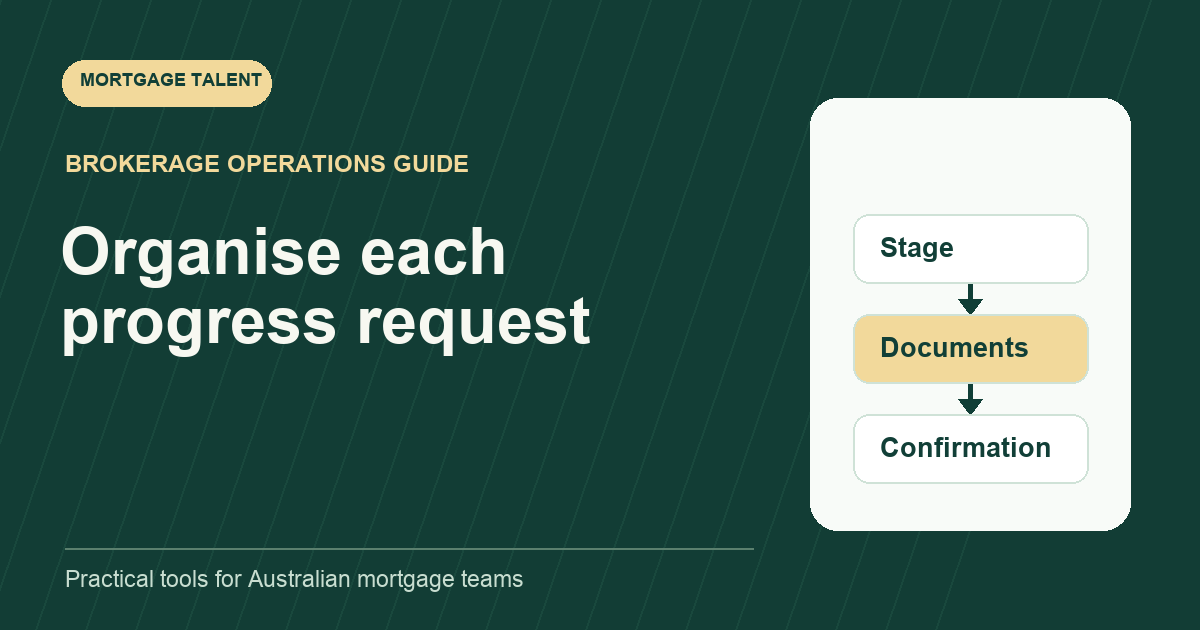
A mortgage support team can organise construction progress-payment administration by maintaining one request record for each stage, tracking the lender-specific document list and returning unresolved items to the broker. Separate a prepared request, a submitted request and a confirmed payment event. Support coordination does not certify building completion or authorise a payment.
This workflow is for Australian brokerages defining administrative assistance around construction files. The lender's current instructions and the broker's approved directions govern the actual case. The document request tracker provides the collection foundation; the stage register below keeps repeated requests distinguishable.
Use the lender's actual stage instructions
Ask the broker to identify the relevant request process, documents and reviewer. Record the source and check date with the file. Do not reuse another lender's checklist simply because the stages have similar names. Keep the approved directions available to the worker preparing the next request.
ANZ's construction loan instructions describe a progress-payment instruction form, a builder's invoice and possible inspections. These are examples from ANZ's process, not a universal document list. Confirm the requirements for the particular facility through the responsible broker and lender.
The support role can track whether requested items have arrived and which questions remain. It should not infer that an invoice proves the relevant construction work is complete, or decide how a variation or amount difference should be funded.
Create one record for each request
Scroll sideways to see all columns →
| Register field | Purpose | Example observation |
|---|---|---|
| File and request identifier | Distinguish this request from earlier or later stages. | Fictional file C, request 2. |
| Stage label | Use the label in the approved instructions. | Label copied from current request directions. |
| Required items | Track the case-specific list and its source. | One item still awaiting receipt. |
| Document versions | Show which received version is being reviewed. | Revised invoice received Tuesday. |
| Review point | Name who resolves questions before submission. | Broker review scheduled. |
| Submission and response | Record the approved route and factual reply. | Request acknowledged; further information asked for. |
| Confirmed event | Separate a verified outcome from an assumption. | Awaiting confirmation from responsible party. |
The examples are fictional. The register coordinates evidence; it is not a payment ledger or a substitute for the lender's systems. Keep actual documents in the approved location and preserve the link between the request and the source version reviewed.
Manage versions and changed requests explicitly
When a new invoice or instruction arrives, record what changed and ask the reviewer whether it replaces the earlier item. Do not silently overwrite the prior version or assume that an amended amount has been accepted. A short change note helps the broker find the difference without reconstructing the message history.
If the stage label differs across documents, note the discrepancy and ask for clarification. If there is a query about a variation, inspection, amount or payment destination, return it to the named responsible person through the brokerage's process. The support worker's useful action is a precise question with linked evidence.
Keep customer follow-up focused on the item the broker has approved for collection. Avoid expanding the request list based on a generic article. That can create unnecessary work or contradictory instructions while leaving the actual missing item unresolved.
Walk through a fictional revised-invoice example
Imagine the team receives a revised builder invoice while an earlier version is awaiting broker review. The new email says “updated” without explaining the change. The stage request has not yet been submitted. All details in this example are constructed, and no payment amount or required timeframe is asserted.
The assistant indexes both versions, records the changed label or amount as a factual observation and asks the broker which version should be used. The request remains awaiting review. The assistant does not combine the two versions, approve the difference or tell the customer that payment is on its way.
After the reviewer supplies directions, the worker updates the register and prepares the approved pack. A submission receipt is recorded separately from any later confirmation. If the lender asks another question, the register shows the owner and next check point for that question.
Write updates that match the evidence
Use concise state descriptions: “documents being collected”, “prepared for broker review”, “submitted, response pending” or “additional item requested”. Avoid a broad “complete” label until you specify what has actually been completed. A document pack can be complete while the lender's decision remains pending.
Use the factual status update patterns to draft messages for review. Identify the last confirmed event and the next action. Any expected timing should come from a current responsible-party response, with uncertainty retained where appropriate.
Escalate an approaching verified date with the open requirement and owner. Repeatedly asking for progress without identifying the missing item rarely gives the broker a useful decision. Keep the enquiry specific to the request being coordinated.
Can several stage requests share one open task?
Keep a separate identifier and next action for each request even if the same person coordinates them. A reply about one stage should not mark every request complete. Link any shared issue, such as a revised instruction, to the affected requests and let the reviewer determine its effect. This makes it possible to report what is known about each request without implying that an earlier acknowledgement applies to a later pack.
Define the support skill and supervision needed
Before assigning this work, test version tracking, request indexing and escalation with a fictional stage pack. Record the worker's readiness in the support skills matrix. Introduce unfamiliar workflows with a named reviewer and a manageable scope.
Explore processor hiring or assistant hiring according to the duties you need covered. Browse the talent marketplace and discuss construction-file coordination support with the document tasks and approval boundaries, so the role remains tied to factual administration.
Take the next step
Explore Mortgage Talent or speak with our team about your hiring needs.