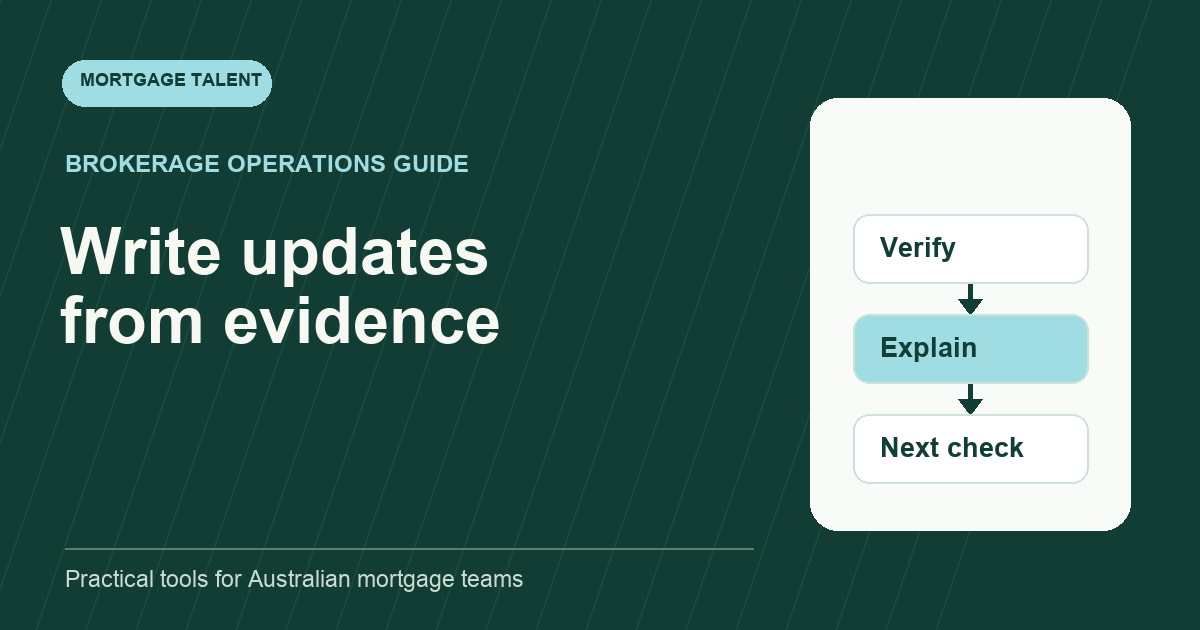
A useful mortgage application update tells the customer what has been verified, what is still outstanding, who is acting next and when the team will check again. Keep an observed status separate from an estimated outcome. Support staff should prepare and send messages within the brokerage's agreed review and communication process.
The four templates below are fictional writing patterns for Australian mortgage teams. Replace the placeholders with checked file facts and the approved wording for the situation. They complement the work described on the mortgage broker assistant hiring page.
Build the update from a current evidence check
Check the source of the status and its timestamp before drafting. A note from yesterday may no longer reflect the current file. Confirm that any outstanding action is still required and that another team member has not already sent an update.
Bankwest's broker help centre describes a tracker for application stages. Use the relevant lender's current information as one source for a factual update. Do not assume a portal label answers every customer question or applies identically across lenders.
Record the preparer, reviewer where required, final message and next promised check in the approved workflow. If the customer asks a question outside the sender's assigned scope, route it to the broker and acknowledge who will respond.
Template 1: a verified stage change
Hi [name], we checked your application at [time and date]. The current recorded stage is [verified wording]. The next open action is [action], which [owner] is handling. We will check for a further update by [time and date] and let you know what has changed. Please contact [broker or team contact] if your circumstances or timing have changed.
Use this when the stage genuinely changed and the team has evidence for the wording. Explain a technical label in language the reviewer has approved. Do not replace the label with a more optimistic term simply because it sounds clearer.
Check whether the next action belongs to the customer, your team or another party. If the owner is uncertain, resolve that internally before presenting it as settled. A message can be concise while still naming the unresolved question.
Template 2: an outstanding customer action
Hi [name], the open item on your application is [specific item from the approved request]. Please use [approved channel] to provide [clear description]. If the request is unclear or the item is unavailable, let [contact] know so we can ask the broker about the next step. We will check receipt by [time and date]; receipt will then need the relevant review.
Request one clear action or a short organised list. Refer to the current approved checklist, rather than creating additional requirements from memory. The document tracker keeps request, receipt and acceptance distinct.
A customer may reasonably think an upload means an item is complete. This wording explains the next check without asserting that the document will be accepted. Route questions about alternative evidence to the nominated reviewer.
Template 3: no material change since the last check
Hi [name], we checked the application at [time and date]. There has been no verified change to [specific open stage or item] since our last update. [Owner] has [factual action taken, if any]. Our next check is planned for [time and date]. We will tell you when we have new information; please let [contact] know if there is a change to your timing.
An unchanged-status update can still be useful if it shows a real check and a next action. Avoid saying “everything is on track” when the team has not established that. If a deadline is at risk, obtain the broker's direction and communicate the checked facts.
Do not manufacture activity to make the message appear reassuring. A truthful statement that a question remains open is more usable than a vague claim that the application is progressing well.
Template 4: a question needs the broker
Hi [name], thanks for your question about [topic]. I have passed it to [broker], who will review it with your file context. [Broker or team] will respond by [agreed check or response time]. I will keep the question open until we have the response for you.
Use an agreed time that the team can support. The sentence should not promise a substantive answer by a time nobody has accepted. If the review time is not yet known, state that the team is arranging it and name the next check.
The inbox workflow can assign the question and preserve ownership. A forwarded email without an owner is an incomplete handoff.
Use a send checklist and a fictional example
- Is the status supported by a current source and timestamp?
- Is the recipient and file reference correct?
- Does the message identify the action and owner?
- Is any promised check recorded in the team's work queue?
- Has the required reviewer accepted the wording?
- Does the final message avoid an unsupported approval or timing promise?
In a fictional file, an assistant sees “documents received” and drafts “your application is approved”. The send check catches the mismatch and replaces it with the observed status and next review action. The example is illustrative; no lender result or customer outcome is claimed.
After settlement, switch to the post-settlement care workflow. If preparing consistent updates is the role you need to fill, explore the mortgage talent marketplace and discuss assistant support with Mortgage Talent using your actual communication scope and review arrangement.
Take the next step
Explore Mortgage Talent or speak with our team about your hiring needs.