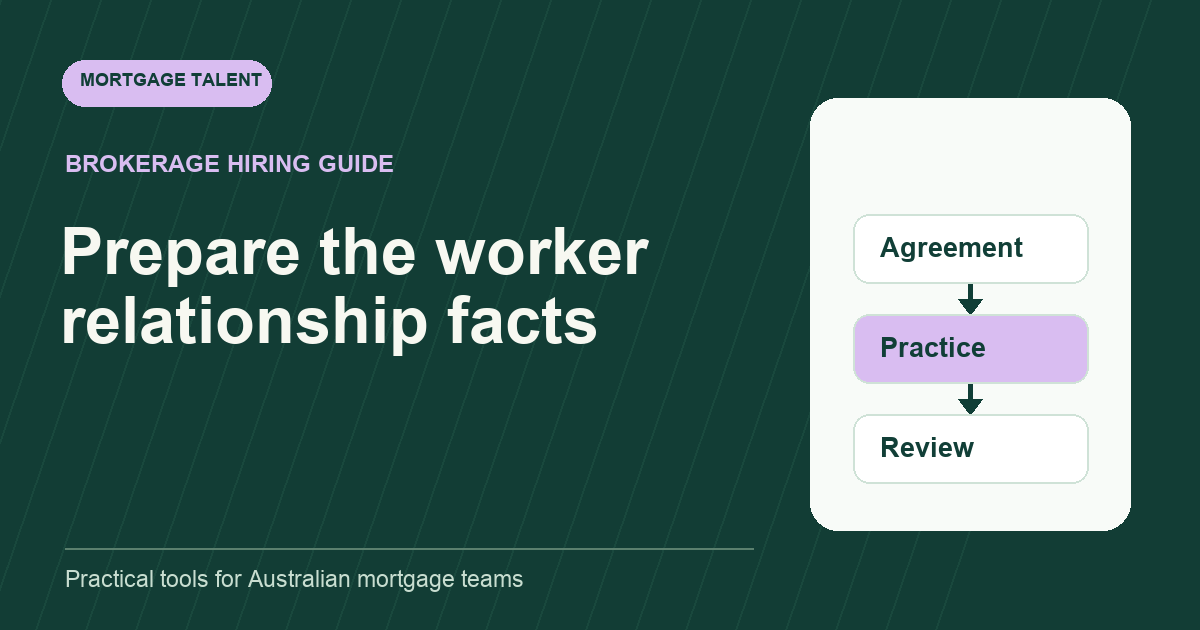
Before engaging a mortgage support worker as a contractor, assemble the proposed agreement and a plain description of how the work will actually run. Take both through the appropriate classification review. Do not let a contractor label, an ABN or an invoice replace that assessment.
For Australian brokerage owners, the useful preparation is an evidence pack: who engages whom, what has been agreed, who directs the queue and what happens in practice. The worksheet below helps prepare that discussion. It is not a calculator that determines employment status, and it does not decide the treatment of an overseas engagement.
Separate the service model from the worker relationship
A brokerage may be buying recruitment assistance, engaging a person directly or contracting with a supplier for an agreed service. Draw those relationships before discussing classification. Identify the exact entities and the individual whose relationship is being reviewed.
The recruitment versus managed outsourcing guide helps map who recruits, engages, supervises and invoices. That operating map does not itself decide whether a person is an employee or contractor. Keep the commercial service question and the worker-classification question distinguishable.
For example, a supplier agreement may describe support capacity while a separate arrangement governs the worker. Ask the responsible adviser which relationships require assessment and what information they need. Do not assume your brokerage directly employs the worker, or that a supplier's involvement settles every responsibility.
Confirm the applicable test before using a checklist
Fair Work's contractor guidance explains that different tests apply depending on factors including when the test is applied and the type and location of the engaging business. It distinguishes the start-of-relationship test from the whole-of-relationship test. Have the appropriate reviewer establish which test applies to the actual arrangement.
This matters before using a generic internet checklist. A description aimed at one business type or period may not answer your own question. Do not silently apply the Australian guidance to a worker in another jurisdiction without reviewing that engagement's circumstances.
Under the whole-of-relationship test described by Fair Work, the real substance, practical reality and true nature of the relationship matter, including the terms and how the contract is performed. Fair Work lists factors such as control, financial responsibility and risk, tools, delegation, hours and continuing work. It also says an ABN or issuing invoices does not automatically make someone a contractor.
Build a six-part evidence pack
Scroll sideways to see all columns →
| Area | Proposed arrangement | Evidence to take to the reviewer |
|---|---|---|
| Parties and scope | Who engages the person, for which work? | Entity details, agreement, role or service description |
| Direction | Who decides the method, priorities and changes? | Allocation instructions and an ordinary-day example |
| Risk and payment | What is paid for, and who bears the identified risks? | Actual terms, invoicing basis and correction arrangements |
| Tools and access | Who supplies equipment and controls system use? | Equipment terms and the practical access arrangement |
| Delegation | Can work be delegated, and what happens in practice? | Substitution terms and how a proposed replacement is handled |
| Hours and continuity | How are work times and continuing work arranged? | Agreed windows, expected duration and actual pattern |
Use one column for agreed terms and another for observed practice. Where an engagement has not begun, label the second column “proposed practice” rather than inventing a history. Mark unknowns as questions for the reviewer. Do not turn the rows into points where three ticks produce a legal conclusion.
Include complete relevant terms, not selected clauses that support a preferred answer. If discussions or later variations affect the arrangement, identify them and explain their status. The person advising you needs the real arrangement, including where the documents and intended workflow do not align.
Test a fictional processor arrangement
Everything in this example is invented. A brokerage proposes directly engaging a processor under an agreement headed “contractor services”. The operations manager plans to assign a daily queue, specify fixed availability and require the individual to perform every task personally. The payment discussion refers to monthly invoices, but correction responsibilities have not been settled.
The owner prepares the contract, proposed work pattern and unresolved payment questions for review. The pack records who would set the queue and how changes would be communicated. It does not conclude that invoicing proves contracting or that fixed availability alone decides employment.
Now change one fact: the arrangement is actually a service agreement with a provider that allocates work among its own team. The owner redraws the relationships and asks the reviewer what additional agreements and practices must be considered. They do not reuse the conclusion from a different direct engagement merely because both services prepare mortgage files.
The exercise exposes missing facts before anyone tries to classify the arrangement. Its purpose is to improve the question taken for advice, not to recommend either model or provide a disguised answer key.
Revisit the review when the arrangement changes
Fair Work's contractor guidance notes that changes to how work is performed can affect the outcome under the whole-of-relationship test. Keep a practical review trigger when proposed changes alter direction, hours, substitution or other relevant facts.
For example, an arrangement described as a defined preparation service might gradually become an open-ended role taking instructions throughout the day. Record the actual change and seek the appropriate review before treating the earlier assessment as permanently settled. A revised job title alone will not explain what changed.
Use the scope-change record for operational changes while keeping the classification decision with the appropriate owner. Retain the relevant instruction and follow-up in the approved business record; do not ask an assistant to interpret employment law while managing the queue.
Resolve the engagement before completing the hiring brief
Finish with the actual proposed work, identified parties, review outcome and unresolved conditions. Confirm who is responsible for employment, tax, commercial and cross-border advice where those questions arise. This guide supplies preparation, not a complete treatment of those separate obligations.
Discuss your mortgage support hiring brief with Mortgage Talent. Bring the work and service responsibilities you need, and confirm the proposed engagement arrangements directly. Do not assume that recruitment services include an employment-status determination or specialist legal advice.
Take the next step
Explore Mortgage Talent or speak with our team about your hiring needs.