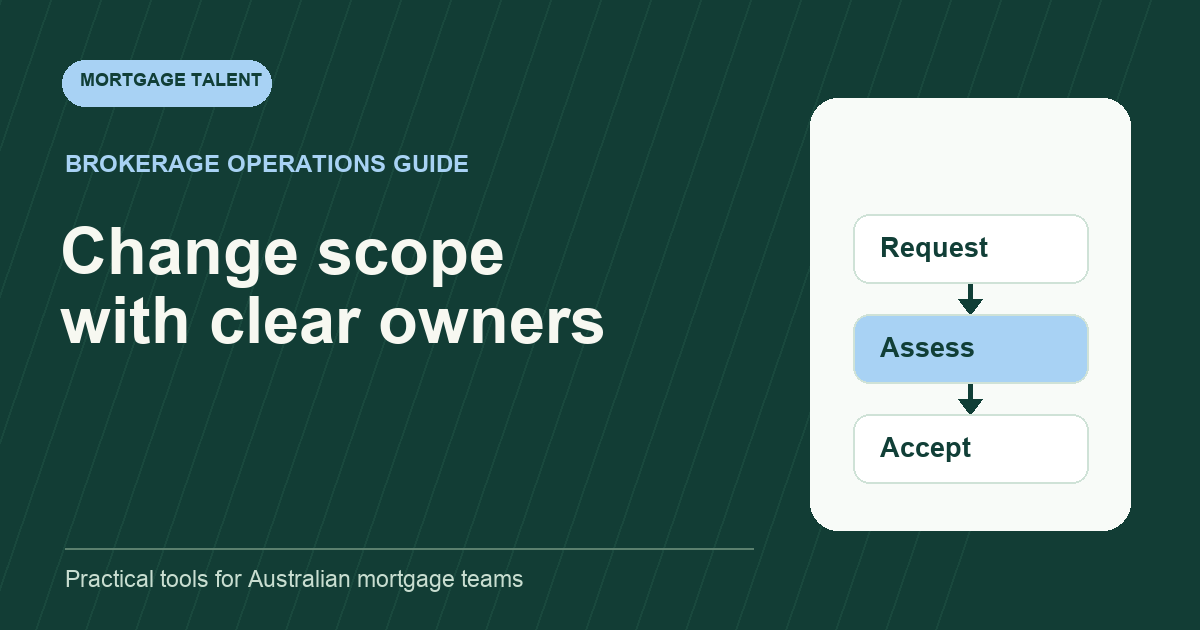
Manage a mortgage support scope change by recording the proposed duty, why it is needed, what it will replace or add, and who will approve its introduction. Check instructions, capability, system dependencies and review capacity before treating the change as routine work. Confirm acceptance after a small, defined trial.
This is an operational change record for Australian brokerages using in-house or outsourced support. It helps clarify the work but does not amend an agreement by itself. Use the service expectation template to see the existing scope and your authorised process for any commercial or contractual changes.
Distinguish a one-off exception from a recurring change
A broker might ask an assistant to prepare an unfamiliar report once, or expect that report every week. The first request may need a limited instruction; the second changes ongoing workload and supervision. State which is intended so the person does not inherit a recurring duty through an ambiguous message.
Describe the current task and proposed task in concrete terms. “Provide more settlement support” is difficult to review. “Maintain the owner-and-evidence checklist for the five specified coordination steps and return unresolved items to the broker” gives the team something observable to assess.
Identify the trigger for the change: an observed gap, a new system step, a revised workflow or a stakeholder request. Keep the problem separate from the proposed solution so the reviewer can consider a smaller or different change.
Copy this change request template
Scroll sideways to see all columns →
| Field | What to write |
|---|---|
| Current scope | The duty and instruction version in use today. |
| Proposed change | The new input, action and expected output. |
| Reason and evidence | The observed gap or specific request behind the proposal. |
| Workload effect | Added effort, displaced work and new review demand. |
| Dependencies | Instructions, approved systems, training and available reviewer. |
| Approval owners | People who can approve duties, setup and terms as applicable. |
| Trial and acceptance | Defined sample, review date and evidence of completion. |
| Fallback | Who retains the work if the change is not accepted. |
Give the request a date and identifier. Keep its state visible as proposed, being assessed, approved for trial, accepted or declined. Approval for a trial should not silently become approval for every future file.
Assess the effect on the whole workflow
Ask where the new duty receives its input and where its output goes. Identify a named person at each handoff. A task may be simple for the worker but create a new review queue for the broker, or depend on information another team does not yet supply consistently.
Estimate effort using a small sample of the actual task where possible. Label any initial estimate as an assumption. Record which current duties will move or pause if the worker has no spare time. Avoid treating a request as free capacity simply because no new job title is involved.
Use the skills matrix to identify the evidence and practice required. Your approved process should determine any changes to authority, access or terms; the worker should not expand those themselves to complete an informal request.
Try a fictional change to lender follow-up work
Suppose a fictional processor currently prepares packs and records lender responses supplied by the broker. The team proposes adding factual follow-up enquiries. The change introduces a new contact step, a writing standard and a queue of replies to manage. This is a constructed planning example, not a claim about permitted activity in a particular arrangement.
The workflow owner defines the enquiries covered, the approved contact route, the reviewer and the stop points for substantive questions. The manager estimates the added coordination effort and identifies which existing task will move. A small trial begins only after the relevant approvals and instructions are in place.
At review, the team checks whether each enquiry had an owner, whether replies were recorded accurately and whether unresolved questions reached the broker. If those conditions are not met, the duty returns to its previous owner while the missing instruction or training is resolved.
Update the instruction and tell affected people
Once the change is accepted, update the working SOP with the new steps, inputs, owner and review point. Record the effective date and replace obsolete directions in the place workers actually use. Do not leave a chat message as the only source of the new process.
Tell the people supplying inputs and reviewing outputs what changed. Ask the worker to demonstrate the new handoff. Keep a short record of acceptance and any remaining conditions. If an agreement needs to change, route that separately through the people authorised to review and approve it.
Schedule a follow-up after the duty becomes routine. Compare observed effort with the estimate and check whether the displaced task has a stable owner. A successful trial can still reveal a longer-term workload conflict.
What if an urgent request cannot wait for the full trial?
Define a time-limited exception with an authorised owner, a narrow output and a review point. Record which ordinary work is displaced and who retains responsibility after the exception ends. Then decide whether a recurring change is needed through the normal assessment process. Urgency can justify a changed sequence, but it should not erase the duty boundary or convert an isolated favour into an unreviewed permanent responsibility.
Use recurring changes to reconsider the role
A series of small additions may eventually describe a different role. Review the accumulated scope rather than approving each new duty in isolation. Determine whether the gap is preparation, coordination, review or management, then update the hiring brief around that evidence.
Explore workforce solutions and the mortgage talent marketplace with the current and proposed responsibilities. Discuss the support scope your team needs when the changes justify additional capacity or a different mix of experience.
Take the next step
Explore Mortgage Talent or speak with our team about your hiring needs.