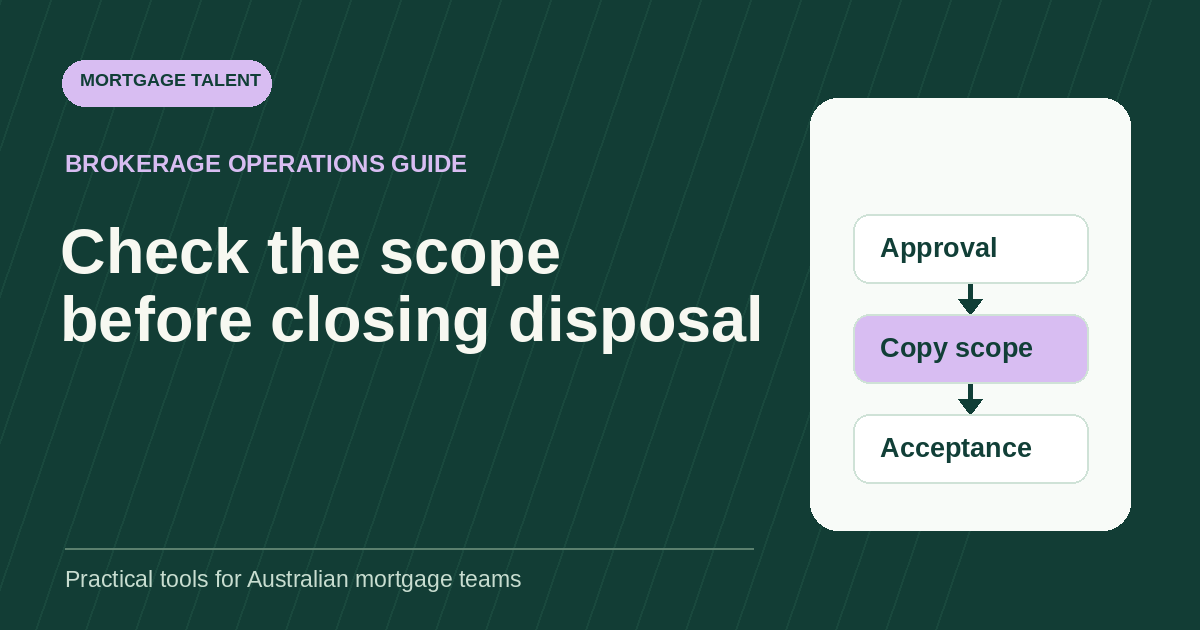
Before mortgage support staff remove old records, have the responsible owner approve the exact records or copies, the retention and hold decision, and the permitted method. Then check the returned evidence against that instruction. A date-filtered list identifies candidates; it does not establish what may be removed or what has actually been destroyed.
This guide helps a brokerage principal or operations manager brief administrative records support. Its completed fictional exercise separates eligibility, execution and acceptance. Your records, privacy and licensee advisers determine the applicable requirements; system owners determine the technical treatment. Nothing here authorises deletion of a real file.
Get the retention decision before assigning removal
For APP entities, OAIC's APP 11 guidance requires reasonable steps to destroy or de-identify personal information when no permitted need remains, subject to the Commonwealth-record and Australian-law or court/tribunal retention exceptions. Ask your privacy adviser which obligations apply to your entity.
ASIC's RG 273.164 recognises other recordkeeping obligations. RG 273.168 explains that retention can depend on the loan term, interest-only period and refinancing. Those paragraphs do not supply a universal disposal date for every mortgage record.
In your instruction, name the person who can resolve retention classification, the relevant trigger event and any preservation hold. Support can collect the references that person needs. A folder creation date, a closed CRM stage or a withdrawn application should not be substituted for their decision.
If the immediate problem is inaccurate fields or duplicate candidates, start with the controlled CRM cleanup plan. For this disposal exercise, the owner must separately identify the item eligible for removal. Keep an unapproved candidate in the review queue.
Make the approved instruction specific enough to check
Use the following six-part instruction as an operational proposal. The records owner approves its substance and the system owner confirms that its references describe the actual environment. Do not fill gaps by assuming that every brokerage uses the same storage locations.
- Item and classification: identify the exact record or copy, its record class and the approved schedule version used by the owner.
- Trigger evidence: record the policy event and the evidence the owner accepted as establishing it.
- Retention and holds: reference the owner's continuing-need and retention review, including the status of relevant preservation holds.
- Authorised treatment: specify retain, review pending, remove a named redundant copy, or dispose of a named record set.
- Covered locations: list the copies and repositories the system owner actually confirmed, with required retained records explicitly excluded.
- Action and acceptance: name the approval reference, permitted operator, approved technical method and person who checks the result. Specify the approved location, owner and review reference for the acceptance evidence that must remain.
Where the goal is whole-record disposal, ask the system owner to establish the complete held-copy scope. Where the goal is removing a redundant export, identify the authoritative record that must remain. A link labelled “customer file” is too ambiguous for either instruction.
The document version-control method can help identify the exact item and its relationship to other versions. A superseded label still needs the separate disposal decision above. Keep the existing document references rather than creating another uncontrolled copy for this exercise.
Work through four candidates with different decisions
Every identifier, fact and outcome below is fictional. The exercise assumes that the responsible owner has made the stated decisions under an approved policy. It supplies no actual retention period and does not establish eligibility for your records. All four candidates appeared in the same old-record review.
Scroll sideways to see all columns →
| Candidate | Evidence and owner's decision | Permitted support response |
|---|---|---|
| DEMO-A: closed loan file | The owner records active preservation hold HOLD-A. Retain the file; disposal is not authorised. | Exclude it from this disposal run and return future review responsibility to the hold owner. |
| DEMO-B: temporary review export | The required authoritative record is complete in the approved archive. The owner confirms no separate need to retain COPY-B and approves removal of that copy only under APPROVAL-B. | Pass COPY-B's exact reference to the named operator. Preserve the archive and the specified disposal evidence. |
| DEMO-C: withdrawn application | The folder date is known, but the relevant trigger event and retention classification remain unconfirmed. No disposal approval exists. | Return those two questions to the records owner. Keep the candidate pending without removing anything. |
| DEMO-D: approved record set | After its retention and hold review, the owner issues APPROVAL-D. The system owner confirms D-CRM, D-VENDOR and the specific D-BACKUP as the held-copy scope. | Coordinate the approved operator requests and collect results for each identified location. |
The first check is whether the coordinator applies all four decisions accurately. Someone who removes every old item fails that check. So does someone who deletes DEMO-B's archive after receiving an instruction about its temporary export. The distinction is visible in the approved objects, without asking the worker to interpret retention law.
Match execution evidence to the authorised copy set
OAIC paragraph 11.39 covers all held copies, including archives and backups. Paragraphs 11.46 and 11.50 address documenting disposal and verifying destruction on third-party hardware.
For the exercise, each response must identify its approval, actual object and result. The reviewer compares those references with the instruction. A generic provider statement about its usual deletion service cannot answer whether the particular item was handled.
Scroll sideways to see all columns →
| In-scope item | Returned evidence | Acceptance result |
|---|---|---|
| COPY-B only | The named operator confirms the approved secure removal. The reviewer matches COPY-B to APPROVAL-B and checks that the required archive remains accessible. | Accept the limited-copy disposal. The customer's whole record has not been deleted. |
| D-CRM | The system owner supplies exact identifiers, the approved action result and its verification record. | This location is completed within APPROVAL-D. |
| D-VENDOR live copy | The provider identifies the relevant live object and confirms the approved deletion; the system owner verifies the returned scope. | This location is completed within APPROVAL-D. |
| D-BACKUP | The provider's response addresses the live object but does not establish the treatment of this named backup copy. | Unresolved. Whole-record disposal remains incomplete. |
Keep the required acceptance evidence in its approved location. Use object references and decision records rather than attaching the disposed customer material to the completion report. The records owner should specify what evidence is retained and how that evidence is itself handled.
As a further fictional check, suppose a response cites APPROVAL-D but names a different export, D-EXPORT-2, rather than D-BACKUP. Matching the approval number alone does not resolve that object mismatch. The coordinator returns it to the system owner and leaves D-BACKUP unresolved until evidence addresses the approved object.
Leave the unanswered backup question open
OAIC describes destruction as making information irretrievable. Its beyond-use route concerns limited circumstances where electronic destruction is impossible: no ability or attempt to use or disclose, no access for another entity, appropriate technical, physical and organisational security including access controls, logs and audit trails, and a commitment to take reasonable steps to destroy when possible.
Return D-BACKUP to the system owner with APPROVAL-D and the provider's actual response. Ask what treatment is technically available, which approved method applies and what evidence will establish the result. The coordinator should not invent an expiry date or relabel restricted ordinary access as completed destruction.
If the provider identifies a technical limitation, the responsible owners must determine the appropriate next instruction and review point. In this exercise, that answer has not arrived. The correct report therefore remains: D-CRM and D-VENDOR verified; D-BACKUP unresolved. Removing the open row would conceal the remaining work.
Use the result to define the support role
The completed handback accounts for four candidates: one retained under an active hold, one awaiting owner decisions, one limited-copy disposal accepted and one whole-record disposal still incomplete. It makes no claim that all four records were deleted. Give the unresolved decisions named owners and an agreed next check.
Use the exercise when briefing or assessing a records-support worker. Ask them to explain why COPY-B can be closed while DEMO-D cannot, and to write the next question for D-BACKUP. Look for exact references, accurate status and escalation to the correct owner. Speed is less useful if the person reports an outcome the evidence does not establish.
A suitable administrative brief can cover factual inventory, preparation of owner decisions, coordination with authorised operators and reconciliation of returned results. Keep legal applicability, retention decisions and technical disposal authority with the designated people. Specify the systems and permissions already approved for the role; this exercise grants no additional access.
To discuss your records-support hiring brief, bring the proposed outputs, the decision and system owners, and the boundaries illustrated here. That gives Mortgage Talent a concrete staffing conversation. It does not ask a support hire to provide privacy advice or certify data erasure.
Take the next step
Explore Mortgage Talent or speak with our team about your hiring needs.