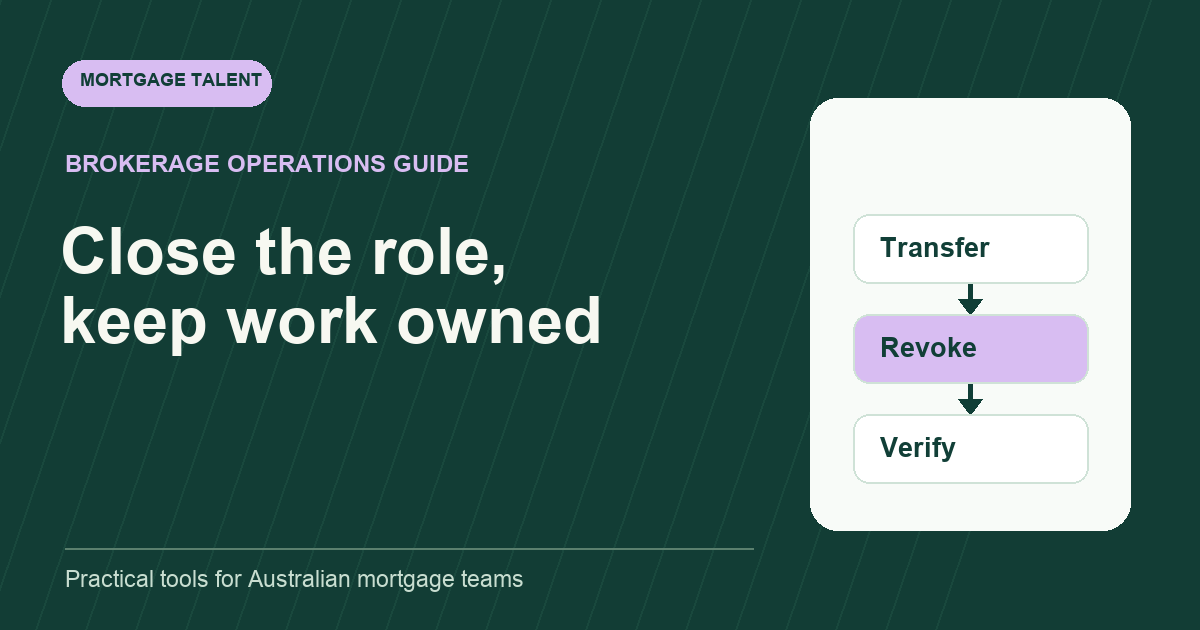
Offboard mortgage support staff through two coordinated workstreams: transfer every open task to an accepted owner, and have the relevant administrators remove access that is no longer required. Verify both outcomes. A completed handover does not prove access is closed, and a disabled account does not prove that customer follow-up has an owner.
This checklist covers the operational exit of an individual assistant or processor. Handle employment, contractual and record-retention decisions through the responsible people in your organisation. Set the operational timing around those decisions rather than using this guide to decide a worker's legal entitlements.
Name the coordinator and the exact change point
Assign one coordinator, the manager receiving the work and the administrators responsible for each system. Record the agreed date and time when the person's duties and access change, with a time zone. If the departure needs immediate action, follow your organisation's authorised incident or exit process rather than waiting for a routine meeting.
List the systems the person actually used: CRM, application portal, email, file storage, team chat, calendars, support-provider workspace and any approved automation. Include access granted through groups and shared resources. Start with the access permissions matrix, then check the current administrator records.
Distinguish accounts owned by the person from business resources they administer. A form, shared inbox or recurring task may need a new business owner before the personal account is closed. Ask the administrator how the system handles that transfer; do not assume account removal will preserve every linked resource.
Transfer open work at task level
Inventory active files, unanswered requests, promised updates, preparation awaiting review and future appointments. Give each item a next action, due point, evidence reference and receiving owner. Include new work arriving during the exit window so it does not continue to land with the departing worker.
Ask the receiving owner to confirm access to the current instruction and explain the next step. Record the acceptance date. If a task lacks usable context, keep it on the coordinator's unresolved list with a person responsible for resolving it. Do not label an export or forwarded inbox as a completed transfer.
The provider transition plan explains queue reconciliation for a wider team change. For an individual exit, focus on the person's actual work and recurring responsibilities, including small follow-ups that may not appear in the main application pipeline.
Use one exit record with separate completion evidence
Scroll sideways to see all columns →
| Area | Required outcome | Evidence owner |
|---|---|---|
| Active tasks | Receiving owners accept each next action | Operations manager |
| New work routing | Inbox, forms and queues route to current owners | Workflow administrator |
| Business resources | Necessary resource ownership transferred | System administrator |
| Accounts and rights | No-longer-needed access removed or suspended | Each system administrator |
| Credentials and sessions | Applicable revocation steps completed and checked | Security or identity administrator |
| Records and devices | Preservation and return handled under approved policy | Responsible records or device owner |
Record what the administrator checked, when and in which system. Avoid recording passwords, tokens or unnecessary personal information in the checklist. An entry saying “IT done” is difficult to review if several independent services are involved.
Close access through the responsible administrators
The Australian cyber security system-access guidelines recommend removing or suspending access when the legitimate business requirement ends and revoking credentials no longer required. Treat this as a security reference for your exit plan; it does not establish that every ISM control applies as a legal obligation to every brokerage.
Have administrators check the controls each service supports, including individual accounts, group membership, shared folders, delegated inbox rights and active authentication artefacts. Record exceptions with a named owner and reason. Business-resource continuity should be handled by transferring ownership, rather than casually retaining a former worker's login.
If a shared credential existed, ask the authorised administrator to address it under the organisation's security process. The coordinator should track the outcome without sending credentials through the handover. Do not ask a departing worker to give their personal account password to the replacement.
Reconcile a fictional departure before closing it
Illustrative example: a processor leaves with seven open work items. Six receiving owners accept the next actions, but one lender response is linked only in a private message. The coordinator assigns that unresolved item to the manager, who obtains the current evidence through the approved system. All seven items now have a visible next owner.
The administrator separately finds that the processor owned a recurring reminder rule. The rule's business ownership is transferred and its route checked before the account closure is confirmed. The example is fictional; it shows why task acceptance and system ownership require separate checks.
At the chosen reconciliation time, compare the original task inventory with completed, transferred and unresolved items. Explain changes caused by work arriving or finishing during the window. A matching total alone is insufficient if the wrong task has been counted twice.
Check the first working day after the exit
- Are new messages and tasks reaching a current owner?
- Can receiving staff find the evidence referenced in the handover?
- Are any reminders or calendar invitations still assigned to the departed person?
- Have administrators confirmed the expected access state?
- Does every unresolved exception have a next check and owner?
Close the operational exit only when the two workstreams are evidenced or their remaining exceptions have an explicit management decision. Preserve the relevant business records under your approved policy; do not delete loan or recruitment records simply to make the checklist look complete.
Mortgage Talent connects role context with agreements, onboarding and team operations. If your exit process relies on disconnected lists, book a people operations walkthrough and review the connected platform. Bring the systems, task owners and closure evidence you need to keep visible.
Take the next step
Explore Mortgage Talent or speak with our team about your hiring needs.