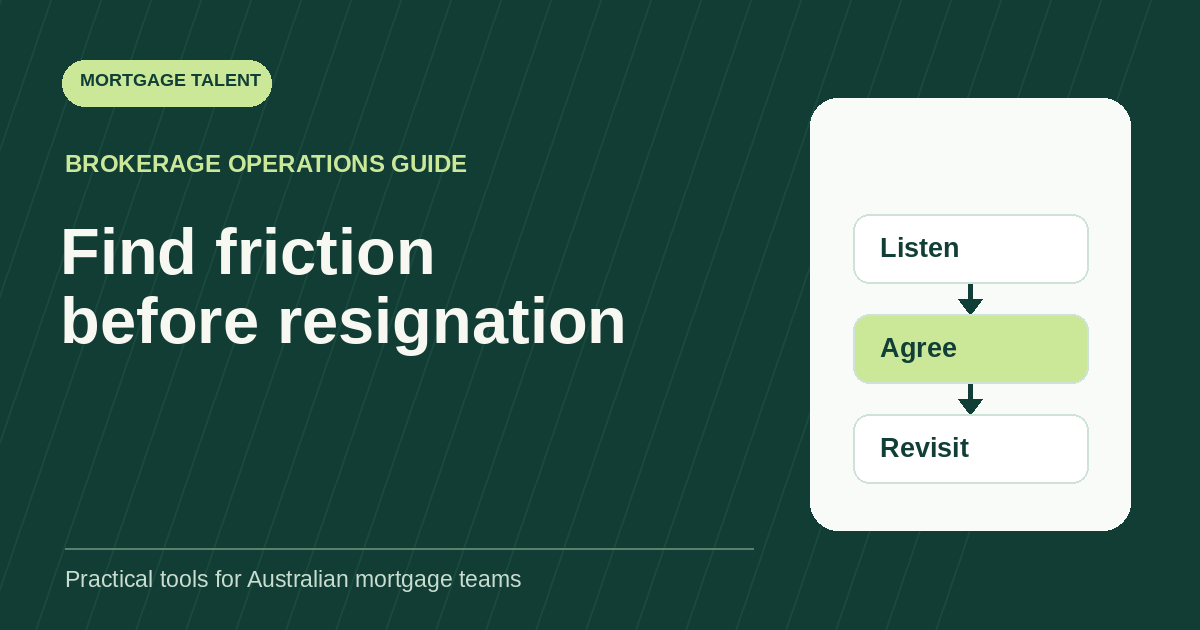
A mortgage support stay conversation gives an experienced assistant or loan processor room to explain what makes their current work worth continuing and what is wearing them down. Ask about specific recent experiences, identify changes the brokerage or provider can actually make, and return with evidence that those changes happened. Do this while the person is still working with you, rather than waiting for a resignation.
This guide offers a practical conversation and worksheet for Australian brokerage owners working with outsourced support. It is an original management proposal, not a tested retention programme or a prediction that someone will stay. Its purpose is to uncover preventable friction in the existing job.
Make the invitation safe to answer honestly
Choose a private time inside the person's agreed working window. Explain the purpose in advance: “I'd like to understand which parts of working with our brokerage are going well and which make your day unnecessarily difficult. We'll agree what we can change and come back to anything we cannot resolve today.”
Keep this conversation separate from file-error coaching and productivity reviews. An experienced processor should not have to defend last week's completion count before explaining a problem with the work. If their main concern is a future role, arrange a separate discussion using the career progression guide.
For provider-managed staff, confirm the appropriate arrangement for the conversation. Identify who can change brokerage instructions and who handles people-management matters. Offer an established alternative contact if the concern involves the person leading the discussion.
Explain who will see the notes and why before taking them. Do not promise absolute confidentiality or make candid answers a condition of continued work. Let the person decline a question or send a considered answer later. Keep borrower details out of the conversation record.
Begin with the experience you should preserve
Ask: “Which part of working with this team would you miss if it changed?” Follow with a recent example. The answer might be a broker who explains unusual document requests, a predictable working window, or the satisfaction of returning a well-organised review pack.
Record the feature in the person's words. “Likes the team” is less useful than “Can ask the lead broker to explain a request without being made to feel slow.” Ask what might accidentally remove that benefit, such as routing all questions through a new intermediary.
Then ask: “What has made you question whether this working arrangement is sustainable for you?” Leave space for an answer. Do not demand details of job searches or an assurance of loyalty.
Explore three kinds of mortgage-work friction
Workload that is invisible in the allocation list
Ask the person to describe a recent difficult working window. What arrived unexpectedly? What did they stop? Which apparently small task kept returning? A list of six files may conceal repeated document chasing, interrupted preparation and several unresolved lender questions.
Safe Work Australia's job demands guidance includes too much work in too little time among examples of high demands. It distinguishes occasional busyness from severe, prolonged or frequent exposure. Use the conversation to understand the pattern; do not diagnose the person or treat this worksheet as a safety assessment.
A useful follow-up is: “When a settlement-related request interrupts your document follow-ups, who tells you what can wait?” Listen for work the assistant absorbs silently because nobody accepts the trade-off.
Instructions that force the person to guess
Ask: “Where do two people expect different things from the same task?” For a processor, one broker might expect a draft pack returned with open questions while another expects those questions resolved before seeing it. The friction is the unspoken difference.
Safe Work Australia's role clarity guidance identifies contradictory instructions, unclear reporting lines and unclear priorities as examples. Ask which instruction the person could actually find at the time, rather than explaining what you intended.
Access to a reviewer when the answer matters
Ask: “Which question is hardest to get answered, and what happens while you wait?” Distinguish access to a system from access to an authorised person. A working CRM login does not resolve a conflicting broker instruction.
Safe Work Australia's poor support guidance includes unavailable supervisors, unclear guidance and slow decisions among its examples. In your discussion, locate the missed opportunity for help and the effect on the person's day. Keep the existing review boundary in place while improving access.
Copy the stay conversation worksheet
Complete these fields together in your approved people-management record. Use general task descriptions or authorised references instead of customer names, balances or document copies. The worksheet records what the worker said and what management will do; it does not assign a flight-risk score.
Scroll sideways to see all columns →
| Field | What to record |
|---|---|
| Keep | One feature the person values; a recent example; what might disrupt it. |
| Friction | The person's description of workload, instructions, reviewer access or another concern. |
| Recent episode | The task situation, when the difficulty occurred and whether it has happened repeatedly. |
| Effect on their day | Work displaced, uncertainty carried, repeated chasing or another effect they describe. |
| Requested change | What would make a noticeable difference from their perspective. |
| Decision owner | The named brokerage or provider contact who can approve the change; dependencies still unresolved. |
| Commitment | Specific action, responsible person, due date and what happens pending a decision. |
| Sharing boundary | Who needs the action summary; what information is necessary; any concern about attribution. |
| Return conversation | Date, evidence to check and the question to ask about the person's experience after the change. |
Read the note back before finishing. Ask: “Have I captured the problem you meant, or have I turned it into an easier problem for me to solve?” An assistant asking for fewer conflicting requests may not be helped by another checklist.
Turn one fictional concern into an owned repair
Illustrative scenario: an experienced outsourced processor says they enjoy preparing application packs but dread the final hour of their shift. Two brokers send urgent clarification requests then become unavailable. The processor repeatedly reopens the same work without knowing which request takes priority.
The owner first checks their understanding: “The concern is being left responsible for a response while the decision you need is unavailable. Have I got that right?” The processor confirms and asks for a reliable answer route before the end of their window.
The brokerage owner agrees to arrange a named reviewer and backup for that window, and to tell both brokers who resolves conflicting priorities. The provider contact checks that the proposal fits the agreed working arrangement. Nobody asks the processor to extend their day or infer an approval.
The note records who will confirm coverage, when confirmation is due and the existing escalation route until it is ready. At a follow-up after the revised arrangement has operated, they check whether the promised reviewer was actually reachable and ask whether the end-of-day pressure changed. The broker approval queue guide can support implementation without turning the stay conversation into another queue meeting.
Return with an answer, including when it is no
Separate actions you can approve now, decisions awaiting the provider and requests you cannot currently meet. Give unresolved requests a decision date. Avoid promising a new role, remuneration change or working arrangement controlled by someone else. Handle those matters through the responsible party's process.
If the person raises a serious conduct or safety concern, use the appropriate reporting and support route promptly. Do not leave it sitting in a routine retention worksheet until the next catch-up.
At the return conversation, distinguish delivery from usefulness: “We introduced the review window. Did it actually make your day easier?” A calendar entry proves that something was scheduled; the person's account helps establish whether it solved the difficulty they raised.
Close the agreed action when its outcome is clear, or revise it openly. A positive conversation is not a commitment to stay. If the discussion reveals a genuine gap in support capacity, discuss your assistant requirements with Mortgage Talent using that defined gap, while continuing the repairs owed to the current team.
Take the next step
Explore Mortgage Talent or speak with our team about your hiring needs.