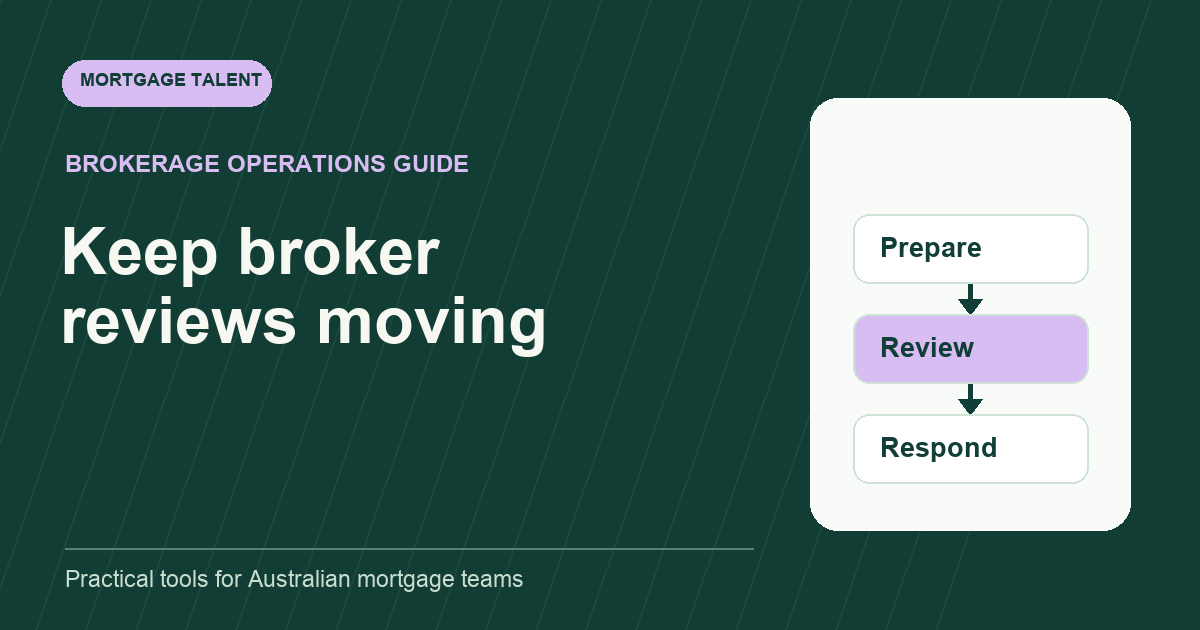
A broker approval queue works when every entry states the exact decision required, links the supporting evidence, names the reviewer and shows when the answer is needed. Separate ready decisions from incomplete requests, then agree review windows with an urgent exception path. Adding support capacity will not move work that is waiting for an unavailable reviewer.
This is a coordination method for prepared work. Your brokerage sets who may approve each activity. It complements the broker-to-processor handoff by making the return trip to the reviewer visible.
Define what qualifies for the review queue
A request is ready when the reviewer can understand the question and find the relevant evidence without reconstructing the file. Use a short packet: file reference, requested decision, source items, unresolved conflict, consequence of delay and proposed next step. A proposed step can help explain the question; it is not an approval.
Keep incomplete requests in a preparation state with an owner and missing-input list. Otherwise the reviewer spends their available window identifying omissions. Do not remove incomplete requests from visibility altogether: they still need a next action and may carry an approaching deadline.
Write one decision per entry when separate answers could arrive at different times. Combining three questions into “please review file” makes it harder to know which part is resolved. Group linked questions only when one answer truly controls all the next steps.
Copy the decision-packet fields
Scroll sideways to see all columns →
| Field | Purpose |
|---|---|
| Request reference and file reference | Find the request without duplicating the file |
| Decision required | State the question in a sentence |
| Evidence references | Point to the current source records |
| Preparation owner | Resolve missing inputs |
| Reviewer and backup | Show who can answer and who arranges cover |
| Needed-by time and reason | Explain the actual dependency |
| State | Preparing, ready, in review, answered or returned |
| Decision record | Capture the answer, date and linked next task |
Use the approved system of record for source documents and decisions. A queue summary should point to it. If you prototype state fields in Excel, Microsoft documents Data Validation lists. A list standardises labels; it does not establish reviewer approval.
Agree review windows and an exception path
Ask each reviewer when they can actually review prepared work. Make the window visible to the support team, and identify a backup arrangement for absence. The right pattern depends on the reviewer and queue; this guide does not prescribe an industry response time.
Define how a genuinely urgent request is raised and what evidence it must include. “Urgent” should explain a deadline and dependency. If every request bypasses the queue, examine whether priorities, review capacity or request preparation are failing. Repeated interruptions are evidence to investigate, rather than a reason to abandon the record.
Align review timing with the team's service expectations. Keep the clock for preparing the request separate from waiting for a broker answer. That makes both delays discussable without blaming the wrong person.
Calculate review capacity with fictional inputs
Suppose six ready packets arrive each day and the team estimates eight minutes of review per packet. That is 48 minutes of review demand. If only 30 minutes are available, the plan contains an 18-minute daily gap before interruptions or returned questions. These figures are illustrative and are not mortgage staffing benchmarks.
A further processor may prepare more packets but cannot create the missing reviewer time. The manager can reduce unnecessary requests, improve packet clarity, change reviewer availability or adjust the work released into the queue. Each option has a different effect; do not assume faster preparation solves the constraint.
Use observed review time from your own tasks when possible. Separate quick factual confirmations from complex decisions instead of applying one average to everything. The pipeline capacity forecast can include review demand as a distinct work category.
Close the loop after an answer
Record the answer in the approved location and link the next task. A verbal response that never reaches the task owner leaves the queue apparently open. An entry marked answered without a usable instruction creates the opposite problem: the queue looks healthy while work is still blocked.
For a returned request, record what is missing and who will prepare it. Preserve the earlier question so the team can see whether the return was caused by incomplete inputs, changed circumstances or an unclear decision. Do not count a resubmitted packet as a new independent file completion.
When an answer changes an earlier instruction, make that change visible to the preparation owner and any downstream task owner. A closed request can still create rework if only the reviewer sees the updated direction. Include the affected tasks in the handoff and confirm that their owners have the current instruction before resuming work.
Review the queue before expanding the team
Inspect the oldest ready requests, repeatedly returned packets and missed review windows. Ask whether the same issue appears across reviewers or only in one task. Change one part of the process and check the next sample before treating a shorter queue as a lasting improvement.
When preparation capacity is the remaining need, visit loan processor hiring and compare experience in the mortgage talent marketplace. Discuss the support role with Mortgage Talent using both the preparation workload and reviewer arrangement. A clear review plan makes the capacity request more realistic.
Take the next step
Explore Mortgage Talent or speak with our team about your hiring needs.