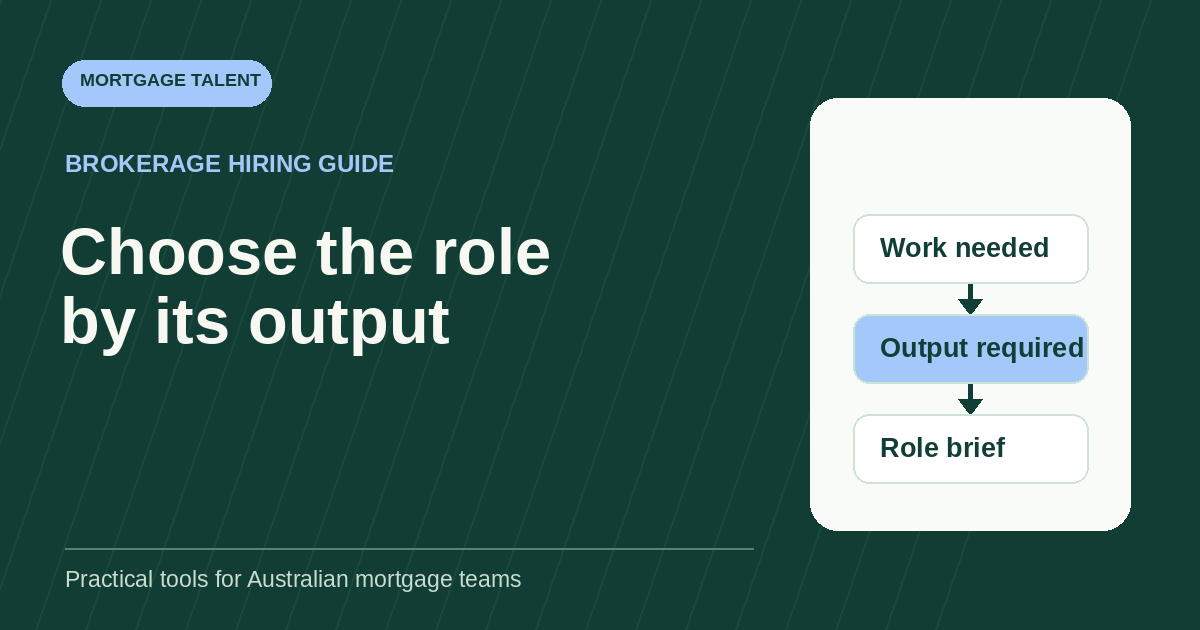
If you are comparing a parabroker with a loan processor, start with the work you want returned to your desk. Is it an application pack prepared from approved instructions, a source-linked policy research note, or an analytical working paper explaining assumptions? Those are different hiring requirements, even when advertisements use overlapping titles.
A credit analyst may belong in the conversation when the missing output is analysis rather than file coordination. But none of these titles establishes permission to recommend a loan, contact a lender or make a credit decision. This guide helps an Australian brokerage choose a role brief, not determine someone's legal authority.
Why the titles need a second question
Public service descriptions show why the label needs context. Tarino's current mortgage-broker page compares a loan processor with a client services officer and says titles vary between brokerages. That provider's comparison does not define every parabroker or credit analyst role. Ask what the person actually prepares before treating differently named roles as equivalent. Tarino's mortgage-support role comparison.
The useful second question is: “What does the broker receive, and what decision remains with the broker?” A title without that answer can attract candidates whose experience sounds relevant but solves a different problem.
Compare the output, not a seniority ladder
Treat the following as starting points for a brokerage-specific brief. They are not a claim that every employer uses these titles identically.
Loan processor: a prepared file and visible outstanding work
A processing-focused role starts from the assigned application instructions and supporting records. The useful output is organised application information, a clear record of discrepancies and a visible list of outstanding requests. The hiring question is whether the person can prepare and track that work accurately without quietly deciding unresolved facts. Mortgage Talent's loan processor template provides a starting task list.
Choose this direction when the intended loan workflow is already established but preparation or follow-through is waiting. Do not assume that excellent file tracking demonstrates experience building analytical working papers.
Parabroker: broker-facing research and preparation
For a parabroker brief, identify the research and preparation that should reach the broker before the broker completes their decision. That might include organising fact-find information, comparing supplied policy material and documenting unanswered questions. Mortgage Talent's parabroker template includes source-noted policy and serviceability preparation within assigned authority.
The selection question is whether the candidate can make the broker's next review easier while distinguishing evidence, assumptions and decisions. Avoid using “parabroker” as shorthand for someone who can take every difficult task off the principal's desk.
Credit analyst: analytical working papers for review
A credit-analysis brief should identify the calculations and analysis required, the approved methodology, and how uncertainty must be reported. The output might show inputs, workings, assumptions and how a changed input affects the result. Mortgage Talent's credit analyst template covers analytical preparation for authorised reviewers, including explicit treatment of assumptions.
For a brokerage hire, make the context clear. Experience preparing work for a lender's credit team is not automatically experience supporting a broker's workflow. Ask who commissioned the analysis, who reviewed it and what the candidate personally produced.
Locate the missing output in your own queue
Review a small, representative sample of recent work internally. Do not send borrower files to applicants. For each delayed item, record the last usable input, the output still needed and the person waiting for it.
Three different patterns could emerge:
- Instructions are available, but application fields and supporting documents still need preparation. Investigate a processing brief.
- The broker is repeatedly assembling policy references and unresolved questions before reviewing a scenario. Investigate a parabroker-style preparation brief.
- The broker needs clearer calculations, assumptions and alternative-input workings. Investigate an analytical brief.
These are scoping prompts, not automatic classifications. If the real blockage is an unanswered broker decision, another preparer may simply create a larger review queue. Name the reviewer and confirm their capacity before adding more preparation work.
Use this fictional role-scoping exercise
Imagine a fictional brokerage, Harbour Example Finance. It has three work cards. No real borrower, lender policy or financial data is involved.
Card A: The broker has supplied an approved instruction sheet and a mock document index. A preparation record needs completing, with missing items returned in an exception list.
Card B: The broker has supplied two fictional policy extracts, labelled version one and version two. A research note needs to identify differences, reference the extracts and list questions. The exercise does not say which extract applies.
Card C: A fictional worksheet defines a simple calculation: supplied figure X minus supplied figure Y. X is 10 and Y is either 3 or 5, pending clarification. The reviewer needs both results, the unresolved input and a note explaining what cannot yet be concluded. This is arithmetic practice, not a lending or serviceability method.
Before choosing a job title, write the output and reviewer for every card. Then select which output the vacancy must produce first. If the position combines all three, state their priority and assess each separately rather than assuming one title covers them.
Answer key for the hiring manager
Card A points towards application preparation. A useful answer identifies the required record and exception list, with the broker as reviewer. It does not infer readiness to lodge from the mere existence of instructions.
Card B points towards research preparation. A useful answer compares the supplied extracts without inventing a reason to select one version. The unresolved applicability question remains visible for the broker or designated reviewer.
Card C points towards analytical preparation. The two results are 7 and 5. A useful answer shows both, preserves the uncertainty in Y and avoids converting either result into a lending conclusion.
The exercise distinguishes outputs, not people by title. A candidate could demonstrate more than one capability. Record that evidence directly. A strong result on Card A does not answer Card C, and a strong calculation does not establish reliable file coordination.
Turn the choice into a brief candidates can answer
Use one paragraph per required output:
“From these inputs, prepare this working document for this reviewer. Record these sources and assumptions. Stop when these questions arise. Return the work through this channel by the agreed review point.”
Add the actual systems, working overlap and essential experience. Ask candidates to describe similar outputs without providing previous employers' documents or client information. Keep claimed experience separate from what you observe in an entirely fictional assessment.
For a blended role, identify the primary queue and what happens when research and processing deadlines compete. A broad title is not a priority rule. If the essential tasks demand different experience, consider whether one role remains realistic before combining them in an advertisement.
Keep authority separate from capability
ASIC says people engaging in credit activities generally need a credit licence, authorisation or an applicable exemption. Its description includes suggesting or assisting with a particular credit contract. Have your licensee or qualified adviser assess the proposed activities and appointment arrangement before work starts. A successful exercise is not authority to perform those activities. ASIC credit licensing guidance.
For more detailed task-boundary questions, use the mortgage support task-boundary guide. If the need is mainly enquiry coordination rather than research or analysis, revisit the assistant-versus-processor comparison.
Discuss the work before requesting the title
Bring Mortgage Talent the outputs you need, the systems involved and the person who will review the work. Its processor hiring service describes support shaping the brief and searching for relevant experience, with the brokerage making the hiring decision. For a wider preparation or analytical role, start with the linked role templates and discuss your requirements.
That conversation should establish the role and current candidate availability. It should not begin with an assumption that a title guarantees capability, authority or immediate readiness.
Take the next step
Explore Mortgage Talent or speak with our team about your hiring needs.