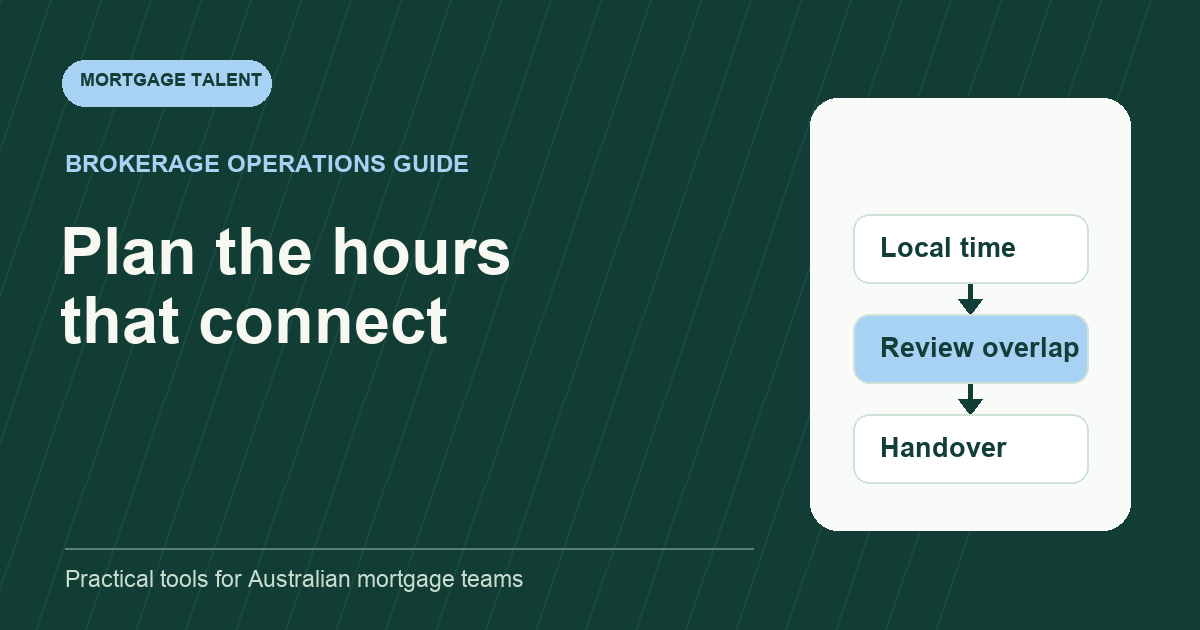
Build a remote mortgage team roster around the hours when work and decisions need to meet. Start with the brokerage’s required coverage, then map each person’s local working window, reviewer availability and handover point. A roster that lists only “Australian hours” leaves too much room for misunderstanding.
This guide is an operational scheduling method. It does not prescribe working hours, employment conditions or availability outside an agreed arrangement. Confirm the actual schedule with the people involved and use your normal process for approving changes.
Name the time zone and the date
Record a named location-based time zone for each schedule, such as Australia/Sydney, rather than relying on a loose abbreviation. Put the effective date beside the roster. Where team members are in different locations, show the same working window in each person’s local calendar and check it on a real date.
Google Calendar’s time-zone guidance explains how events can use different time zones and how Calendar handles daylight-saving changes. Use the corresponding features in your chosen calendar and verify upcoming dates. A static offset typed into a spreadsheet should not be assumed correct indefinitely.
Make the roster’s reference zone explicit in meeting invitations, handover notes and due-time conventions. “Before 3 pm” should identify whose 3 pm and on which day. That small detail matters when work is transferred between people who do not share the same local date or clock.
Map three kinds of coverage
Separate processing time, decision overlap and incoming-message coverage. Processing time is a protected block for preparing agreed work. Decision overlap is the window when the broker or reviewer can answer questions. Incoming-message coverage identifies who monitors and routes new work. One person may cover several functions, but do not assume all three occur throughout their shift.
Scroll sideways to see all columns →
| Coverage block | Required owner | Question to settle |
|---|---|---|
| Preparation block | Support person | Are inputs ready before the block begins? |
| Review overlap | Broker or designated reviewer | When can decisions actually be made? |
| Message triage | Named queue owner | Who handles arrivals outside preparation time? |
| End-of-window handover | Outgoing and incoming owners | Who accepts unfinished time-sensitive work? |
Place the work on a weekly grid before assigning people. This reveals whether the proposed arrangement has an uncovered period or asks the same reviewer to support several people simultaneously. It also prevents a long shift from looking adequate when the only available decision window is missed.
Design the overlap around decisions
Reserve overlap for questions that cannot reasonably progress asynchronously. Ask support staff to prepare the file reference, exact question, options within their instructions and the required checkpoint. A broker can then use the window to decide rather than reconstructing the history from scattered messages.
Keep routine status updates in the agreed task system or handover. If every update becomes a meeting, the overlap window may disappear before the difficult questions are addressed. Conversely, do not force an ambiguous decision into a long written exchange when a short scheduled conversation would resolve it.
Set a route for missed overlap. If the reviewer becomes unavailable, identify the backup or the next checkpoint. Support staff should not have to infer permission to proceed because a scheduled call did not happen.
Work through a fictional roster check
Suppose a brokerage proposes a support window from 10 am to 4 pm in its chosen reference zone, with a reviewer available from 2 pm to 3 pm. The work plan places preparation before the review window, then corrections and handover afterwards. Each participant confirms the corresponding local times in the calendar for the first working week.
The check reveals that the reviewer has a recurring client appointment on Tuesdays. The team moves Tuesday’s decision window, confirms the revised local times and adjusts when preparation must be ready. It does not describe the whole week as covered simply because four days work well.
A later calendar check shows a future week with different local-time alignment. The manager reviews the arrangement before that week, discusses the options with the participants and records the agreed schedule. No one is expected to absorb a shift change silently. These times are illustrative and are not a recommended standard roster.
Prepare for calendar exceptions before they become gaps
Maintain a shared view of agreed leave, training, public-holiday arrangements and other known unavailability. Confirm the relevant dates for each location through your normal scheduling process. Do not infer that everyone is available because the brokerage’s own office is open.
Review the next several weeks at a regular checkpoint and look for time-zone changes, different local calendars and reviewer absences. Assign an owner to verify affected recurring invitations. A roster document and a calendar invitation should agree; if they do not, resolve the mismatch before the work begins.
Use the business continuity plan for backup coverage. A time-zone roster describes normal operation; it should link to the separate plan for outages or unexpected absences rather than trying to bury every contingency in one timetable.
Make the handover an accepted transfer
Use the daily handover template to list active exceptions, the next action, owner and due checkpoint. For time-sensitive items, confirm that the receiving owner has accepted the transfer. Posting a message at the end of a shift is not evidence that someone else will see it in time.
Keep a rule for work that arrives near the end of coverage. The triage owner should route it according to the agreed urgency and availability, not automatically assign it to the person about to finish. The inbox workflow helps make that queue visible.
Review the roster using actual waiting time
- Which tasks waited because no reviewer was available?
- Which messages arrived in an uncovered window?
- Which meetings fell outside an agreed local schedule?
- Which handovers lacked an accepting owner?
- Would a different overlap solve the problem without extending coverage?
Use those observations to revise the schedule, then confirm the new effective date. If you are hiring remote support, share your coverage requirements with Mortgage Talent. A clear roster brief helps distinguish a genuine capacity need from a timing mismatch.
Take the next step
Explore Mortgage Talent or speak with our team about your hiring needs.