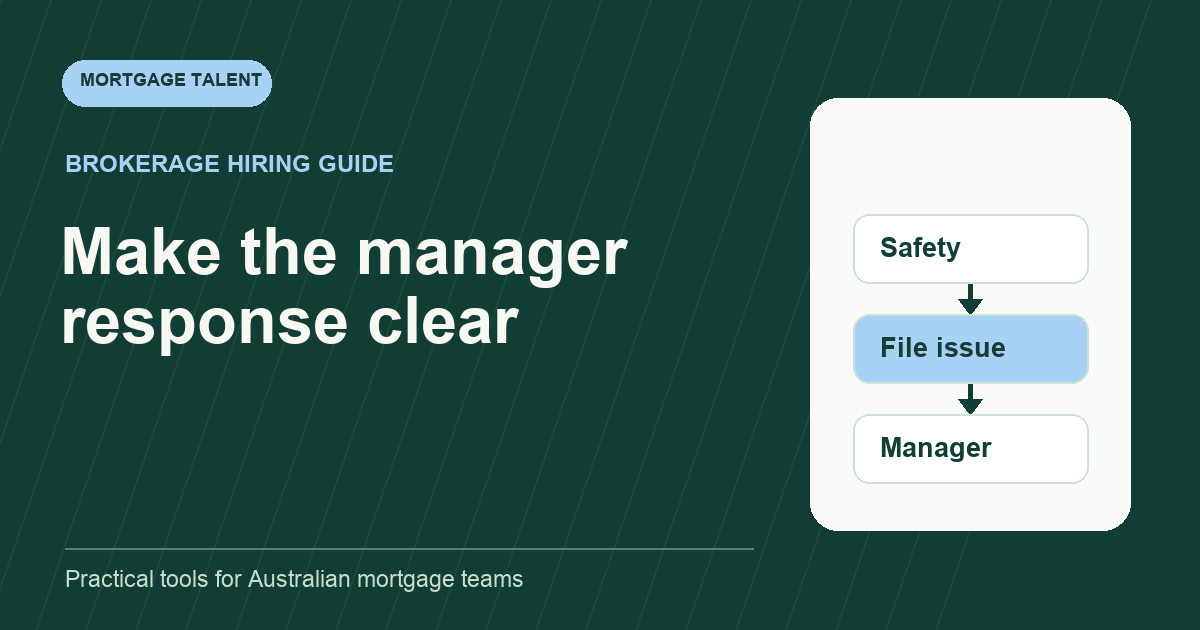
When a mortgage assistant receives abusive contact, the manager needs to take ownership of both the worker's safety and the customer's unresolved matter. Forwarding a message is not enough. The assistant should know how to activate the approved response, who accepts the handover and who decides the next contact arrangement.
Prepare that process with the employer or provider and the person responsible for work health and safety. The response card below is a proposed operating tool, not a universal legal right to end any call or a substitute for a workplace-specific safety plan. For an offshore worker, identify the actual employer, local support and emergency route rather than assuming Australian arrangements apply identically.
Describe behaviour without labelling the customer
A caller can be frustrated, dissatisfied or experiencing financial difficulty without being abusive. Do not use a customer's hardship, disability, accent, background or other personal characteristic as a shortcut for deciding how to respond. Record the behaviour that occurred and the worker's immediate concern.
“The caller disagreed with the update” and “the caller made a specific threat” require different management responses. If the assistant is unsure, the plan should let them seek manager help without having to prove the customer's motive or make a diagnosis.
Safe Work Australia's guidance includes abuse through calls, texts, email and other work technology, including from customers and when working remotely. It recommends safe systems, procedures, training, supervision, reporting and access to support. Safe Work Australia develops national policy; it is not the enforcing regulator. Check the applicable requirements with the relevant state or territory authority and your workplace's responsible adviser.
Set up the manager route before the next difficult call
Name a primary manager and an available backup for each client-contact period. Agree how the worker signals that help is needed, whether the phone system supports a safe transfer, and what the approved fallback is if neither manager answers. Rehearse the route with fictional information.
The manager should approve any boundary wording and explain when it is suitable. Do not require a worker facing immediate danger to complete a script or wait for a routine callback. The location-specific emergency procedure takes priority.
Also decide who can change contact arrangements, restrict a channel or consider ending a client relationship. Those decisions belong in the authorised management and licensee process, not with an assistant improvising under pressure. A safety response should not make the underlying file or complaint disappear.
Use a two-lane response card
Keep the records appropriately restricted and cross-reference them where necessary. Avoid spreading distressing messages through a broad team chat. Capture enough factual information for the responsible people to act, with incident evidence handled under the workplace's approved process.
Scroll sideways to see all columns →
| Decision point | Worker safety and contact management | Customer file or complaint |
|---|---|---|
| Immediate handover | Named manager accepts responsibility for the incident response and checks immediate needs. | Named broker or complaints owner accepts the unresolved customer action. |
| Information needed | Channel, time, behaviour, current location-related concern and steps already taken. | Customer's request, relevant file reference, stated deadline and any complaint already received. |
| Next action | Approved contact route, worker support and any safety escalation. | File check, customer response or complaint action through the existing procedure. |
| Exception | Manager unavailable, repeated contact or immediate danger activates the pre-agreed fallback. | Deadline risk or disputed ownership escalates to the responsible broker or licensee contact. |
| Closure evidence | Manager confirms support follow-up and a considered return-to-contact arrangement. | Customer-work owner confirms the next step; the incident record does not close the complaint. |
ASIC's RG 271 sets internal dispute-resolution requirements for specified financial firms, including Australian credit licensees. Use the brokerage or licensee's applicable procedure for the underlying complaint. This guide does not assign statutory complaint duties to the assistant or set a universal response deadline.
The existing complaint intake and support handoff guide covers capturing and transferring the complaint. The extra decision here is who protects and supports the worker while that customer process continues.
Rehearse three fictional calls
A frustrated customer wants a missing update
Fictional situation: a customer says they have asked twice about an outstanding document and are unhappy with the delay. There is no personal insult or threat in this example.
The assistant can use the approved service response: acknowledge the unresolved request, establish what update is being sought and route it to the broker or complaints owner as appropriate. They should not promise a lender outcome or dismiss dissatisfaction as abuse. If the conversation becomes hard to manage, asking the manager to assist is still an available operational step.
The manager checks whether the promised update was missed. The useful result is accepted ownership of the issue, rather than a note saying the customer was “difficult”. Use the application-status update framework to separate verified file facts from a promised lender outcome.
A personal insult continues after an approved boundary
Fictional situation: the caller repeatedly directs personal insults at the assistant. The brokerage has approved a boundary statement and a manager-takeover route for this circumstance.
An illustrative statement is: “I can help route your file question, but I cannot continue this conversation with personal insults. I will bring in my manager using our contact process.” Adapt the wording to the actual approved procedure; this example does not authorise every worker to end every call.
If the conduct continues, the assistant follows that procedure and activates the manager or backup. The manager confirms acceptance, checks the worker's immediate needs and takes the next customer-contact decision. The broker separately retains the file question. An unanswered transfer request leaves the incident open; it is not a successful handover.
The customer makes an immediate threat
Fictional situation: a caller makes a credible, immediate threat to a worker's physical safety. Do not turn this into a coaching exercise about being more patient.
Follow the workplace's emergency procedure and prioritise immediate safety. Safe Work Australia advises calling 000 for immediate danger in Australia. For someone outside Australia, use the emergency route for their actual location and involve their employer's responsible contact. Routine customer follow-up waits until it can be handled safely by the appropriate owner.
The manager should not ask the worker to repeat the incident to multiple colleagues merely to keep everyone informed. Allocate the required reporting and evidence handling to the designated people.
Agree what happens before the worker takes another contact
After the immediate event, the manager checks privately what support is needed and explains the available workplace support routes. Do not assume that a calm voice means no impact, or require the worker to diagnose their own response.
Record who will contact the customer next, through which approved channel, and what supervision or temporary task changes the responsible manager has agreed. The decision should consider the worker's concerns and the workplace's procedures. A return to the same customer should not happen simply because the queue assigns the file back.
Where the customer also describes repayment difficulty, record that concern and route it to the responsible broker through the approved process; do not promise a lender decision. If the customer is also expressing dissatisfaction, retain the separate complaint intake and handoff. Preserve the safety and customer-work actions without treating financial distress as evidence of abusive behaviour.
Test the process, not the assistant's tolerance
In a short rehearsal, ask a manager to accept a fictional escalation and show where the two owners are recorded. Test the unavailable-manager fallback and the next-contact decision. The process needs improvement if the worker still has to choose between enduring harmful contact and abandoning the customer matter.
Review staffing and supervision after the incident without making the worker's willingness to absorb abuse a performance measure. For future hiring, describe client-contact duties, manager backup and training in the role brief. When that scope is ready, you can discuss your mortgage assistant requirements.
Take the next step
Explore Mortgage Talent or speak with our team about your hiring needs.