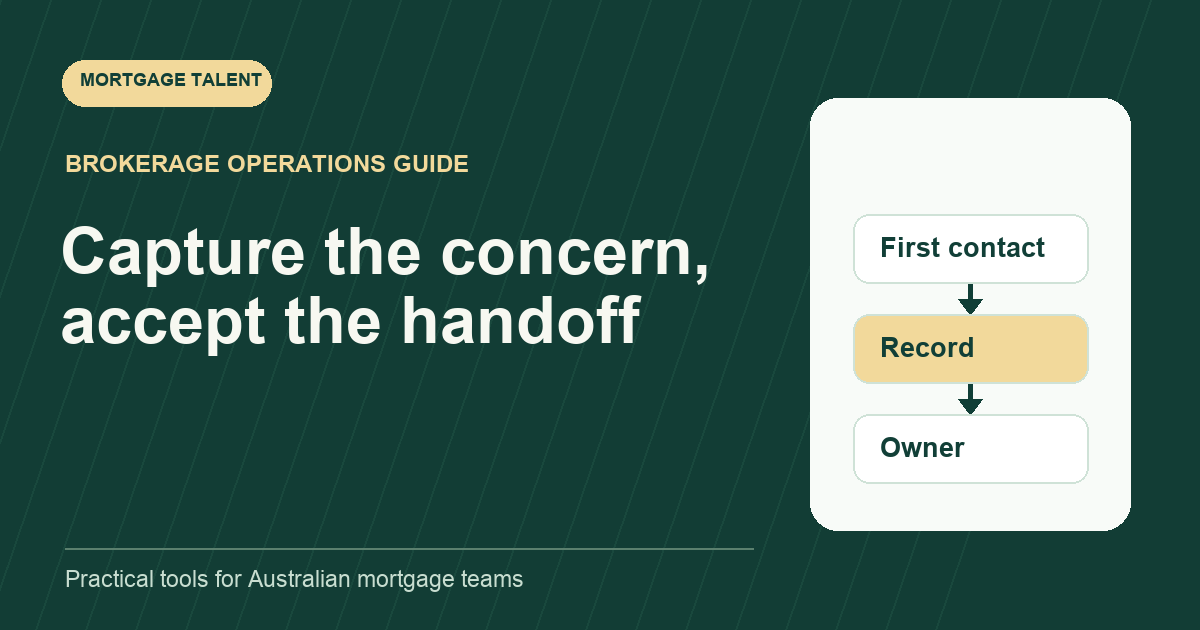
Give mortgage support staff an intake process that records the customer's concern accurately, preserves when it first reached the team and transfers it to the designated complaints owner with an acknowledgement. The assistant's role is to capture and route the matter under the approved procedure, rather than decide whether it has merit or promise a remedy.
ASIC's RG 271 defines a complaint around dissatisfaction with an organisation's products, services, staff or complaint handling where a response or resolution is expected. Its guidance says a consumer does not need to use the word complaint or put it in writing.
Teach recognition through the approved process
Ask the brokerage's complaints owner to provide the current intake instructions, responsible contacts, backup and acknowledgement wording. Train the assistant with those materials before assigning customer contact. This worksheet organises a handoff; it does not replace the firm's complaints procedure or determine its applicable obligations.
If the message is ambiguous, preserve the customer's words and ask the designated owner to assess it. Avoid closing the item as “general feedback” simply because the assistant thinks the problem is minor. The record should allow the responsible person to understand the concern without first correcting the intake summary.
Record the original contact and the requested response
Scroll sideways to see all columns →
| Field | What to capture |
|---|---|
| First received | Date, time, time zone and original channel |
| Controlled file reference | Approved link to the customer or service record |
| Customer's concern | Accurate words or a clearly attributed summary |
| Response sought | What the customer asks for, or what remains unclear |
| Relevant source | Message or call record under the approved procedure |
| Immediate concern | Any issue needing the designated urgent route |
| Receiving owner | Named person, handoff time and acknowledgement |
| Next communication | Approved owner and recorded next step |
Keep the original received time separate from the time an assistant entered the note or forwarded it. An overnight message and a morning handoff are two different events. The complaints owner should apply the firm's rules to that history; the assistant should not calculate a new start time from the reassignment.
Store customer detail in the approved record. A broad handover message can identify the controlled reference, receiving owner and next action without reproducing the whole concern.
Use neutral acknowledgement wording
Use the firm's approved acknowledgement and contact channel. A factual intake message can confirm receipt and identify the team handling the next step. Any promised response timing should come from the authorised procedure or owner, rather than an assistant's estimate.
Do not promise compensation, agree that a lending decision was wrong or tell the customer the concern is invalid. Do not ask them to withdraw it before the owner has assessed the matter. An assistant can be respectful and helpful while keeping the merits and remedy outside the intake role.
If the customer asks for a change to an active file, record that request separately and route it to the appropriate broker as well. Keep the related tasks linked so a routine operational answer does not accidentally stand in for a complaints response.
Practise with three fictional contact examples
First, a mock customer says, “I have asked twice for an update and nobody has answered. Please explain what is happening.” The assistant records the dissatisfaction and requested response, links the earlier mock messages and follows the complaints-intake route. They do not require the customer to rename the message.
Second, a fictional caller reports an unclear fee and asks for an explanation. The assistant captures the stated issue and routes it for assessment under the firm's procedure. They avoid deciding from the call alone whether the concern is justified or which response category applies.
Third, a mock message combines a service concern with difficulty making a payment. The assistant uses the approved routes for the separate concerns and links the handoffs. This constructed exercise does not classify the matter legally or prescribe a universal hardship process.
Make transfer an accepted handoff
Sending an email to a team address is an attempt to transfer work. Record the receiving owner and their acknowledgement under your procedure. If no owner accepts it, use the designated backup or escalation rather than leaving the matter in a sent folder.
The inbox triage workflow can keep the incoming message attached to the task. The complaints record should retain its own owner and next action, so moving an email out of the inbox does not make the concern disappear.
At a shift handover, include the original received time, current owner, unanswered question and next agreed communication. Keep internal work-status changes distinct from the complaints owner's decision about closure.
Review intake quality without judging the customer's merits
- Can the owner locate the original contact?
- Does the summary preserve the actual concern and response sought?
- Are original timing and later handoff timing distinct?
- Did a named owner accept the matter?
- Were operational and other related concerns routed clearly?
Sample intake records under the approved review process and correct recurring omissions. Coach the worker on accurate capture, acknowledgement and ownership. Do not reward a low complaint count produced by relabelling dissatisfied contacts.
Define this boundary in the support role
The post-settlement care workflow identifies where concerns can surface; this intake method explains the limited handoff work that follows. Include the current procedure, trained contacts and backup arrangement in onboarding.
Explore assistant support and discuss customer-intake duties. Describe the capture and routing tasks without presenting the support role as an independent dispute-resolution function.
Take the next step
Explore Mortgage Talent or speak with our team about your hiring needs.