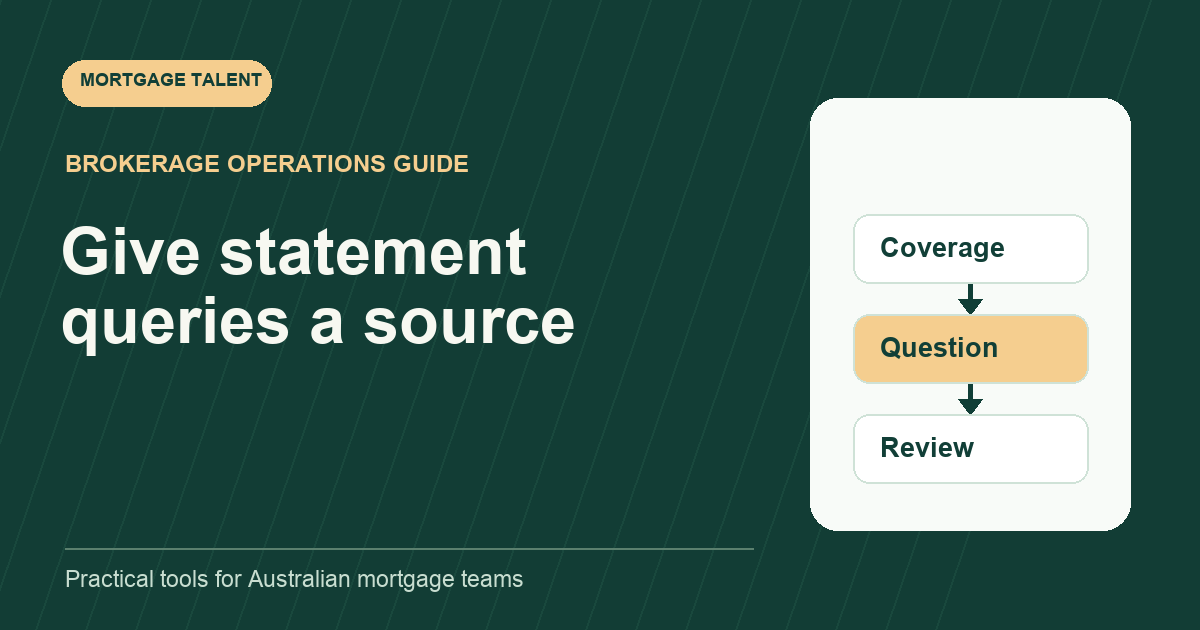
Prepare a bank statement query handoff by first checking the requested account and period coverage, then recording factual questions against exact source pages or entries. Keep the customer's explanation separate from the broker's conclusion. Support staff should make the review easier to follow without deciding what a transaction means for affordability.
ANZ's document guidance lists salary-credit bank statements among income-evidence examples and says to confirm the actual requirements with the lender or broker; it excludes ANZ Plus products. Start with your broker-approved list for the case rather than applying a generic period to every account.
Build the coverage index before raising transaction questions
Record the approved account label, requested period, document reference, stated period and page sequence. Use the permitted internal reference instead of putting full account details into a broad queue. Ask the reviewer how to handle an account or period that was not in the original instruction.
Check whether the supplied item is readable and appears to cover the request. A complete-looking page sequence is only an administrative observation. It does not prove authenticity or establish that the lender accepts the evidence. Keep those judgments outside the coverage tick.
Use the document request tracker for missing pages or replacement requests. Do not create another customer-chasing list inside the query ledger. Link the query to the existing request so both owners can see the same next action.
Write observations that the reviewer can locate
Scroll sideways to see all columns →
| Field | Useful entry | Avoid |
|---|---|---|
| Source | Document reference, page and entry date | A screenshot without file context |
| Observation | The exact label or difference that prompted a question | An assumed explanation |
| Question | Specific clarification the broker should approve | A broad request to explain everything |
| Customer reply | Attributed explanation and date received | Presenting the reply as independently verified |
| Reviewer decision | Named reviewer, recorded instruction and time | Support staff's lending interpretation |
| Next action | Owner and task linked to the decision | A closed tick with no basis |
Use neutral language. “The description does not identify the payer” is a factual observation. “This is definitely salary” is a conclusion that the support worker should not infer from a convenient label. If the source cannot be read confidently, record that limitation.
Keep extraction, explanation and assessment distinct
If the broker assigns a factual extraction task, specify which fields to capture and how to reference the source. Copy the date and description as shown. Leave an unclear value flagged rather than filling it from memory or a similar entry elsewhere.
When a customer supplies an explanation, record who provided it and which query it addresses. A reply may answer one question while leaving another unresolved. Avoid copying the same explanation onto every similar entry without an instruction from the reviewer.
The broker can then decide whether further clarification, additional evidence or a different preparation step is needed. Save that instruction as its own event. This separation lets a colleague understand what was observed, what was reported and what the authorised reviewer decided.
Practise with three fictional statement issues
Illustrative exercise: a mock statement has a missing page, a credit with an unclear description and a transfer that appears in two supplied mock accounts. The trainee receives an approved request list and fictional documents. No real borrower information is used.
The missing page becomes a coverage exception linked to the existing document request. The unclear credit becomes a source-linked question for the broker to review. The apparent transfer is described as an observation involving two entries, not classified as income or excluded from an assessment by the trainee.
A mock customer reply explains the credit but supplies no additional document. The trainee records the reply separately and returns it to the reviewer. The exercise is successful when the reviewer can locate each source and unresolved question; it does not test a credit decision.
Give each question a stable reference. If a new document answers only part of it, record that response against the same question and state what remains. Link related questions instead of merging them into a broad resolved note. This keeps duplicate requests and partial answers visible when another person takes over.
Group the handoff around decisions, not page volume
Give the broker a short summary of complete coverage, missing coverage and questions needing a decision. Link the underlying ledger and original documents in the approved system. Put time-sensitive or instruction-blocking questions first according to your agreed review process.
For an entity-heavy pack, connect the work to the self-employed document index. Keep the same entity and period labels across both records. If a newer statement arrives, identify which queries still refer to the earlier version before updating their source links.
After review, move approved follow-ups into the normal task queue. A ledger full of reviewer answers is still unfinished work if no one owns the resulting requests. Record completion against the actual assigned action.
Scope the role around observable preparation work
- Matches the supplied account and period to the approved request.
- Locates missing or unreadable pages without guessing.
- Writes a neutral, source-linked question.
- Attributes explanations accurately.
- Returns unresolved points for review and records the next instruction.
Use these criteria in a fictional work sample and supervised onboarding. Measure avoidable clarification and traceability rather than rewarding the worker for closing the most questions. A clear unresolved note can be more useful than an unsupported answer.
Explore processor support and share your statement-preparation workflow. Include your approved systems, document mix and broker review arrangement when defining the role.
Take the next step
Explore Mortgage Talent or speak with our team about your hiring needs.