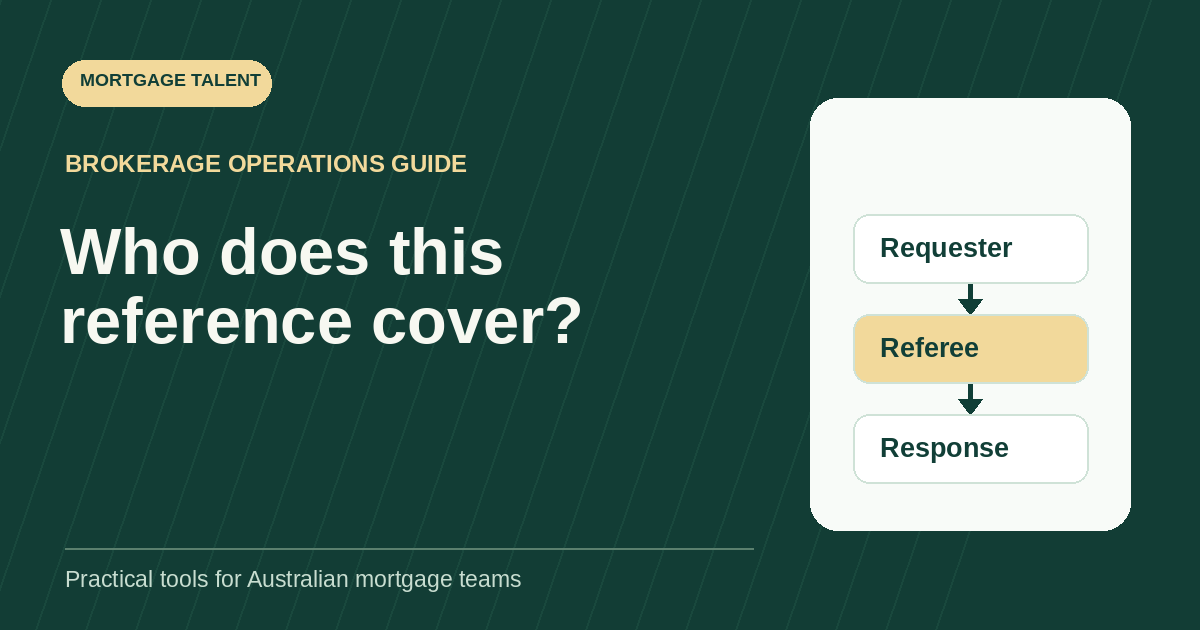
Before marking a broker recruitment reference complete, check which organisation requested it, whose consent and authority supported that request, and which referee replied. An aggregator's completed check may serve its own purpose without documenting your brokerage's request. A shared candidate name is not enough to merge the records.
This guide is for a mortgage brokerage holding its own Australian credit licence (ACL) and assigning administrative support to a broker recruitment process. It gives a fictional requester map and a completed correction exercise. The responsible licensee determines applicability, required checks, forms and the hiring decision. It does not turn an ordinary assistant reference call into the ASIC process.
Identify the requesting organisations before chasing replies
ASIC's reference-checking guidance distinguishes a recruiting licensee considering employment or authorisation from a future mortgage intermediary considering an intermediary relationship. Their requests can concern the same person while serving different decisions.
Ask the recruitment owner to name the organisations and their capacities. Record the actual legal entities rather than a shared trading brand or a shorthand such as “the aggregator”. Then identify who controls the request and where the underlying documents are held.
For ordinary assistant or processor recruitment, use the support reference-checking guide. The present exercise concerns an owner-confirmed protocol process for a prospective mortgage broker. Keep any separate performance-reference conversation clearly identified; a general endorsement and a prescribed reference are different source items.
The current protocol, sections 5–7, distinguishes the recruiting licensee's required reasonable steps from an intermediary's discretionary request and specifies consent and request templates. Have the responsible owners settle the applicable process. The map below supplements those forms; it does not replace or rewrite their questions.
Test a returned reference against three purpose rows
All people, entities and records in this example are invented. On 16 October 2026, brokerage A is considering employing Morgan as a mortgage broker. Separate aggregator B is considering acting as intermediary. The owners have confirmed those capacities and that the protocol applies to their proposed requests.
Morgan has represented credit licensee C since 1 May 2026. Immediately before that, Morgan represented credit licensee D from March 2023 to April 2026. Assume there are no other relevant current or former licensees in this bounded example. The protocol's definition of former licensee uses the preceding five years; D falls within that window. The responsible owner still confirms which entities the actual case requires.
Because the current C relationship is shorter than twelve months, A's reviewer identifies C and the most recent former licensee D under section 5(1)(b)(ii). B separately elects to request a reference from C. The coordinator therefore tracks three requester/referee purposes, even though there is only one candidate.
B's portal shows “reference complete”. The underlying consent and request name B only, and a response from C has arrived. There is no arrangement authorising B to act for A. The coordinator compares the actual records with each purpose row.
Scroll sideways to see all columns →
| Requester and referee | Evidence actually present | Preparation finding |
|---|---|---|
| A requesting C | The available request names B, not A; no agency arrangement for A is recorded. | A's request is not documented by this item. Refer the missing route to A's recruitment owner. |
| A requesting D | No request or response from D is in the supplied record. | A separate referee remains outstanding. Assign the consent/request preparation and owner review. |
| B requesting C | B's consent, request and C's response are connected. | Response received for B's reviewer. Do not turn receipt into an appointment decision or copy the status to A. |
A CV attachment also contains a favourable letter from a former manager at D. That letter does not fill the empty request row merely because its author worked at the right organisation. Give A's reviewer the letter's actual provenance and keep the protocol request outstanding until the owner resolves it.
The finding concerns the supplied process record. It does not establish that Morgan is unsuitable, that B's check is defective, or that information can never be shared between the organisations. Those would be different conclusions requiring their own basis.
Correct the missing route without rewriting history
In this version of the exercise, A's owner chooses to proceed through A's own approved requests to C and D. Support prepares the required consent and request material for review, records actual dispatches and follows each response through the agreed process. B's earlier correspondence remains accurately labelled.
Do not rename the recipient on the old request, backdate an agency arrangement or mark a message as sent because a draft exists. If an owner wants to rely on or share existing information, record that question for their assessment rather than silently treating a newly proposed arrangement as historical fact.
Preserve three distinct states: material prepared; request actually sent under the approved arrangement; response received for the named reviewer. The owner then records the substantive decision. These states explain why an assistant may finish a retrieval task while the recruitment decision remains open.
Give each missing item an owner and next review point. For A/D, that might be “recruitment owner to confirm request package; coordinator to dispatch only after acceptance”. “Follow up references” does not tell the next shift what is missing or what it may do.
Plan a combined request prospectively
ASIC expressly describes a coordinated route: one requesting party may act as the other's agent to obtain a reference for both, with the individual's consent covering both parties. A licensee remains responsible for its agent's acts or omissions. This is an arrangement to establish, not an inference from receiving a forwarded email.
Consider a separate version in which A and B plan together before any request is sent. The owners settle the agency arrangement, consent and applicable prescribed forms. The coordinator then records which purposes each dispatch covers.
Scroll sideways to see all columns →
| Planned dispatch | Purposes it is intended to cover | Evidence the coordinator connects |
|---|---|---|
| Request to C through the approved coordinated route | A/C and B/C. | Both requesting parties, the approved agency arrangement, applicable consent and request documents, actual dispatch and returned response. |
| A's separate request to D | A/D only. | A's approved consent/request package, actual dispatch and D's response or unresolved status. |
The arithmetic is three purpose rows and two planned dispatches. It is not a rule that every recruitment requires two requests. Combining the C route does not remove D, and receiving two replies does not approve either appointment. Reconcile each reply to its intended purposes before presenting the record to the owners.
Do not create a shortened hybrid questionnaire to make the combined route convenient. Use the owners' approved implementation of the current requirements. Support should flag a missing party, form or question, rather than decide that a broadly similar document is sufficient.
Make the support handoff precise
Use the candidate information-sharing checklist for the separate question of who receives each recruitment document and how a corrected pack reaches its actual recipients.
Give the next worker the candidate record reference, requester/referee pairs, approved document locations, dispatch evidence, response status and named decision owners. For each purpose row, also record the consent date, parties covered, expiry or currentness check and the controlled consent reference. Keep sensitive reference content in the controlled recruitment record rather than copying it into a general team handover.
ASIC's consent guidance states that consent ceases twelve months after it is given unless withdrawn earlier. Check the actual consent record before a further request or chase; a previously completed checklist does not establish that consent remains current.
If consent changes while a request is outstanding, escalate immediately through the approved process. Section 6 restricts further reference or update requests without current consent and requires notice to an unanswered referee when consent is withdrawn or ceases. Do not continue an automated chase because the original task is still open.
As a fictional candidate exercise for an operations hire, provide the first table's source items without its findings. Ask which purpose rows are evidenced, what remains missing and who decides the next step. Look for accurate attribution and a bounded handoff, rather than a confident opinion about Morgan's suitability.
Discuss your recruitment-administration support brief with Mortgage Talent. Specify record preparation, confidential coordination and available owner review. Confirm any specialist compliance or regulated reference-checking service separately; a support placement does not itself provide that service.
Take the next step
Explore Mortgage Talent or speak with our team about your hiring needs.