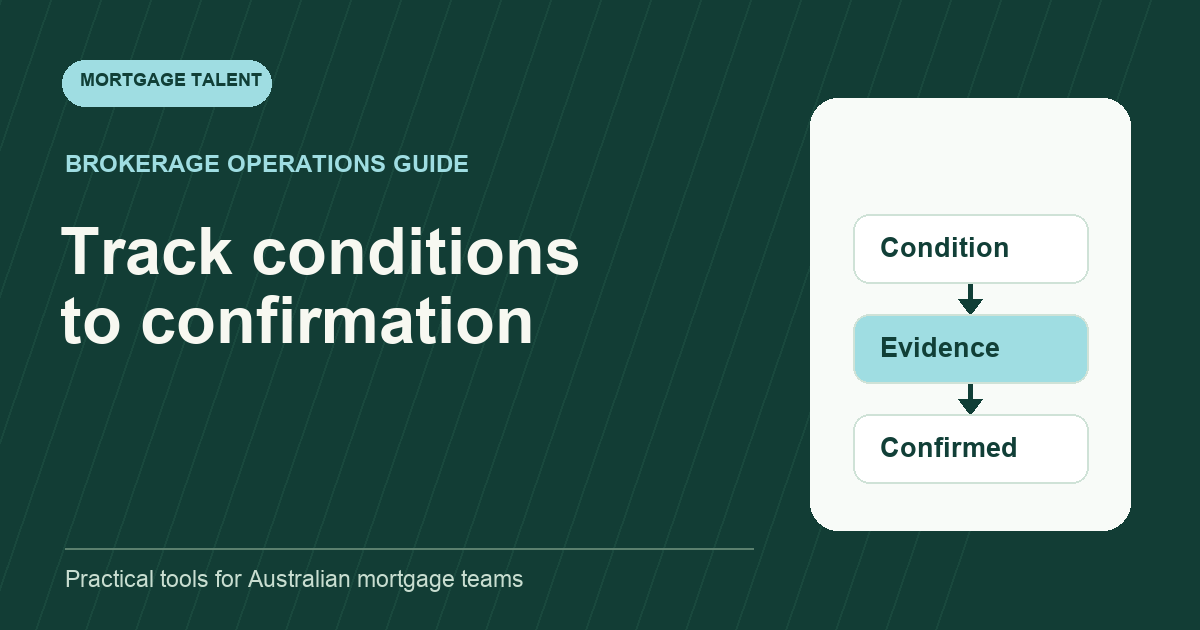
Track each mortgage approval condition as its own work item, with the lender's wording, an action owner, supporting evidence and a confirmed resolution state. Separate receiving a document from reviewing it, sending it and receiving lender confirmation. Keep a condition open until the responsible reviewer has evidence for closing it.
This is a support workflow for organising conditions, not a decision about whether an application is approved. ANZ's full-approval checklist explains that the information and conditions needed can vary with the particular loan. Use the actual lender communication for the file rather than assuming a universal condition list.
Capture the condition before turning it into a request
Record the lender communication, its date and the exact condition reference. Link the original wording in the approved record. Then have the broker or designated reviewer translate it into a specific next action. A support worker should not guess what alternative evidence would satisfy an unclear request.
Check whether the condition relates to one applicant, an entity, a property or the application as a whole. Keep the internal task description accurate without putting unnecessary personal information into a broad team list. Use the authorised file reference to connect the work to its evidence.
Distinguish a genuine condition from a general status note or an unanswered question. If the team cannot establish what needs to happen, create a clarification task with a named reviewer. Do not manufacture a completion criterion simply to populate the tracker.
Use states that show the next action
Scroll sideways to see all columns →
| State | Meaning | Next owner |
|---|---|---|
| Clarification needed | Required action is not yet clear | Broker or nominated reviewer |
| Requested | Approved request sent to the relevant person | Follow-up owner |
| Received | Evidence arrived and awaits the agreed check | Reviewer |
| Prepared for lender | Reviewed material awaits the authorised action | Submitter |
| Sent; response pending | Transmission recorded, resolution unconfirmed | Lender follow-up owner |
| Confirmed resolved | Current evidence supports closure of this condition | Reviewer confirms record |
These are proposed internal work states, not official lender labels. Keep the lender's observed status in a separate field where needed. Add a checked time so a colleague can see how current the observation is.
The document request tracker handles collection and review. This conditions tracker adds the link from the document to a specific lender condition and the evidence of its resolution. One document may support several conditions; one condition may require more than one action.
Give each condition a complete record
Record the condition ID, source communication, approved action, owner, due or next-check time, current state and evidence reference. Include the reviewer and the date of the last meaningful change. A last-edited timestamp alone may reflect a spelling correction rather than progress.
Track related conditions without collapsing them into one tick. If a lender request combines two distinct items, keep both actions visible and link them to the same source communication. This makes a partially complete response understandable to the broker.
Use the lender follow-up log for unanswered requests. Link the follow-up to the condition so another worker does not send a duplicate question. Record the actual reply and what it changes, rather than marking the condition complete because someone contacted the lender.
Work through a fictional three-condition file
Illustrative example: a file has three operational condition items, labelled A, B and C. Evidence for A has arrived but awaits review. B has been sent through the approved route and awaits a response. The current lender communication confirms C is resolved. The broker summary should describe those three states separately.
“All documents received” would be an inaccurate summary of this work. A still needs review; B still needs confirmation; C has an evidenced closure. The example uses invented condition labels and does not represent a real approval or imply that these steps are sufficient for any particular loan.
At the next check, the reviewer finds the evidence for A incomplete. A returns to the approved request stage with a clear explanation of the missing portion. The history of receipt remains recorded, but the current state shows the action that is now required.
Reopen a condition when new evidence changes the basis
If a lender issues a changed request or the broker identifies conflicting information, record the new source and have the responsible reviewer decide the next state. Keep the earlier confirmation as history. Do not overwrite it in a way that hides why the condition was reopened.
Define who can close or reopen items in your internal process. A support worker can prepare an evidence note while a designated reviewer confirms the interpretation. The role title alone should not determine who can decide what a lender communication means.
When ownership changes, transfer the next action and the unresolved question together. A list of condition names without their evidence and checked times is an incomplete handover. Use an ordinary team queue rather than relying on one person's inbox.
Make the broker summary useful at a glance
- Conditions confirmed resolved, with source references.
- Items awaiting reviewer action.
- Items sent and awaiting a lender response.
- Customer or external-party actions still outstanding.
- Changed requests or approaching commitments needing a decision.
State what was checked and when. Avoid replacing unresolved conditions with an optimistic overall label. Any customer-facing wording should follow the brokerage's review process and reflect the actual file evidence.
If condition follow-through regularly loses ownership, review the processor role and discuss a condition-tracking support brief. Bring a de-identified task description, systems and reviewer arrangement so the role can be scoped around the work your team needs.
Take the next step
Explore Mortgage Talent or speak with our team about your hiring needs.