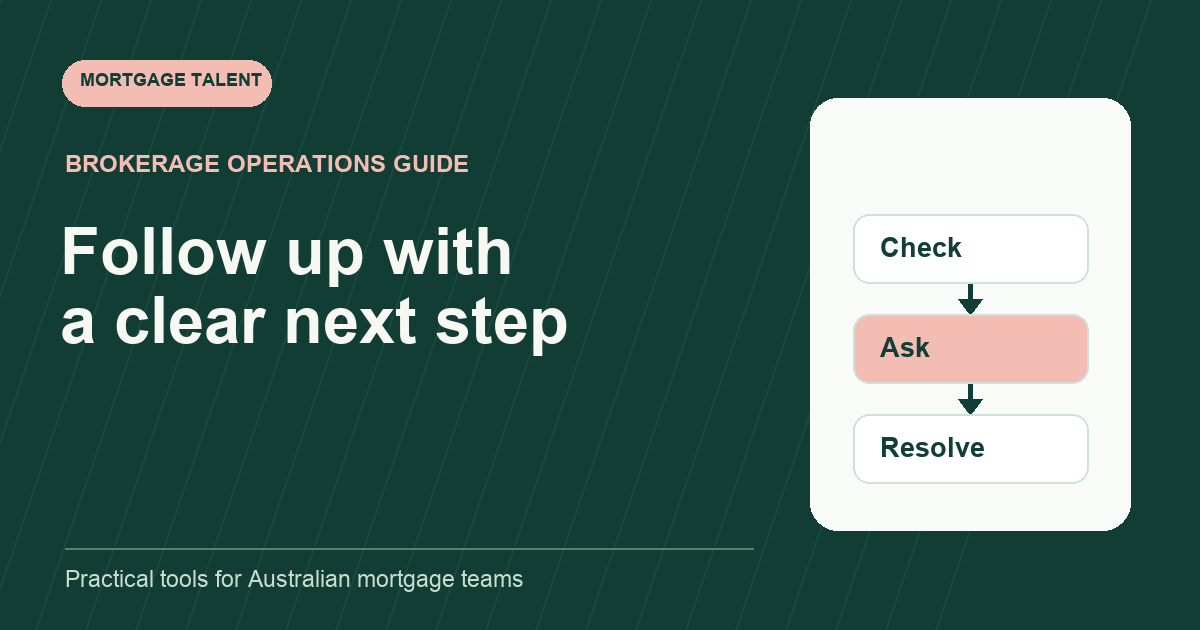
A lender follow-up log should show the request being resolved, the latest verified information, the person responsible and the next action. Record the result of a call or message, not just that contact occurred. Check the current status before sending another enquiry so several team members do not chase the same issue independently.
This template is for Australian mortgage brokerage coordination. It does not set lender turnaround expectations or promise an approval date. The brokerage should assign the task and approved contact channels as part of its loan processor role scope.
Use one record per open lender question
A file may have several separate questions: whether an item has been received, what information is still outstanding, or who owns an unresolved operational request. Keep distinct questions separate when they have different owners or next actions. A single “followed up lender” note is difficult to use after the original caller is away.
Before creating a record, search for an existing open request on the same topic. Add new evidence to that record rather than starting a parallel thread. If a reply resolves one part and leaves another open, describe the remaining question. Do not mark the whole issue complete merely because a response arrived.
Use the lender's current portal and contact instructions for that file. Bankwest's broker help centre, for example, describes application-stage tracking and Broker Chat for simple application enquiries. That is a lender-specific example; check the relevant instructions for other lenders.
Copy the follow-up fields
Scroll sideways to see all columns →
| Field | Useful entry |
|---|---|
| File and request references | Approved internal reference and lender enquiry reference |
| Open question | The factual issue needing a reply |
| Latest evidence and checked time | Portal note or recorded reply, with its timestamp |
| Request owner | One person coordinating the next contact |
| Last contact | Channel, time and a concise result |
| Next action and date | What the owner will do or check next |
| Dependency | The task or deadline waiting on the answer |
| Escalation decision | Named reviewer and the instruction received |
| Resolution evidence | The reply that answers the original question |
Keep source records in the approved file location and use references in the log. Include only the details needed to coordinate the task. The log is a summary of evidence, rather than a new place to duplicate every customer document.
Prepare an enquiry the recipient can answer
Write the enquiry around a specific question. State the application reference through the approved channel, identify the relevant prior message and ask what is needed to resolve the issue. If there is a real dependency, explain it factually. Avoid a long chronology that leaves the recipient guessing what answer is required.
A fictional example: “The portal note recorded yesterday requests an updated document. Our file records show the approved item was uploaded at the stated time. Could you confirm whether it has been received and whether any further action is required for this request?” The actual references and evidence would come from the assigned file. This is an illustrative writing pattern, not a statement that an upload satisfies a lender requirement.
If the recipient needs something different, record the new instruction and route any substantive question to the nominated broker. A follow-up owner should know where their assigned coordination task ends.
Work through a fictional duplicated enquiry
A processor checks a portal in the morning and records an open receipt question. An assistant then calls without seeing the record, while the broker sends a separate email. Three contacts produce two different replies, and the team cannot tell which reply reflects the latest evidence. No real customer or lender is represented here.
The corrected workflow names one owner, records the check time and links each reply to the original question. The broker can still make an escalation decision, but that instruction is visible to the owner. If responsibility changes, the handover transfers the next action explicitly.
Contact count falls in this example because duplicate work is removed. That does not establish faster lender assessment. Judge the log by whether the team can identify what remains unresolved and who is acting on it.
Set follow-up timing from the actual instruction
Use a stated response window or the brokerage's agreed check date where one exists. Record the basis for the next action. Do not apply a universal daily-chase rule to every request, particularly when the relevant lender has supplied a different process.
When a deadline approaches without a usable answer, assemble the evidence and request a decision through the approved escalation path. Keep the last verified status distinct from an estimate about what might happen next. The service-level template helps define the brokerage's own response and escalation responsibilities.
Review unresolved requests and hand off cleanly
Review records with no next action, stale evidence, multiple owners or repeated replies that fail to answer the question. Link incoming replies through the inbox triage workflow. If the next step is a customer document request, use the document request tracker.
If lender coordination is consuming the capacity your team needs elsewhere, explore the mortgage talent marketplace and discuss a loan processing support role with Mortgage Talent. Bring a de-identified summary of the request types and ownership gaps, rather than a file containing customer information.
Take the next step
Explore Mortgage Talent or speak with our team about your hiring needs.