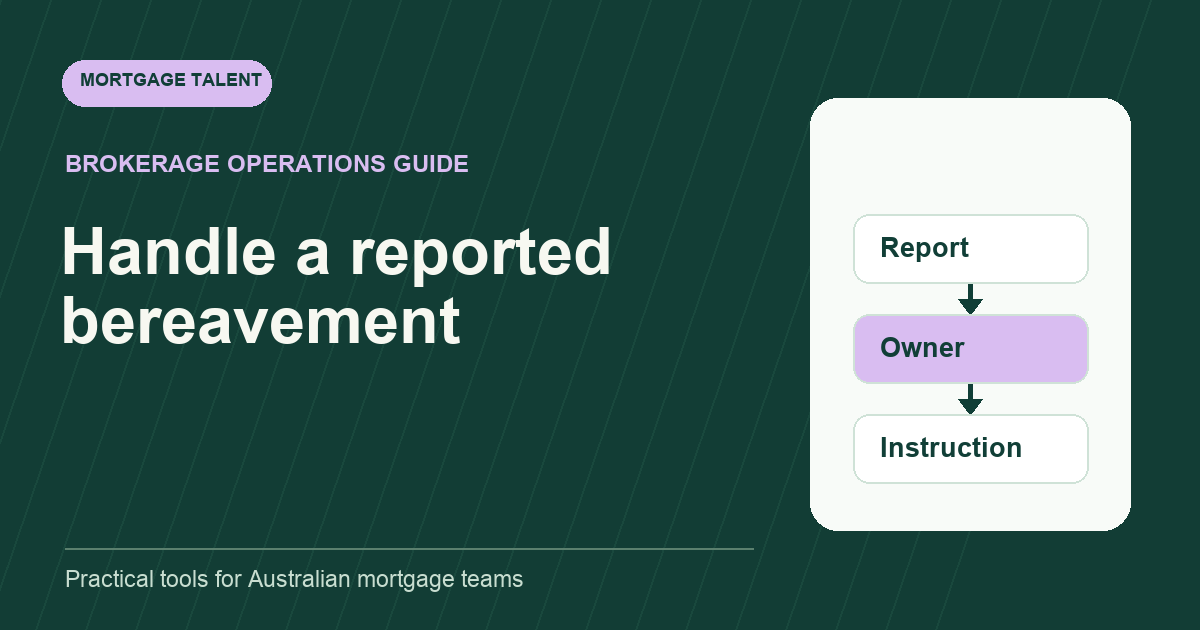
When someone tells your mortgage support team that a customer has died, acknowledge the report sensitively and route it to the brokerage's nominated owner. Keep the notification separate from any decision about who may receive information or give instructions. A caller's relationship description is a fact to record, not an authority determination for the assistant to make.
This guide gives Australian brokerage operations leads a proposed coordination record and fictional exercise. It does not explain estate administration law, decide a person's authority or prescribe one document pack for every lender.
Separate notification, authority and the next task
These are three different events: the brokerage receives a report; the appropriate process establishes what a person may do; an owner authorises a particular administrative action. Avoid putting all three under a single “estate handled” task.
A lender's own process illustrates why the distinction matters. CommBank's deceased-estate guidance says anyone can notify it that a customer has died, while it limits account information and action on requests to identified authorised estate representatives. This describes that bank's process; confirm the relevant lender's current requirements rather than applying one bank's wording universally.
The assistant can locate the brokerage's approved route and pass the report to the responsible owner. They should not promise a balance statement, send a complete joint file or confirm that the person contacting them can authorise a discharge. Record unresolved questions for the owner instead.
Use a two-layer coordination record
Scroll sideways to see all columns →
| Reported information | Owner-confirmed instruction |
|---|---|
| When and how the report arrived | Who accepted the internal handoff |
| The contact's stated relationship and preferred communication route | Which contact arrangements the owner approved |
| The controlled customer or file reference | Which existing tasks need review under the approved process |
| The request actually made | The specific action support may prepare or perform |
| Any stated time-sensitive issue | Who owns that issue and the next check |
Keep the two columns distinguishable in your existing system. A caller saying they are the executor belongs in the reported-information column until the appropriate process establishes the relevant authority. An assistant forwarding the message is an action performed, not evidence that the recipient has accepted ownership.
Use a controlled record and the minimum necessary description for the internal handoff. Do not place certificates, identity documents or family correspondence in a broad operations chat to make the request appear complete.
Rehearse a fictional notification and follow-up
Everything in this example is invented. A person phones about mock customer B, says they are B's adult child and asks for the outstanding loan balance. The assistant records the report and contact details through the approved process. They acknowledge the difficulty of the situation and explain that the nominated owner will handle the next steps. They do not disclose a balance from the CRM.
The owner accepts the handoff and asks the assistant to identify open administrative tasks and upcoming routine messages for review. The assistant supplies controlled references, not a new estate assessment. The owner decides what should happen to those tasks and communications under the approved process.
Later, another relative makes a conflicting request. The assistant preserves the second person's account separately and routes it to the same owner. They do not replace the earlier contact record, decide which relative is correct or treat the most recent call as overriding the existing instructions.
Finally, the usual owner is unavailable. The trainee uses the agreed backup route and records acceptance. This variation tests whether the process depends on one person's inbox. It does not authorise the backup to bypass lender or brokerage requirements.
Make changes to existing work explicit
A notification may affect appointment reminders, document chases or a planned client-care message. Identify those dependencies for the responsible owner. Follow the specific instruction about holding, changing or continuing them; do not silently cancel every task or leave an unsuitable routine message in a queue nobody has reviewed.
The post-settlement workflow helps locate planned communications. Use the factual file-note method to record the source report, owner's instruction, action performed and unresolved next step. Keep the report itself intact if later information corrects a detail.
Where the owner asks support to coordinate with a lender, confirm the exact administrative scope and permitted contact route. Do not collect every document listed on a general estate webpage before the relevant process says what is required. A large attachment bundle does not establish authority or make a handoff more useful.
Define the duty before assigning client contact
Before a worker handles this situation, they should be able to find the approved owner and backup, record notification without upgrading it into verified authority, and explain which actions remain unapproved. Review the fictional exercise with the person responsible for your brokerage's procedure.
Discuss sensitive client-contact coordination in your support brief with Mortgage Talent. Describe the administrative tasks and reviewer availability you will provide. Confirm estate, legal and lender-specific advice separately; an assistant role does not establish those services.
Take the next step
Explore Mortgage Talent or speak with our team about your hiring needs.