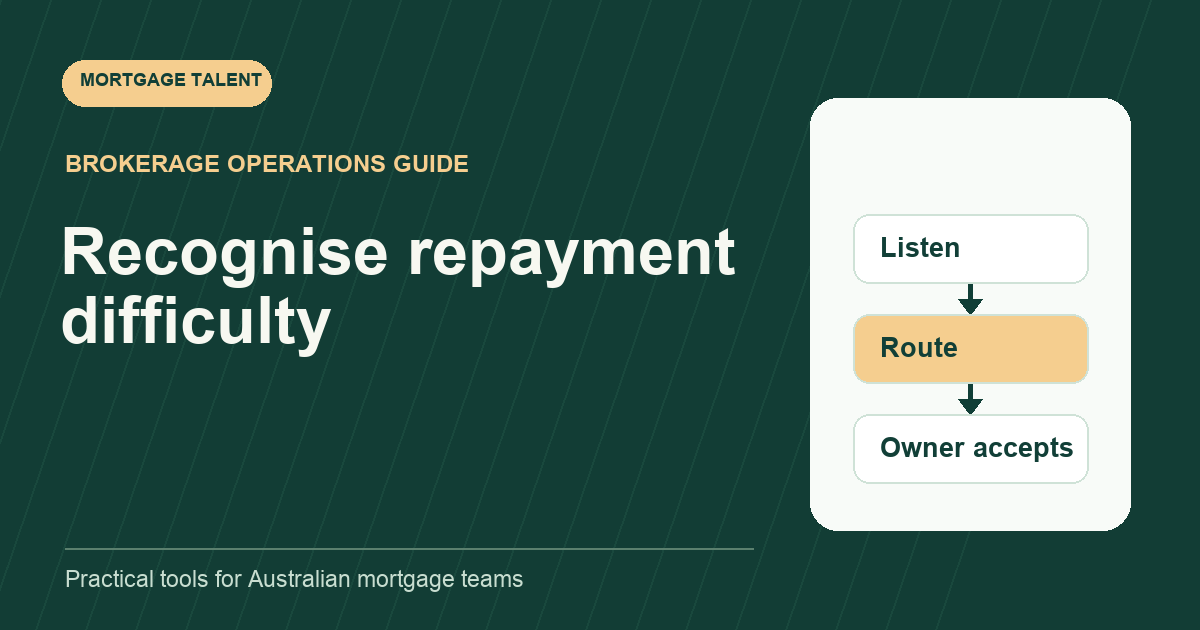
When a customer tells a mortgage assistant they cannot meet a repayment, recognise the concern and move it promptly to the brokerage's approved support route. Record what the customer actually said, any immediate timing they identified and who accepted the next action. Do not turn the conversation into an improvised loan recommendation or a promise that the lender will change the repayments.
This is a proposed training exercise for Australian brokerages assigning client-contact duties to support staff. It concerns recognising and routing repayment difficulty, rather than assessing a hardship application or determining the customer's financial options.
Recognise the changed purpose of the conversation
A routine post-settlement call may change when the customer says, “My hours have been cut and I don't think I can make the next payment.” The worker's original task might have been to confirm a contact detail. That checklist does not answer the new concern.
Pause the routine script and acknowledge the actual message. Ask only the clarification needed to follow your approved process. Keep a customer's own statement distinct from a worker's inference about their finances. Someone asking for help has not necessarily made a complaint about the brokerage, and the conversation may involve both issues.
The post-settlement client-care workflow identifies life events and exceptions that need another owner. Define the repayment-difficulty branch before assigning unsupervised calls, including the backup when the usual contact cannot respond.
Keep the customer-facing next step accurate
ASIC's Moneysmart mortgage guidance recommends contacting the lender about repayment difficulty and explains how to ask its hardship officer for assistance. It also points to financial counselling for help working out a plan. A brokerage's internal handoff should not be presented as a substitute for contacting those support services.
Agree approved wording and current resources with the responsible brokerage owner. A support worker might explain that they are referring the concern to the named person and provide the approved official information about contacting the lender. They should not tell the customer to wait for a routine broker review before seeking help from their lender.
Avoid promising a pause, reduction, approval or particular outcome. If the customer asks what they should stop paying or whether to sell, keep that decision outside the administrative response and use the appropriate qualified support route. Do not assess a legal notice from a short description or invent how long the customer has to act.
Practise three versions of a fictional call
All details in this exercise are invented. In the first version, a mock customer reports reduced work hours and concern about the next repayment. The trainee records the statement and asks the approved contact to accept the handoff. They leave the actual next action visible rather than closing the call as a successful routine check-in.
In the second version, the same customer also says their earlier message was ignored. The trainee preserves both concerns. They follow the brokerage's repayment-support route and its complaint-intake process, linking the records where appropriate. They do not assume that sending one internal email resolves both.
In the third version, the customer refers to a letter with a date tomorrow. The trainee records the exact description and date supplied, flags it through the approved urgent route and avoids interpreting the document. The assessment checks whether timing reached the receiving owner; it does not test the trainee's ability to make a legal or financial determination.
Replace vague notes with a usable handoff
“Customer unhappy; broker to call” loses the repayment concern, timing and whether anyone accepted responsibility. An illustrative alternative is: “Customer reports reduced work hours and concern about the next repayment. Contact preference and stated timing recorded in the controlled call note. Approved support information provided. Handoff accepted by owner R; next communication remains with R.”
Adapt that example to what actually occurred. If acceptance is still pending, say so and use the backup route. If a message was only drafted, do not record it as sent. Keep unnecessary financial or personal detail out of broad team channels.
Assess the support duty before live allocation
Ask the trainee to recognise the changed purpose, use approved wording, preserve the customer's account and demonstrate accepted ownership in all three versions. Review the route itself when the exercise exposes an unavailable contact or unclear instruction. Confidence on the phone does not establish that an unresolved concern reached the right person.
Discuss the client-contact duties in your support brief with Mortgage Talent. Name the routine work, escalation owner and training you will provide. Confirm any specialist hardship, counselling or legal services separately rather than assuming they are included in staffing support.
Take the next step
Explore Mortgage Talent or speak with our team about your hiring needs.