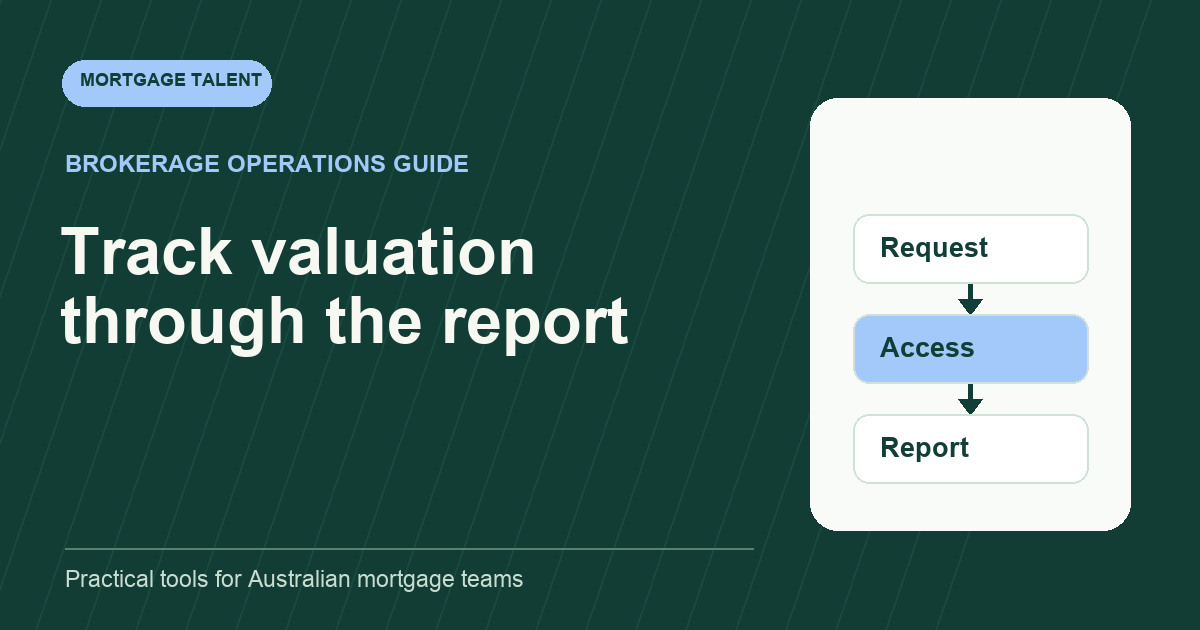
Track a mortgage valuation as a sequence of evidenced events: the approved request, any access arrangement, the observed inspection status and the availability of the report for the broker. Give each unresolved step an owner and next check. A booked appointment should not be labelled a completed valuation.
This is a proposed administrative workflow. ANZ's full-approval checklist says a property inspection may be needed and that ANZ can arrange it with the real estate agent in most cases; its page excludes ANZ Plus products. Use the actual lender instruction for each case, rather than arranging an inspection by assumption.
Start with the authorised request
Record the lender, property reference, requesting broker, approved ordering route and instruction date in the controlled file. Confirm which action the support worker is assigned: preparing an order, recording a request already made, coordinating an approved contact or monitoring a response.
If the instruction is unclear, ask the broker before proceeding. Do not order a second valuation because an earlier request cannot immediately be found. Check the approved system and ask the responsible person to reconcile the missing reference. A duplicate entry in an internal sheet is not evidence of a second external order.
Keep the required authority and system permissions explicit. The tracker organises work within the assigned role; it does not grant permission to place an order, disclose customer details or approve a valuation result.
Separate the external observation from the next internal action
Scroll sideways to see all columns →
| Record | What belongs here | What it does not establish |
|---|---|---|
| Request reference | Recorded order or approved request identifier | Inspection has occurred |
| Access arrangement | Approved contact, confirmed appointment or unresolved access issue | Report is available |
| Observed status | Exact status from the approved source and checked time | Broker acceptance of the result |
| Report location | Current report reference when available through the approved route | Loan approval |
| Next action | Named owner, question and next check | A promised external completion time |
Use the lender or provider's actual status wording in the observation field. Your internal action may be “ask about access” while the external status remains unchanged. Keeping both fields prevents a useful internal task from becoming an invented lender milestone.
Add the source and time of the last check. Someone taking over tomorrow needs to know whether a status came from a current portal view or an older email. Preserve earlier observations in the ordinary activity record.
Coordinate access through the approved contact route
Confirm who is responsible for access arrangements before contacting an agent, owner or another party. Share only the details authorised for that task. A team handover can use an internal property reference and a controlled contact link rather than repeating personal contact information across broad channels.
Record the actual contact result: message left, response received, appointment confirmed or access unresolved. If a proposed time is awaiting agreement, keep it proposed. Do not send a customer update saying an inspection is booked merely because an email requested a slot.
If a contact asks the assistant to change the order scope, cost or property details, route the request to the responsible broker or authorised owner. Keep the existing reference visible while the change is assessed so a colleague can avoid duplicating work.
Work through an illustrative access delay
In a fictional file, the broker's approved request is recorded on Monday. An access contact suggests Thursday, but the relevant party has not confirmed that time. The tracker records “appointment proposed; confirmation pending”, names the access follow-up owner and sets the brokerage's chosen next check.
On Tuesday, the contact confirms Friday instead. The worker records the new message and updates the internal task. The request history still shows what was proposed earlier. No one treats the changed appointment as a completed inspection.
At Friday's check, the available source shows the inspection occurred but no report is yet visible. The worker records that observation and asks the approved follow-up question. The broker summary is “inspection recorded; report availability not confirmed”, without a prediction about when an approval will arrive.
Escalate the question that is actually unresolved
Use the lender follow-up log when a request needs a reply. Include the existing reference, last observed event, specific question and relevant file commitment. Avoid repeatedly asking “any update?” without stating what remains unknown.
If a report raises a question, the support worker can identify its location and record the broker's next instruction. Interpretation of the result and any lending decision remain with the responsible people. Do not relabel an unfavourable or unclear observation to make a dashboard look complete.
Where the valuation relates to a lender condition, connect the report handoff to the approval conditions tracker. Availability of a report and confirmation that a condition is resolved are different recorded events.
Close coordination with a usable broker handoff
- Correct request and property references are reconciled.
- The latest observed event includes its source and checked time.
- The current report location is recorded if available.
- Any open access or follow-up issue remains assigned.
- The broker can find the material and the question needing review.
Test these checks with a fictional file before giving a new worker live coordination duties. Ask them to distinguish a request receipt, a proposed appointment, an inspection observation and a report handoff. The exercise tests administrative accuracy rather than valuation expertise.
If this work regularly loses ownership, review the loan processor role and discuss valuation coordination support. Describe the lender routes, approved contacts and reviewer arrangement the person will use.
Take the next step
Explore Mortgage Talent or speak with our team about your hiring needs.