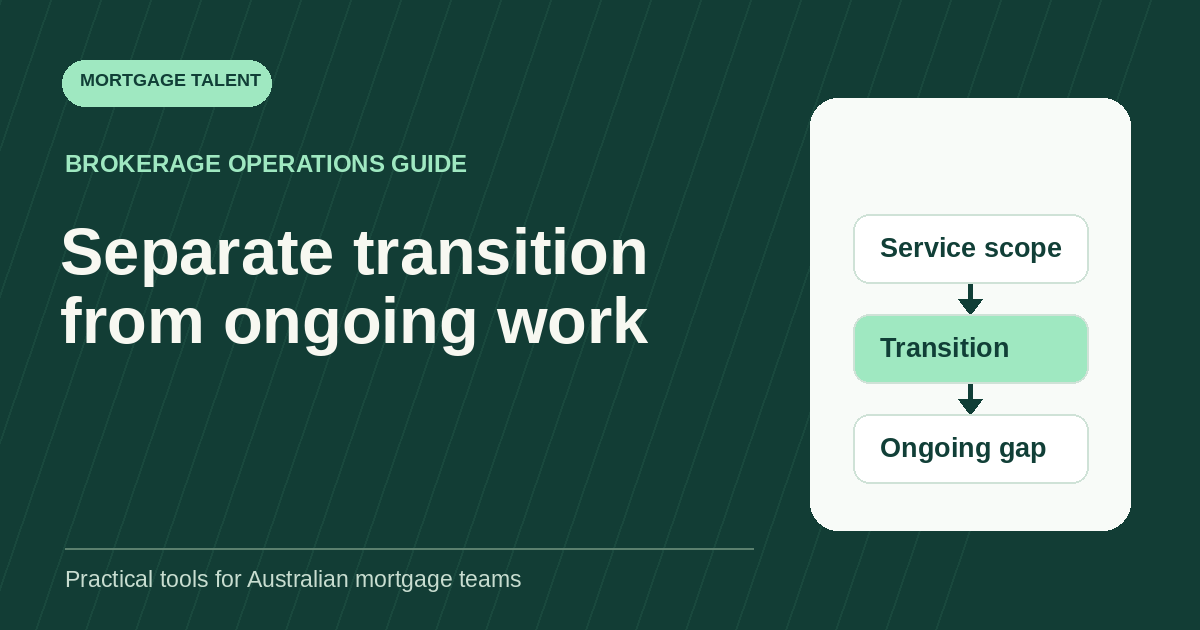
Before adding staff for a mortgage loan-book acquisition, separate the work needed to establish the new arrangement from the service work that will continue afterwards. Confirm which duties the buyer is taking on, which people will actually be available and how much capacity the existing brokerage can spare. Those answers produce a more useful hiring brief than the number of loans or the monthly trail alone.
This guide gives Australian brokerage owners an operational staffing worksheet and a fictional worked comparison. The buyer and their advisers retain the purchase decision, valuation, transaction terms, employment arrangements and decisions about data transfer or client contact. Completing this worksheet does not establish that an acquisition should proceed.
Define the service work included in the proposed purchase
Ask the transaction advisers to identify what the proposed arrangement includes before translating it into tasks. Record commission administration, client servicing, open applications, unresolved service requests, communication channels, systems and people separately. Leave an uncertain item marked unconfirmed, with someone responsible for obtaining an answer.
business.gov.au's buying-a-business guide recommends reviewing financial records, business operations and legal documents during due diligence. The support worksheet below addresses the operating-work part of that review. It cannot determine what the sale documents transfer.
Ask for an aggregate picture of the work: outstanding service requests, upcoming agreed reviews, unanswered enquiries and applications with approaching commitments. Identify what the seller will finish and what the buyer is expected to receive. A loan count does not show how many of those tasks will become yours.
Copy the acquisition support worksheet
Scroll sideways to see all columns →
| Work or dependency | What to record | Staffing consequence |
|---|---|---|
| Included service duties | Adviser-confirmed scope and the date each duty changes owner | Include only confirmed duties in the base staffing brief |
| Open work at handover | Aggregate task types, due windows, current owner and proposed receiving owner | Separate inherited unfinished work from new weekly arrivals |
| One-off transition work | Approved record reconciliation, handover sessions, instruction preparation and checks | Estimate a finite project workload with acceptance criteria |
| Continuing service work | Recurring task types, observed effort and the source of each estimate | Estimate ongoing support after the transition finishes |
| Seller or existing staff contribution | Named contribution, confirmed availability, end point and handover output | Do not count an informal promise as continuing capacity |
| Buyer capacity | Spare support time and separate broker-review time after existing commitments | Identify the gap without removing cover from current clients |
| Unconfirmed items | Missing scope, access, people or contact decision and its owner | Show a conditional scenario; do not quietly assume zero work |
Keep the planning worksheet free of borrower identities. For a business covered by the Privacy Act, the OAIC's selling-a-business guidance says vendors should consider de-identifying information and prospective purchasers should generally avoid collecting personal information where possible. Have the responsible adviser approve the information-sharing process; a staffing estimate does not justify sending client files to a prospective support provider.
For each continuing-effort estimate, record the observation period, the comparable tasks observed and the uncertainty that remains. An exact number in a planning sheet is still an estimate. Use the linked capacity forecast for ranges and weekly timing rather than treating the fictional hours below as a staffing benchmark.
Check whether the operating knowledge will remain available
List the tasks that currently depend on the seller or a particular staff member. Ask who knows why a service request is open, where its latest instruction sits and what was promised to the client. Identify which of those explanations can be documented and which require a supervised handover conversation.
For each contribution, record the agreed availability and the output you need from it. Two handover sessions might help explain the open queue, but they do not provide a person to run that queue next month. If staff are part of the proposed transaction, ask the employment adviser to confirm their arrangements before counting their future capacity.
Give the receiving worker a fictional or otherwise appropriately approved handover exercise. Can they identify the next action, find the instruction and name the person who decides an exception? Use the controlled support-transition plan for task acceptance. Keep data mappings and system cutover in the separate CRM migration support plan.
Compare two fictional purchase briefs
The following briefs are constructed examples, not descriptions of standard sale terms. Assume the relevant advisers have confirmed the stated scope. The figures demonstrate staffing reasoning; they are not a valuation, an industry benchmark or an estimate of revenue.
Scroll sideways to see all columns →
| Planning item | Brief A: income administration only | Brief B: client service included |
|---|---|---|
| Headline portfolio | 120 loans | 120 loans |
| Confirmed buyer support duties | Reconcile the acquired income records; no client-service duties included in this example | Receive agreed service tasks and operate the continuing client-service queue |
| One-off support work | Eight task hours of approved setup and reconciliation | Thirty-six task hours across a six-week transition |
| Continuing support estimate | Two task hours each month | Twelve task hours each week |
| Existing spare support capacity | Three task hours each month, with setup separately scheduled | Five task hours each week |
| Resulting support brief | Assign the setup project and verify the monthly workload before opening a continuing role | Plan for seven continuing task hours weekly, plus a six-hour weekly transition allowance |
Brief B's arithmetic is explicit: twelve continuing hours minus five available hours leaves seven. Thirty-six transition hours spread across six weeks add six per week. The initial additional requirement is therefore thirteen task hours a week, falling to seven after the defined transition work is accepted.
These are productive task hours. Turn them into a proposed roster only after allowing for the selected arrangement's meetings, training, coordination and cover. Do not promise a thirteen-hour roster merely because the worksheet shows thirteen task hours.
Brief A does not justify a new client-care role from its loan count alone. Brief B supports a continuing service contribution and a separate temporary workload. Combining them into one permanent full-time vacancy without identifying further duties would leave the hiring decision unexplained.
Test the temporary workload and the broker constraint separately
For Brief B, ask what happens if the same thirty-six hours of transition work must finish in three weeks. The transition allowance rises to twelve hours a week, and the additional support requirement becomes nineteen for that window. The continuing gap remains seven. This changes the short-term coverage discussion without establishing a larger continuing role.
Now add a separate fictional constraint: the acquired service queue needs three hours of broker review each week, but the buyer has only two available. The one-hour review gap remains even if every support hour is supplied. The principal must resolve review availability or the proposed service scope before accepting a plan that assumes the queue can flow.
Use the four-week capacity forecast to place confirmed work into actual weeks. Preserve the existing brokerage's commitments in that forecast. A plan that works only by borrowing time already promised to current clients is incomplete.
Write separate outputs for transition and continuing support
- Transition output: agreed open tasks reconciled, receiving owners identified, instructions available and outstanding exceptions assigned
- Continuing output: a defined service queue maintained within the approved contact and review arrangement
- Project end condition: the manager accepts the specified transition outputs, rather than simply reaching a calendar date
- Continuing review: compare actual service arrivals and effort with the estimate, then confirm the ongoing capacity needed
Choose the engagement arrangement with the appropriate advisers and provider. The worksheet identifies a temporary requirement; it does not decide the employment or supplier terms used to meet it. If one worker will cover both contributions, write down which duties stop and how their ongoing scope will be agreed.
Copy a short acquisition support brief
- Confirmed acquired duties: [scope, supporting reference and approving owner].
- Transition contribution: [deliverables, task-hour estimate, availability window and acceptance condition].
- Continuing contribution: [recurring tasks, observed effort, observation period and uncertainty].
- Available capacity: [confirmed spare task hours after existing commitments].
- Separate review constraint: [review hours needed, hours available and decision owner].
- Open assumptions: [question, responsible owner and next check].
Bring the confirmed service scope, transition outputs, available review time and separate continuing gap to a support hiring discussion. That brief lets the proposed person or service be assessed against the acquisition work you actually expect to receive.
Take the next step
Explore Mortgage Talent or speak with our team about your hiring needs.