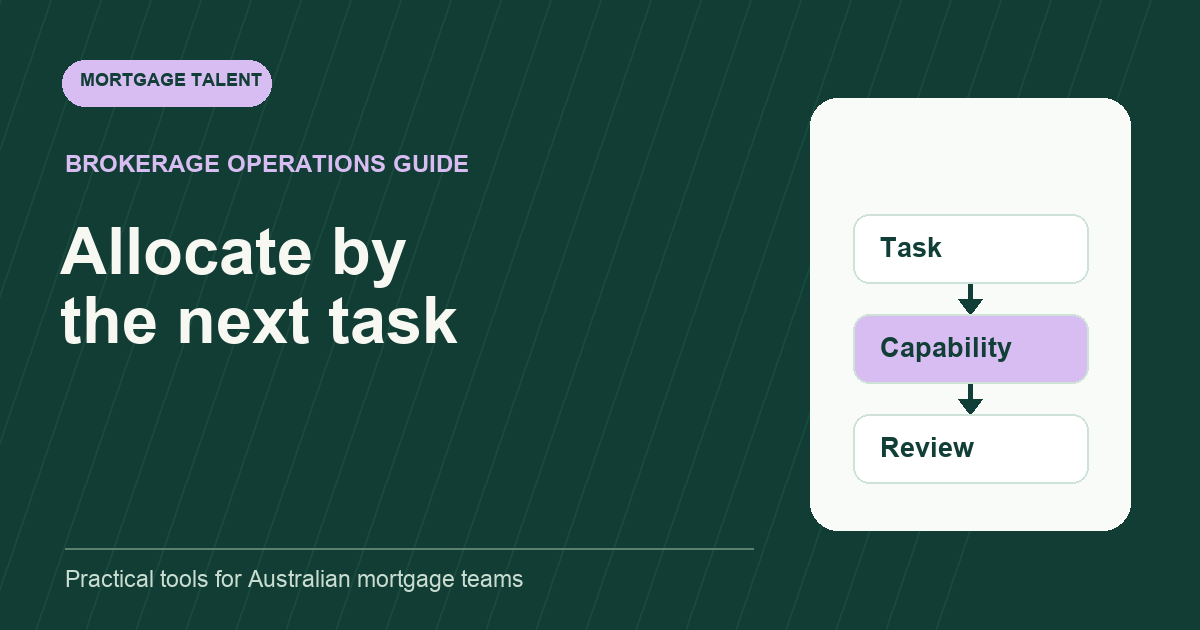
Allocate mortgage support work by the next task, the worker's demonstrated readiness and the reviewer time available. File counts alone are too blunt for a queue containing different preparation needs. Use a simple allocation matrix to make the assignment and its review conditions explicit.
This method is an operational proposal for Australian brokerages. It does not rank borrower suitability, predict approval or set lender policy. Use the pipeline capacity forecast to estimate overall demand; use this matrix to decide who should do a particular piece of work today.
Describe preparation complexity without judging the loan
Describe the observable work: number of document groups, unfamiliar system steps, unresolved factual questions, coordination dependencies and required review. A file with one open task may need specialist supervision; another with several routine tasks may be suitable for someone still learning the workflow.
Use local task labels such as “standard pack indexing”, “multiple-entity document organisation” or “new lender workflow”. Avoid labelling a borrower “easy” or “difficult”. The label should help allocate preparation work and explain what support is needed, not imply a credit outcome.
If the next task is unclear, allocate a short scoping action to the broker or workflow owner first. Do not assign an entire uncertain file to a worker and expect them to infer the scope. The allocation unit can be one task within a file, with a distinct reviewer and completion evidence.
Use four inputs in the allocation matrix
Scroll sideways to see all columns →
| Input | Question | Assignment consequence |
|---|---|---|
| Defined task | What output is needed next, from which approved inputs? | Assign only the scoped preparation or coordination work. |
| Demonstrated readiness | Has this person completed comparable work under review? | Choose independent preparation, paired work or observation. |
| Reviewer capacity | Who can review the output, and when? | Reserve review time before starting work needing it. |
| Timing and dependencies | What verified deadline or external response affects the action? | Schedule, hold or escalate with a named owner. |
Write the decision as a sentence: “Alex prepares the document index; Casey checks entity and period labels at 2 pm; unclear items remain open.” This is more useful than “Alex owns file 14” when several people contribute to the same case.
Try a fictional three-task allocation
Suppose the queue contains Task A, a familiar pack-indexing exercise; Task B, document organisation across two fictional entities; and Task C, a lender request with an approaching date that the broker has verified. One processor has demonstrated A and B. Another is practising A. The broker has one review session available that afternoon. These inputs are illustrative, not staffing benchmarks.
Assign A to the developing processor with its agreed review. Assign B to the experienced processor only if the relevant reviewer is available for unresolved labels. Scope C with the broker before assigning factual coordination, because its next step and deadline may affect the order. If B and C compete for the same review session, make that conflict visible.
There is no universal correct allocation without the actual task effort and review needs. The useful output is the reasoning, owners and conditions. A senior worker's familiarity does not eliminate the broker's decision points, and a quieter queue does not establish readiness for a new task.
Account for review work in the same plan
Use the support skills matrix to find comparable evidence rather than relying on job titles. Record when a person needs paired preparation or closer checking. Add the review demand to the allocation plan so training work does not silently consume time reserved for active-file decisions.
Coordinate with the broker approval queue. If prepared work is already waiting for the same broker, starting another review-dependent task may create a larger return queue. Consider a different ready task, resolve a blocker or use planned training time.
Do not turn a complexity label into a productivity target before measuring your own work. Compare like tasks and record what was actually completed. A count of allocated tasks is not evidence of accepted output or available future capacity.
Set explicit reassignment triggers
Revisit an assignment when the approved scope changes, an unresolved question needs different expertise, a deadline is corrected or the reviewer becomes unavailable. The current owner should document completed work and open actions before another worker accepts the handover.
Record who approved the change and when the new owner accepted it. Keep the history needed to explain the latest state. Do not add another owner without removing ambiguity about who will act next; several names in a task can still leave it effectively unowned.
Review recurring reassignment causes in the team meeting. They may reveal a missing instruction, uneven review capacity or a training need. Resolve the observed cause instead of repeatedly moving the same task between people.
Should the most experienced processor receive every unfamiliar task?
Check their current preparation and coaching commitments first. Allocating all unfamiliar work to one person can leave routine work and training without an owner. Pair a developing worker with a suitable reviewer where the task and team process support it, and reserve a specific check point. Record the arrangement as a learning assignment rather than claiming independent readiness. Revisit it using the actual returned output and the time the reviewer needed.
Use allocation evidence to define the next hire
After several allocation cycles, identify work that repeatedly lacks a ready worker and available reviewer. Separate a preparation capacity gap from a management or review gap. That distinction helps you explain the role your brokerage needs without promising a fixed number of files per person.
Explore loan processor hiring, compare relevant experience in the mortgage talent marketplace and share your recurring allocation gaps. Include task examples, supervision needs and working-hour overlap so the shortlist conversation starts from your actual queue.
Take the next step
Explore Mortgage Talent or speak with our team about your hiring needs.