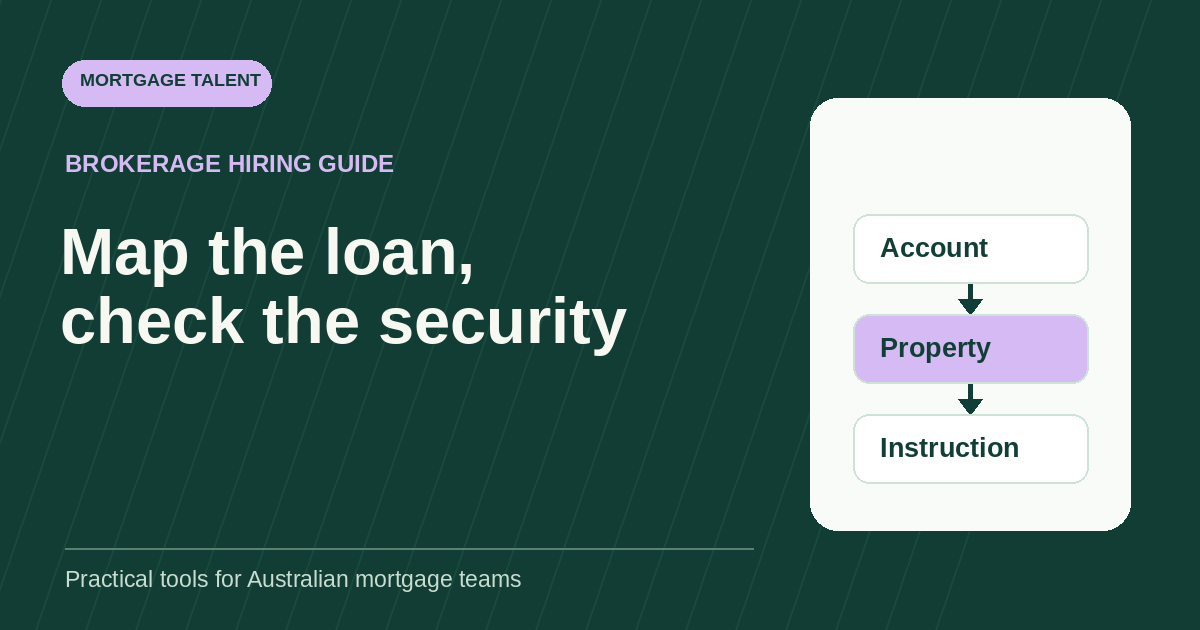
When you hire a loan processor for refinance files, ask what their discharge experience actually involved. Following up an outgoing lender is useful experience. Preparing an accurate description of which loan accounts and property securities are affected is a different task to demonstrate.
This guide helps Australian broker owners assess that narrower preparation skill. It includes an account-and-property mapping exercise, a worked response and evidence to carry into the hiring brief. Use it when the vacancy includes preparing discharge information for broker review, rather than only chasing an already approved request.
Decide which discharge responsibility you are hiring for
Separate the work into two levels before writing the selection criteria:
- Request coordination: track the instructed request, acknowledgement, outstanding items and next owner. The existing refinance discharge coordination guide covers this workflow.
- Scope preparation: describe the instructed change to each loan account and security property, identify what remains, and return unclear relationships to the broker before a request is prepared.
If your vacancy needs only the first level, do not make this specialist exercise an unnecessary barrier. If it needs the second, ask candidates which parts they personally prepared and who checked the account and property scope. Keep examples anonymous and at workflow level; do not request a former employer's files.
The hiring decision is whether the candidate has demonstrated the preparation your role requires, or needs supervised practice before taking it on. Neither a job title nor familiarity with a lender's form answers that question.
Test the relationship, not recall of a form
ME Bank's discharge guidance distinguishes a loan portion payout from a property discharge: one portion of a split loan can be paid out while another remains secured against the property. Its explanation shows why closing a loan portion and releasing a property are separate events.
AMP's home loan management guide separately describes partial discharge as releasing one security where multiple properties secure the loan, and substitution as replacing an existing security with another. These are lender-specific explanations, not an instruction to apply either lender's process to every file.
Give the candidate the relevant current source material and the brokerage's task boundary. The exercise should reveal whether they can use supplied information, not whether they have memorised terminology. For a live file, the broker must resolve the actual scope and the applicable lender process before the worker acts.
Give the candidate three fictional scope cards
The cards below are independent, invented cases. Tree names identify mock accounts and properties, not customers or actual securities. Every change is a request for review, not a confirmed outcome. No balances, payout figures, eligibility assumptions or loan recommendations are supplied.
Scroll sideways to see all columns →
| Card | Starting position supplied | Requested change |
|---|---|---|
| A: loan portion | Loan portions Ash and Birch are secured against property Hill. | Pay out and close Ash. Keep Birch and retain Hill as security. No property release is requested. |
| B: property release | Loan Cedar is secured against properties Banksia and Wattle. | Request release of Banksia. Cedar is intended to continue with Wattle retained. No lender decision is supplied. |
| C: replacement security | Loan Fir is secured against property Cypress. | Request replacement of Cypress with property Elm while retaining Fir. No lender decision is supplied. |
Ask the candidate to return a small change map for each card: loan accounts affected, properties affected, items intended to remain, and the question requiring review. They should also explain why one generic instruction, “close everything and discharge the property”, cannot represent all three cards.
Do not provide access to a live portal or ask the candidate to complete a real discharge authority. Agree the assessment arrangements and any adjustments beforehand. Fair Work Ombudsman guidance on unpaid trials makes purpose, duration and supervision relevant to whether an unpaid demonstration is permissible. Using fictional records does not, by itself, establish that the assessment can be unpaid.
Read the answer at account and property level
Card A: Ash is the only loan portion requested to close. Birch is intended to remain, and Hill is retained as security. There is no requested property release. This follows the distinction described in ME's loan portion payout explanation. A candidate who marks Hill for discharge has changed the scope rather than merely chosen a different label.
Card B: Banksia is the requested release; Cedar and Wattle are intended to remain. This matches the partial-release distinction in AMP's guide. The map describes the requested position only. It does not establish that the lender will accept the remaining security or approve the release.
Card C: Cypress is the proposed outgoing security, Elm the proposed replacement, and Fir the retained loan. This matches AMP's substitution description. Labelling the case “close Fir” would remove the retained account from the instructions. Omitting Elm would lose the replacement part of the request.
Accept different layouts if they preserve these relationships. A neat list of account and property names is incomplete when it does not identify what changes and what remains. Conversely, a candidate who identifies a missing decision has not failed merely because they leave the outcome unresolved.
Add one scope-change question
After the first response, supply this fictional follow-up for Card A: “Please take Hill out as well.” Ask the candidate what changes in their preparation.
A useful response is: “The earlier instruction retained Hill with Birch. The new message requests its release but does not explain the intended position for Birch. Please confirm the revised loan and security scope before I prepare a request. I have kept the original and revised instructions separate.”
This is a clarification exercise, not an invitation to decide how Birch should be secured. The evidence you want is the candidate's recognition that an account can remain in the file while a proposed property change creates a new question.
Use the evidence to set the starting role
Record observations against the actual assignment, using the shortlist evidence scorecard for your wider comparison. Avoid awarding a general “refinance expert” label from this one exercise.
Scroll sideways to see all columns →
| Observation | Hiring implication to investigate |
|---|---|
| Tracks follow-ups well but merges account closure and property release. | Coordination experience does not yet demonstrate scope preparation. Establish whether the role allows training before assigning it. |
| Maps all retained and changing items but needs help writing the broker question. | Check whether supervised preparation and communication coaching fit the available review capacity. |
| Maps the relationships and identifies the unresolved Birch question without proposing a lending solution. | Retain this evidence for the defined preparation task, then assess the other duties in the vacancy separately. |
These are proposed assessment observations, not a validated selection test or a guarantee of performance. Use the same job-related criteria for candidates and record clarifications fairly. The brokerage still makes the hiring decision using the wider evidence.
Carry a precise task into the hiring brief
Replace “experienced in refinances” with a more testable requirement in your processor hiring brief: “Prepare a source-linked account and property change map from broker-approved instructions, preserving retained items and escalating unresolved relationships for review.”
Add who supplies the verified starting position, who resolves scope changes, which preparation the worker may perform and who reviews it. State whether the demonstrated mapping capability is needed at commencement or can be developed with a named reviewer.
Explore Mortgage Talent's loan processor recruitment or discuss your processor role. Bring the exact refinance preparation task and review arrangements, rather than assuming a broad specialist title establishes the capability or that a particular candidate is available.
Take the next step
Explore Mortgage Talent or speak with our team about your hiring needs.